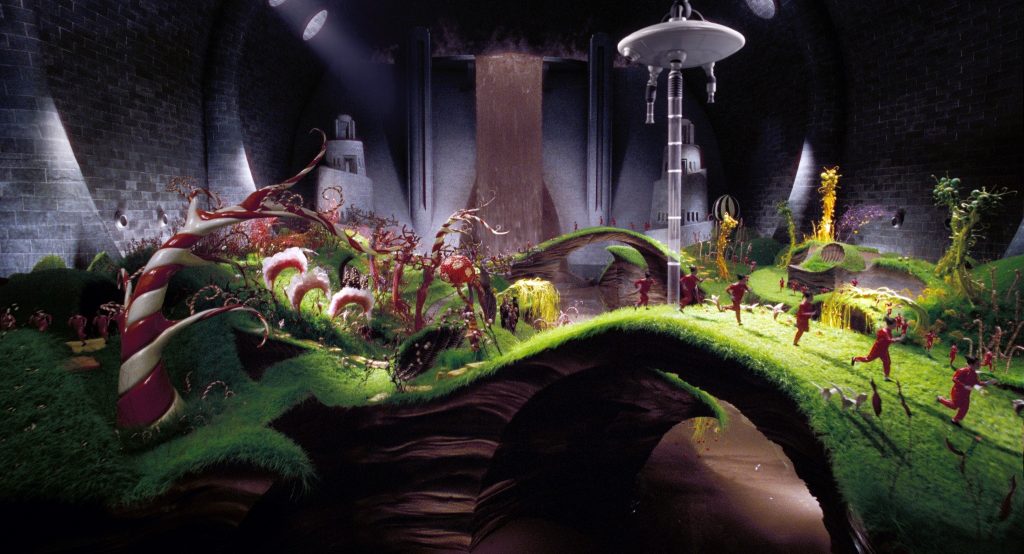
There are some stories that become so tangled up with their film adaptations that it becomes surprisingly difficult to remember what was actually in the book.
Charlie and the Chocolate Factory is definitely one of them.
Roald Dahl published the novel in 1964. Seven years later came Willy Wonka & the Chocolate Factory, starring Gene Wilder as perhaps the most famous version of Willy Wonka ever committed to film. Then, in 2005, Tim Burton returned to Dahl’s story with Charlie and the Chocolate Factory, starring Johnny Depp as a very different Wonka.
They tell essentially the same story. Charlie Bucket finds a Golden Ticket. He enters Willy Wonka’s mysterious chocolate factory alongside four truly dreadful children. Said children refuse to listen to instructions and are systematically removed from proceedings in increasingly ridiculous ways.
But once you put the three versions beside each other, there are some surprisingly large differences.
And despite the enduring popularity of Gene Wilder’s film, it isn’t actually the most faithful adaptation.
First: what happens in Roald Dahl’s book?
The basic story most of us know comes directly from Dahl.
Charlie Bucket lives in extreme poverty with his parents and four grandparents. Willy Wonka, the mysterious owner of the enormous chocolate factory near Charlie’s home, announces that he has hidden five Golden Tickets inside his chocolate bars.
The children who find them are Augustus Gloop, Veruca Salt, Violet Beauregarde, Mike Teavee and, eventually, Charlie.
Each child is allowed to visit Wonka’s factory, and one by one the children’s particular character flaws lead to their downfall.
Augustus falls into the chocolate river and is sucked up a pipe. Violet ignores Wonka and chews his experimental three-course-dinner gum, turning herself into a giant blueberry. Veruca demands one of Wonka’s trained squirrels, only for the squirrels to decide that she is a bad nut and throw her down the rubbish chute. Mike Teavee uses Wonka’s television technology to transmit himself and ends up tiny.
Charlie, meanwhile, does something rather important.
He behaves himself.
There is no elaborate final moral test involving Charlie returning an Everlasting Gobstopper. He doesn’t secretly break Wonka’s rules and then redeem himself.
He simply remains the last child.
Wonka reveals that the entire competition was designed to find a child to whom he could eventually give his factory. Charlie has won.
The three of them then crash through the factory roof in the Great Glass Elevator and head off to collect the rest of the Bucket family.
So how did that become the films we know?
Willy Wonka & the Chocolate Factory – 1971
The 1971 film gets plenty right.
Charlie is still desperately poor. Grandpa Joe accompanies him to the factory. The same five children find the Golden Tickets, and their basic personalities and fates remain recognisable.
Gene Wilder’s Wonka also retains plenty of Dahl’s eccentricity, unpredictability and occasional menace.
But the film makes several major changes.
Perhaps the most obvious one happens before you’ve even watched it.
Dahl’s story is called Charlie and the Chocolate Factory. The film became Willy Wonka & the Chocolate Factory, shifting the emphasis towards Wonka.
The American Film Institute describes the film as generally faithful to Dahl’s novel but notes several significant departures, including the removal of Charlie’s father and the expansion of elements such as Slugworth and the Everlasting Gobstopper.
Charlie’s dad disappears
Mr Bucket is alive in Dahl’s book.
He works at a toothpaste factory, loses his job and later finds employment again repairing the machines that replaced workers like him.
The 1971 film removes him completely, leaving Mrs Bucket as Charlie’s only parent.
The 2005 film restores Mr Bucket and his toothpaste-factory storyline.
Slugworth becomes part of a giant test
This is probably the biggest structural invention in the 1971 film.
Slugworth does exist in Dahl’s novel, but he is simply one of Wonka’s rival chocolatiers. He isn’t secretly lurking around every Golden Ticket winner trying to persuade children to commit industrial espionage.
The film turns him into an apparent villain who offers the children money in exchange for an Everlasting Gobstopper.
Then comes the famous reveal: “Slugworth” actually works for Wonka.
It was all a test.
None of that happens in the book. The filmmakers deliberately expanded the Slugworth and Gobstopper material to create a villain and provide a test of Charlie’s character.
Charlie actually breaks the rules
This is a particularly interesting change because it alters Charlie himself.
In the 1971 film, Charlie and Grandpa Joe drink Fizzy Lifting Drinks despite being told not to. They float towards the ceiling and have to burp their way back down.
It’s one of the film’s most memorable scenes.
It also isn’t in the book.
Fizzy Lifting Drinks exist in Dahl’s story, but Charlie and Grandpa Joe don’t steal them.
Book Charlie wins because, unlike the other children, he doesn’t ignore Wonka and do something stupid.
Film Charlie does.
The movie therefore needs the Gobstopper storyline to give Charlie another opportunity to prove that he’s fundamentally good. He returns the Gobstopper rather than betraying Wonka, passes the real test and inherits the factory.
It’s a neat piece of filmmaking, but it substantially changes Dahl’s original ending.
Veruca is a bad egg instead of a bad nut
Dahl’s Nut Room contains trained squirrels that test walnuts to determine whether they’re good or bad.
Veruca immediately decides she wants one.
The squirrels promptly decide that Veruca is a bad nut and send her down the rubbish chute.
The 1971 film replaces the squirrels with geese laying golden chocolate eggs. Veruca climbs onto an egg-testing machine, is declared a “bad egg” and disappears down the chute.
The AFI notes that this was another deliberate change from Dahl’s story.
And this is one of the areas where the 2005 film swoops in and says: BRING BACK THE SQUIRRELS.
Charlie and the Chocolate Factory – 2005
Tim Burton’s version feels dramatically different from the 1971 film, which can make it seem like the more radical adaptation.
Strangely, in many respects, the opposite is true.
The 2005 film restores numerous details from Dahl’s book that disappeared or changed in 1971.
Mr Bucket is back.
The squirrels are back.
Prince Pondicherry and his enormous chocolate palace are back.
The Oompa-Loompa songs use lyrics taken from Dahl’s book.
Charlie doesn’t steal Fizzy Lifting Drinks.
And the story once again bears its original title: Charlie and the Chocolate Factory.
Even the other children’s eventual appearances are shown. Dahl describes the children leaving the factory physically altered by what has happened to them, something the 2005 adaptation also depicts.
There is therefore quite a lot of Dahl hiding underneath all that Tim Burton.
But then we need to talk about Johnny Depp’s Willy Wonka.
Willy Wonka’s daddy issues are entirely new
If you’ve remembered the dentist father from the book, congratulations: the films have successfully invaded your memory.
Dr Wilbur Wonka does not exist in Dahl’s novel.
The entire storyline involving Wonka’s strict dentist father, his childhood braces, being forbidden from eating sweets, running away from home and eventually reconciling with his father was created for the 2005 film.
It fundamentally changes Wonka.
Dahl doesn’t particularly care why Willy Wonka is Willy Wonka.
He simply is.
He’s already this strange, energetic, brilliant, morally questionable little man when we meet him, and Dahl doesn’t sit us down and explain which childhood trauma made him build a chocolate waterfall.
The Burton film wants an explanation.
It also uses that storyline to build a much stronger theme around family. Charlie has almost nothing materially but refuses to abandon his family. Wonka has everything materially but has spent his adult life estranged from his father.
Eventually Charlie helps Wonka reconcile with him.
It’s actually rather sweet.
It is also completely invented.
The ending is different again
The 2005 film doesn’t simply restore Dahl’s ending either.
In the book, Charlie accepts the factory. Wonka puts Charlie and Grandpa Joe into the Great Glass Elevator and they go to collect the rest of his family.
In Burton’s film, Wonka initially offers Charlie the factory on the condition that he leave his family behind.
Charlie refuses.
That rejection becomes part of Wonka’s character development and eventually leads to his reconciliation with his father. Only after Wonka changes his attitude towards family does Charlie ultimately become part of the factory.
Again: not Dahl.
The film has taken the original ending and turned it into the conclusion of the new Wonka-family storyline it created.
What about the Oompa-Loompas?
This gets slightly complicated because Charlie and the Chocolate Factory itself changed after publication.
The Oompa-Loompas in Dahl’s original 1964 edition were depicted as African pygmies whom Wonka had brought from the jungle to work in his factory. Dahl later revised their depiction, and subsequent editions describe them as coming from the fictional Loompaland.
Neither film therefore gives us a straightforward recreation of the book across its entire publication history.
The 1971 film famously gives us orange-skinned, green-haired Oompa-Loompas.
The 2005 film instead casts Deep Roy as every Oompa-Loompa, digitally multiplying him throughout the factory.
But there’s one particularly book-accurate element in Burton’s version that is easy to miss.
The songs.
The children’s Oompa-Loompa songs in the 2005 film are largely based on Dahl’s own verses from the novel.
Danny Elfman changes the musical styles wildly from one song to another, but much of what they’re actually singing comes from Dahl.
So while the 1971 songs might be considerably more embedded in popular culture — you know exactly what tune your brain just supplied — the 2005 versions have a stronger direct connection to the book.
Gene Wilder vs Johnny Depp vs Book Wonka
And this is where the comparison gets interesting.
Because if we’re talking about plot, the 2005 film wins the accuracy contest fairly comfortably.
But if we’re talking about Willy Wonka himself, things become much less straightforward.
Johnny Depp’s Wonka is socially awkward, uncomfortable around children, unable even to say the word “parents” without struggling and heavily shaped by his unhappy childhood.
That’s Tim Burton’s Wonka.
Dahl’s Wonka is eccentric and unpredictable, but he’s also enormously energetic and commanding. He knows exactly what he’s doing.
Gene Wilder’s Wonka isn’t identical to Dahl’s either. Wilder makes him calmer, more theatrical and far more ambiguous. You spend quite a lot of the film wondering whether he’s joking, furious or quietly planning someone’s demise.
But the 1971 film doesn’t feel the need to psychoanalyse him.
Wonka simply appears at the factory gates as an inexplicable eccentric genius.
And in that particular respect, there’s arguably something rather Dahl-like about Wilder’s version even while his film changes more of Dahl’s actual plot.
So which Charlie and the Chocolate Factory film is closest to the book?
The 2005 film.
At least when we’re talking about the actual events, characters and details of Dahl’s story.
Tim Burton restores Mr Bucket, the nut-sorting squirrels, Prince Pondicherry, more of the factory material and Oompa-Loompa lyrics taken directly from Dahl. Charlie also remains innocent of the Fizzy Lifting Drink incident invented for the earlier adaptation.
The 1971 film makes bigger structural changes. It removes Charlie’s father, creates the Slugworth espionage storyline, has Charlie break Wonka’s rules, replaces the squirrels with golden-egg-laying geese and invents the Gobstopper test that becomes crucial to its ending.
But the answer comes with one enormous asterisk.
The least book-accurate part of the more book-accurate film might be Willy Wonka himself.
Burton’s film reproduces more of Dahl’s world while simultaneously reinventing its most famous character. Wonka’s father, childhood, emotional problems and eventual reconciliation are all inventions of the film.
Which leaves us with a slightly strange result.
If you want the film that most closely follows what happens in Charlie and the Chocolate Factory, watch the 2005 version.
If you’ve spent years remembering Slugworth, Charlie stealing Fizzy Lifting Drinks or Veruca being declared a bad egg and assumed Dahl wrote them?
Nope.
The movies got you.
But, whichever version you prefer, I think we can all agree that in every version, Grandpa Joe is a fraud.


