If you grew up going to school in the UK during the late 1990s or early 2000s, certain things are universally stitched into your subconscious.
WordArt headings. Plastic chairs that make your butt ache. Cauliflowers fluffy and cabbages green. Collecting tins for harvest donations. The distinct whir of a bulky beige desktop PC booting up in the school’s dedicated computer room.
But nothing compares to the absolute rush of adrenaline when the teacher uttered the magical words: “Today, we’re going to play a game.”
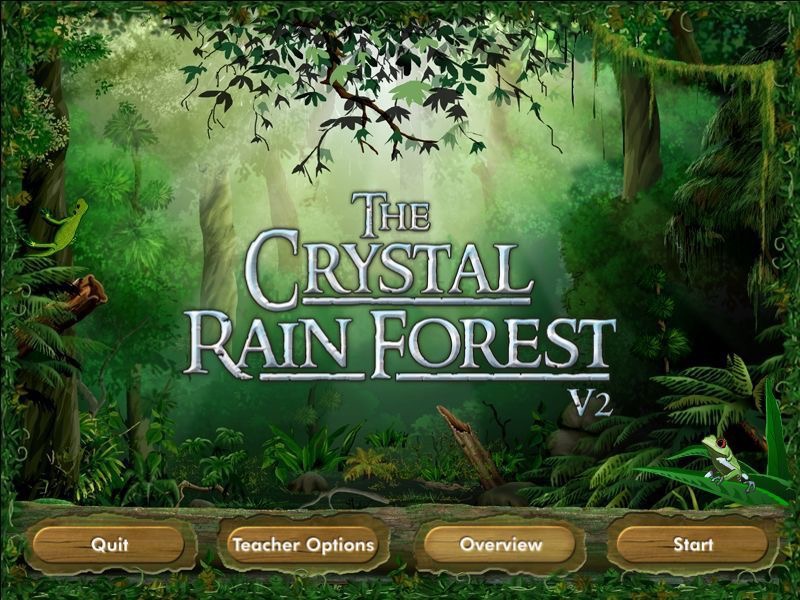
For a generation of British primary school kids, that game wasn’t The Oregon Trail or Where in the World Is Carmen Sandiego? It was a surreal, high-stakes, point-and-click educational odyssey called The Crystal Rain Forest.
Welcome to Oglo (And Your First Coding Lesson)
Released by Sherston Software in 1992 and played heavily on Acorn Archimedes and early Windows PCs well into the late 90s, The Crystal Rain Forest was an environmental sci-fi puzzle game masterfully masquerading as schoolwork.
The plot felt incredibly intense for an eight-year-old: The peaceful planet of Oglo was under threat from “The Cutters”—a ruthless, antagonistic corporation intent on deforesting the planet’s magical jungle. To make matters worse, the king had been shot with a poison dart. It was up to you to venture deep into the wilderness, navigate Aztec-style ancient pyramids, find the hidden crystals, and save the canopy.
Looking back, the game was a masterclass in stealth education. To make progress, you couldn’t just run and jump. You had to stop, look at the screen, and genuinely think your way through a series of increasingly tricky mathematical and logic puzzles.
The Real Heroes: Logo, Angles, and the Floor Turtle
Before today’s kids had Scratch, Minecraft, or Python, The Crystal Rain Forest taught us the foundations of coding.
To bridge a river, unlock an enemy gate, or guide a tiny robot sprite through a treacherous maze, you couldn’t just click an arrow key. You had to type in literal directional commands. If you remember frantically typing inputs like FORWARD 5, LEFT 90, FORWARD 2 into a blocky user interface, you were learning Logo—the exact same programming language that powered the physical, plastic “floor turtles” many of us bumped into classroom walls during maths lessons.
There was a unique blend of childhood frustration and pure triumph when your precisely calculated angles and typed-out instructions successfully guided your character across the screen without a crash.
The Fear of the “Cutters” and 90s Sound Design
What really cemented The Crystal Rain Forest into our brains, though, was its atmosphere. The graphics were a charmingly bizarre mix of pixelated 2D backdrops and early, uncanny 3D renders that gave the jungle a strange, dreamlike quality.
And then there were the villains. The Cutters—who literally looked like terrifying, giant robotic insects—haunted many a 90s kid. If you mistyped a command or failed a puzzle, you didn’t just get a polite “try again” prompt. The game would hit you with a startlingly loud, jarring MIDI sound effect as a giant mechanical claw descended, or a cage dropped down to trap you. The tension of trying to disarm the pyramid’s security system before the timer ran out was real-world stress.
A Collective Classroom Adventure
There is something beautifully nostalgic about 90s educational software. The soundtracks were repetitive, hyper-compressed audio loops that stayed stuck in your head for days after the lesson ended.
But more than the game itself, it was the social experience. Because school computer suites usually meant pairing up two to a monitor, The Crystal Rain Forest became our first collective gaming adventure. The entire classroom would work together, shouting tips across the rows of desks on how to solve the bridge coordinates or what specific angle was needed to shoot the darts.
It was our first real taste of digital world-building—a tiny, pixelated jungle tucked away on a 3.5-inch floppy disk, providing a bright escape on a rainy afternoon in the UK.


