Braveheart is one of those films that has become almost inseparable from the history it depicts.
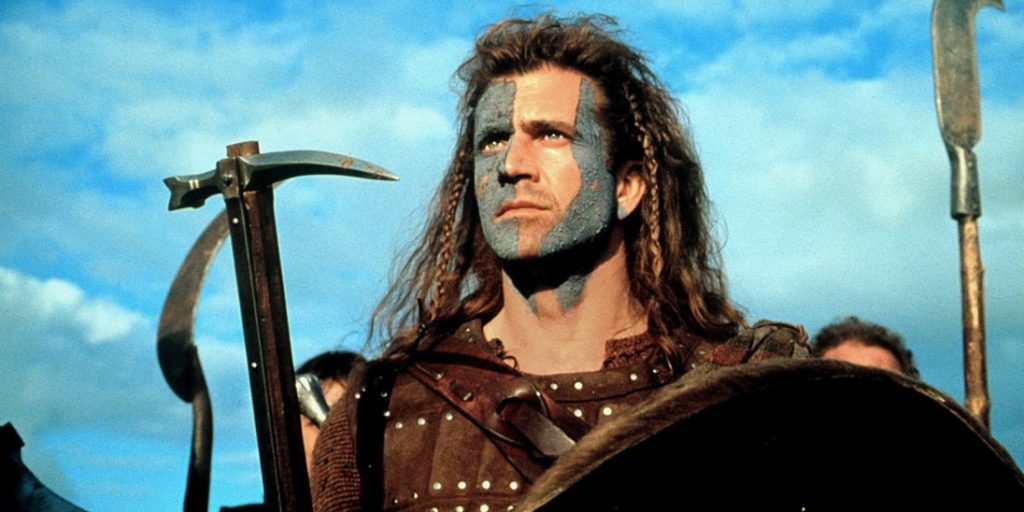
Mel Gibson in blue face paint. Kilts. Enormous swords. Scottish warriors charging across open fields. William Wallace screaming “Freedom!” while being executed by the English.
Released in 1995, Braveheart won five Academy Awards, including Best Picture and Best Director, turned William Wallace into an international symbol of Scottish resistance and ensured that generations of people would forever associate medieval Scotland with tartan.
There’s just one small problem.
Quite a lot of it is nonsense.
And I don’t mean the usual historical-film nonsense where two events have been moved a few years closer together or somebody has been given a slightly better death for dramatic purposes.
Braveheart occasionally looks at the thirteenth century, considers it carefully, and then decides it would rather do something else entirely.
So how historically accurate is Braveheart?
Well.
William Wallace existed.
Let’s start there.
William Wallace was real
Good news!
Sir William Wallace absolutely existed and really did become one of the most important leaders of Scottish resistance to English rule during the Wars of Scottish Independence.
Unfortunately, we don’t know nearly as much about his early life as Braveheart would have us believe.
Wallace was probably born sometime around 1270 into a minor landholding family, although historians have debated both his birthplace and his parentage.
The film presents him as essentially a common man who wants nothing to do with politics. After spending years abroad, Wallace returns home hoping to live peacefully, marry his childhood sweetheart Murron and have a family.
Then the English murder her.
Wallace understandably takes this rather badly.
Her death becomes the personal tragedy that transforms him into the leader of a rebellion.
It’s a fantastic origin story.
There just isn’t good historical evidence for it.
Murron is largely a legend
The story of Wallace’s murdered wife comes primarily from The Wallace, an epic poem written by Blind Harry in the late fifteenth century.
That’s a problem.
Blind Harry was writing roughly 170 years after Wallace’s death.
His work was enormously influential in creating the Wallace legend, but it isn’t something we can simply treat as an eyewitness biography.
In Blind Harry’s version, Wallace’s wife is called Marion Braidfute. She is killed by the English sheriff of Lanark, William Heselrig, and Wallace subsequently kills Heselrig.
The killing of the sheriff itself has considerably better historical support.
Wallace really did kill William Heselrig at Lanark in 1297, and this is one of the earliest firmly recorded events in his rebellion.
Why he killed him is another matter.
The romantic revenge story may be true.
It may also be legend.
The film changes Marion into Murron because the filmmakers apparently wanted to avoid confusion with Maid Marian from the Robin Hood stories.
So Murron isn’t completely conjured from thin air.
But Braveheart takes a much later tradition about Wallace’s personal life and presents it as established history.
And we’re only getting started.
Prima nocta was not why the Scots rebelled
Before Wallace and Murron can marry, Braveheart establishes that Edward I has introduced prima nocta — the supposed right of an English nobleman to sleep with a Scottish bride on her wedding night.
The idea is deliberately horrifying.
It also gives us a very easy reason to hate the English occupiers before Wallace’s rebellion has properly begun.
There is no evidence that Edward I introduced such a law in Scotland.
In fact, historians generally doubt whether the infamous “right of the first night” existed as an established legal practice in medieval Europe at all.
So why is it in the film?
Because explaining the actual political situation in late-thirteenth-century Scotland takes considerably longer.
Scotland had been plunged into a succession crisis after the deaths of Alexander III and his granddaughter Margaret, Maid of Norway. Rival claimants competed for the Scottish crown. Edward I of England was invited to help arbitrate the dispute and recognised John Balliol as king, while simultaneously asserting his own authority over Scotland.
Relations deteriorated.
Edward invaded in 1296, defeated the Scots, forced Balliol to abdicate and removed the Stone of Destiny from Scone.
By 1297, resistance to English rule was spreading.
That is considerably harder to establish in the first twenty minutes of an action movie than:
“The evil English king has invented a sex law.”
So Braveheart takes the shorter route.
Wallace wasn’t really a peasant
This is one of the film’s biggest thematic changes.
Mel Gibson’s Wallace is very deliberately presented as a man of the people.
He’s contrasted with the Scottish nobility, who spend much of the film arguing over land and titles while Wallace actually fights for Scotland.
The historical Wallace was certainly not one of Scotland’s great magnates.
But he wasn’t an impoverished peasant either.
He appears to have come from the lesser landed elite — probably the son of a minor landowner or knight.
That distinction matters because Braveheart builds much of its story around class.
Wallace represents ordinary Scotland. The nobles represent self-interest and political cowardice.
Reality was considerably messier.
Some Scottish nobles resisted Edward. Some cooperated with him. Some switched sides. Some did both at various points because medieval politics was spectacularly inconvenient.
And Wallace himself wasn’t fighting completely outside that political world.
After his victory at Stirling Bridge, he became Guardian of the Realm of Scotland.
More importantly, he wasn’t acting as king.
He was acting in the name of the deposed King John Balliol.
That’s something Braveheart mostly sweeps away because it complicates the much cleaner story of Wallace fighting simply for the abstract concept of freedom.
Can we talk about the kilts?
Oh, the kilts.
If there is one visual image everybody remembers from Braveheart, it is probably Mel Gibson and his army charging into battle wearing kilts.
The problem is that the distinctive belted plaid or great kilt belongs to a considerably later period of Scottish history.
The film is set around 1297.
Its costumes owe much more to our modern idea of Highland Scotland than to what Wallace and his men would actually have worn at the end of the thirteenth century.
And this isn’t a tiny background mistake.
They are wearing them CONSTANTLY.
It’s essentially the equivalent of making a film about Henry VIII and having everyone turn up in Victorian top hats because they’re both old and British.
It looks Scottish to a modern audience.
It just isn’t thirteenth-century Scottish.
And the blue face paint?
Also no.
The blue war paint used by Wallace and his men is presumably inspired by accounts of ancient Britons — particularly the Picts — painting or tattooing themselves.
Unfortunately for Mel Gibson, the Picts belong to a completely different historical period.
We’re talking many centuries before William Wallace.
By the late thirteenth century, Scottish warriors were not running into battle with half their faces painted bright blue.
Visually iconic?
Absolutely.
Historically accurate?
Not remotely.
At this point Braveheart has essentially dressed medieval Scots using items selected from approximately a thousand years of Scottish and British history.
Then we reach the Battle of Stirling Bridge
This is where things become genuinely magnificent.
In 1297, Wallace won his most famous military victory at the Battle of Stirling Bridge.
The clue is in the name.
There was a bridge.
The bridge is rather important.
In fact, the bridge is essentially the reason the Scots won.
The English army needed to cross the River Forth using a narrow wooden bridge near Stirling. Wallace and his fellow Scottish commander Andrew Moray positioned their forces on the opposite side and waited.
And waited.
They allowed part of the English army to cross.
Then they attacked.
The narrow bridge prevented the rest of the English force from quickly joining the battle while simultaneously restricting the retreat of those who had already crossed. English troops were trapped, many were killed and others drowned attempting to escape across the river.
It was an extremely clever exploitation of terrain and one of the great Scottish victories of the Wars of Independence.
Braveheart removes the bridge.
FROM THE BATTLE OF STIRLING BRIDGE.
I’m sorry, but this will never not be funny.
The film instead gives us a huge confrontation in an open field, complete with Wallace’s men using long spears to break an English cavalry charge.
It’s an excellent battle sequence.
It is not the Battle of Stirling Bridge.
Historic Environment Scotland rather wonderfully describes the film’s version as “a version of events that is not supported by the contemporary chroniclers” and notes that, through cinematic licence, the battle takes place in an open field with the bridge playing no part.
That’s Scottish heritage professionals politely saying:
Where is the bloody bridge?
Braveheart also loses Andrew Moray
Removing the bridge isn’t even the biggest problem with the film’s version of Stirling.
Where is Andrew Moray?
The real rebellion of 1297 wasn’t simply Wallace travelling around Scotland gathering everybody behind him.
While Wallace was leading resistance in the south-west, Andrew Moray was conducting a successful uprising against English authority in northern Scotland.
The two eventually joined forces.
And at Stirling Bridge, the Scottish army was commanded by both Wallace and Moray.
Historic Environment Scotland describes the victory specifically as the high point of the campaign of “William Wallace and Andrew Moray.”
Moray was wounded during the battle and died later that year.
His death left Wallace as the dominant leader of the resistance, and Wallace subsequently became Guardian of Scotland.
Yet Braveheart effectively removes Moray from the story.
That’s a pretty enormous omission because it transforms a shared military victory into another step in the rise of one heroic individual.
The real William Wallace was remarkable.
He didn’t need everyone else’s achievements added to his CV.
Robert the Bruce did not betray Wallace at Falkirk
Oh, Robert.
Braveheart does Robert the Bruce spectacularly dirty.
The film portrays Bruce as deeply conflicted. He admires Wallace and wants Scottish independence but remains trapped by his father’s political scheming.
Then at the Battle of Falkirk, Wallace discovers that Bruce has apparently fought on the English side.
Wallace is devastated.
Bruce is horrified by what he’s done.
It’s an important moment in his character arc, eventually inspiring him to embrace Wallace’s cause.
But there is no reliable evidence that Robert the Bruce betrayed Wallace at Falkirk.
Bruce’s activities around the battle are not entirely clear, but the dramatic moment where Wallace discovers him beneath the helmet of an enemy knight is fiction.
The historical relationship between Bruce, Wallace, Balliol and the Scottish political factions was vastly more complicated than the film allows.
Which, again, is understandable.
Unfortunately it leaves millions of viewers thinking Robert the Bruce personally betrayed William Wallace on a battlefield.
Bit harsh.
Edward I wasn’t quite the cartoon villain either
Edward I really did invade Scotland.
He really did depose John Balliol.
He really did wage brutal campaigns.
And he absolutely became Wallace’s enemy.
So Braveheart does not need to invent the central conflict between them.
But Patrick McGoohan’s Edward — “Longshanks” — is almost gloriously villainous.
Every time he appears you half expect thunder to rumble behind him.
The historical Edward was a formidable and often ruthless medieval king, but he was also an extremely capable ruler whose reign involved major legal and administrative reforms as well as warfare in Wales, Scotland and France.
None of that makes his actions in Scotland nicer.
It just makes him a human medieval monarch rather than a Disney villain who appears to spend his mornings considering new ways to torment Scots.
And speaking of things the film does to Edward’s family…
Princess Isabella was a child
Here we go.
One of the film’s most spectacular departures from reality is Wallace’s relationship with Princess Isabella of France, played by Sophie Marceau.
In Braveheart, Isabella is married to Edward’s son, the future Edward II. She becomes sympathetic to Wallace, secretly meets him, falls in love with him and sleeps with him.
Near the end, she tells the dying Edward I that she is pregnant with Wallace’s child.
The implication is obvious.
Wallace has secretly fathered the future Edward III.
There are several problems here.
The largest is that Isabella was born around 1295.
Wallace was executed in 1305.
She was about ten.
She was also still in France.
Isabella did not marry the future Edward II until 1308, three years after Wallace was dead.
Edward III wasn’t born until 1312.
So unless William Wallace possessed both a time machine and an absolutely horrifying disregard for safeguarding, this relationship did not happen.
They almost certainly never met.
Not even slightly.
This isn’t historical licence.
This is historical fan fiction.
Edward II’s portrayal hasn’t aged particularly well either
The film portrays Prince Edward as weak, effeminate and dominated by his father’s contempt.
His relationship with his male companion Philip is used largely as a shorthand for his supposed inadequacy.
Edward I then throws Philip out of a window.
There is no historical evidence that Edward I murdered one of his son’s favourites by launching him from a castle window.
Edward II did have famously intense relationships with male favourites, particularly Piers Gaveston and later Hugh Despenser the Younger. The exact sexual nature of those relationships has been debated by historians for centuries.
But Braveheart isn’t especially interested in that complexity.
It uses Edward’s perceived homosexuality as part of the joke about him being an unsuitable masculine heir.
Very 1995.
Not especially useful as medieval history.
Did Wallace really shout “Freedom!” during his execution?
We don’t know.
William Wallace really was captured in 1305.
He was taken to London, tried for treason and sentenced to an extraordinarily brutal death.
Wallace rejected the accusation of treason on the grounds that he had never sworn allegiance to Edward I.
He was then hanged, drawn and quartered.
The film depicts the execution with surprising brutality, although it understandably doesn’t reproduce every detail.
As Wallace is tortured, the crowd begins begging for mercy.
Instead, Wallace uses his final strength to scream:
“FREEDOM!”
It’s one of the most famous endings in modern cinema.
There is no reliable contemporary evidence that those were Wallace’s final words.
But the film is doing something different here.
It isn’t really trying to document Wallace’s execution.
It’s completing the mythology it has spent the previous three hours building.
The Wallace of Braveheart doesn’t merely fight for Scottish political independence.
He represents freedom itself.
So of course that’s his final word.
Historically questionable.
Cinematically inevitable.
And Wallace wasn’t “Braveheart”
Here’s a particularly fun one.
The title isn’t really about William Wallace.
The term “Brave Heart” has historically been associated with Robert the Bruce.
According to later tradition, after Bruce died in 1329, his heart was removed and carried by Sir James Douglas on campaign, supposedly fulfilling Bruce’s wish that his heart be taken on crusade.
The story developed over time, but the association between Bruce and the “brave heart” is considerably more direct than anything involving Wallace.
So Braveheart isn’t only historically questionable about William Wallace.
It arguably gives him Robert the Bruce’s nickname too.
Poor Robert really cannot catch a break in this film.
So does Braveheart get anything right?
Yes.
And this is where I have to stop bullying it for a moment.
William Wallace really did emerge as a major leader of resistance against Edward I.
He really did kill the English sheriff of Lanark.
He really did lead Scottish forces to an extraordinary victory at Stirling Bridge.
He really did become Guardian of Scotland.
Edward really did return with a major army and defeat Wallace at Falkirk in 1298.
Wallace really did leave Scotland and seek support abroad.
He really was captured in 1305, taken to London, tried and brutally executed.
And his death did not end the struggle for Scottish independence.
Robert the Bruce eventually became King of Scots and defeated Edward II’s army at Bannockburn in 1314.
So the skeleton of Braveheart is recognisable.
It’s everything attached to the skeleton that has gone slightly feral.
So, how historically accurate is Braveheart?
Not very.
Actually, let’s not be cowards.
Braveheart is spectacularly historically inaccurate.
It gets costumes wrong by centuries. It gives medieval Scots ancient war paint. It invents prima nocta. It removes Andrew Moray from his own military victory. It removes the bridge from the Battle of Stirling Bridge. It invents Robert the Bruce’s betrayal of Wallace. It gives Wallace a romantic relationship with a French princess who was a small child living in another country at the time.
And yet…
I understand why Braveheart has endured.
Because it isn’t really trying to be a documentary about William Wallace.
It’s telling the legend of William Wallace.
And legends have always done this.
Long before Mel Gibson arrived in Scotland with blue paint and an alarming disregard for chronology, Wallace’s story had already been expanded and romanticised. Blind Harry was doing it in the fifteenth century.
Braveheart is another chapter in that tradition.
The danger comes when the legend replaces the history.
Because the real story doesn’t need quite as much help as Hollywood apparently thought it did.
The real Wallace rose from the lesser Scottish elite during a political crisis, joined a rebellion already spreading across the country, fought alongside the largely forgotten Andrew Moray and helped engineer a remarkable victory by exploiting a narrow wooden bridge over the River Forth.
He became Guardian of Scotland, suffered catastrophic defeat at Falkirk, travelled abroad seeking support for the Scottish cause, returned, refused to submit to Edward I and was eventually captured and executed.
That’s already a film.
You can even keep the enormous sword.
Just put the bridge back.