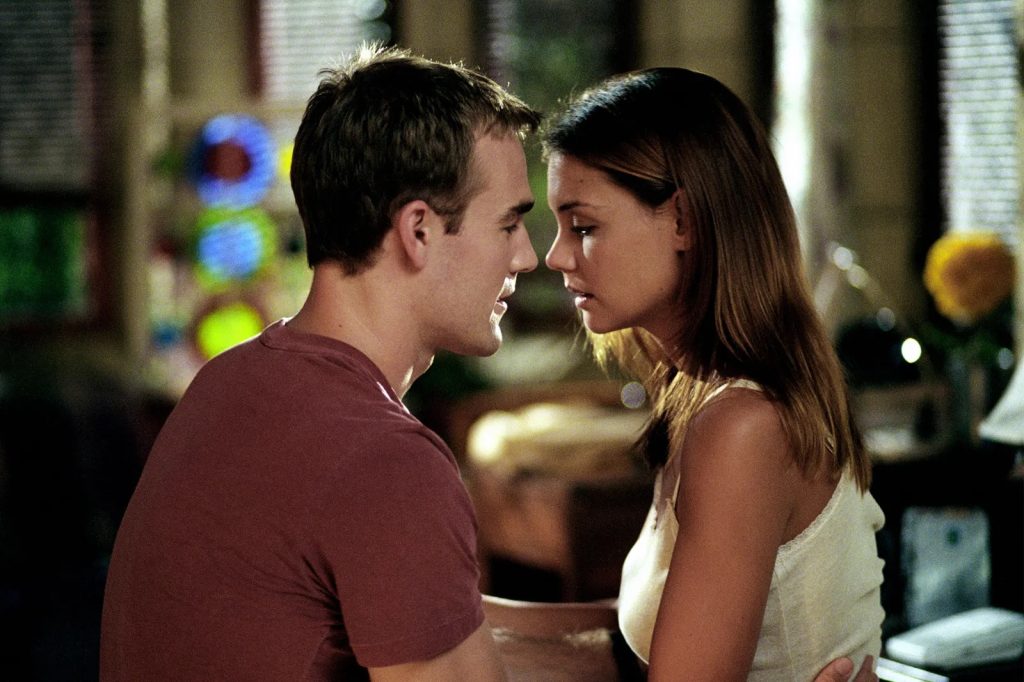
Growing up in the late ’90s, Dawson’s Creek was the undisputed holy grail of teen drama. We wanted Dawson’s hair, Joey’s brooding energy, and Pacey’s quick wit. It felt so grown-up, so intellectual, and so profoundly deep.
But when I sat down to rewatch the pilot episode recently, expecting a cozy, acoustic wave of pure, innocent nostalgia, I instead found myself staring at the screen and whispering a single word to my empty living room:
Jesus.
If you haven’t revisited Capeside since the Clinton administration, let me gracefully jog your memory of what happens in the first forty-five minutes of this show. Within the first ten minutes, fifteen-year-old Joey Potter casually uses the phrase “mounting sexual theoretics” to describe male anatomy while lying in bed with her best friend.
And then there’s Pacey Witter.
Our beloved, lovable underachiever Pacey spends his literal first day of sophomore year aggressively hitting on a woman at the local video store. By the end of the episode, we learn that she is Ms. Jacobs—his high school English teacher—and they are already kissing in her classroom.
Back in 1998, the media framed this as a sexy, edgy, forbidden coming-of-age romance. Watching it today? It feels like watching a true-crime documentary happen in real-time. I just didn’t remember it being quite so… sexual. Maybe I was simply too naive to actually see how much of it there was at the time but wow.
The Parents Were Right (A Sentence I Hate Writing)
When the show debuted, conservative media watchdog groups went absolutely ballistic. The Parents Television Council famously proclaimed the show the single worst program on television, complaining about its “obsessive focus on pre-marital sexual activity.”
At fifteen, I thought those watchdog groups were the ultimate buzzkills. At thirty-something, rewatching a teacher prey on a student while the soundtrack plays breezy acoustic pop, I’m forced to admit something truly horrifying: The uptight parents of 1998 were kind of right.
The “Kevin Williamson” Language Barrier
So, why didn’t we notice how unhinged it was at the time?
Part of it was the genius (and absurdity) of creator Kevin Williamson’s dialogue. He famously wrote teenagers who spoke like forty-year-old therapists who had swallowed a dictionary. Because Pacey and Joey analyzed their raging hormones with the clinical precision of a medical textbook, it masked the absolute chaos of what was actually happening on screen. They weren’t just horny teenagers; they were intellectually exploring their libidinal urges.
Because network television in the late ’90s couldn’t show actual nudity or explicit physical acts, the writers overcompensated by putting every single taboo thought into the script. They talked about sex constantly because they weren’t allowed to do anything else.
“Go On, Lad”: The Disturbed Architecture of the Pacey/Teacher Plot
Let’s unpack the Pacey of it all, because looking back at the narrative framing of his relationship with Ms. Jacobs is where the nostalgia train completely derails.
In 1998, the collective cultural response to a fifteen-year-old boy sleeping with his English teacher wasn’t horror—it was a collective, metaphorical slap on the back. The show treated Pacey like a roguish, charming underdog who had scored the ultimate teenage jackpot. We, the audience, were practically cheering him on from our sofas like, “Yeah, okay, go on lad, get in there.”
He was the lovable screw-up who finally won a prize.
Watching it now, the vibe shift is staggering. It doesn’t feel like a sexy, forbidden coming-of-age romance; it feels like an episode of Law & Order.
When Pacey aggressively hits on Tamara Jacobs at the local video store, he’s a child trying to act grown-up. But when she gives in, she is a literal adult in a position of authority over a minor. The show tries to mask the predatory nature of the dynamic by making Pacey the pursuer, giving him all the witty banter and the bold confidence. But no amount of Kevin Williamson’s hyper-articulate dialogue can change the fact that this is a classroom, she has a grading pen in her hand, and he hasn’t even learned how to drive yet.
What’s truly wild is how the town of Capeside reacts later on. The scandal isn’t framed around a child being taken advantage of; it’s framed as a tragic, star-crossed romance that just “can’t work out because of society.”
We were completely conditioned by late-’90s media to view this as peak television drama rather than a massive safeguarding failure. It’s the ultimate proof of how much our cultural boundaries have shifted—and just how much we brushed under the rug in the name of a good prime-time soap opera.
The Capeside Double Standard: Boys Will Be Boys, Girls Will Be Ruined
If you need any more proof of how skewed the show’s moral compass was, look no further than the immediate double standard applied to the girls versus the boys.
While Pacey is being cheered on for sleeping with an actual adult, the show treats Jen Lindley like a fallen woman before she even unpacks her bags. Jen arrives from New York City with a “wild” sexual history—which, looking back, just meant she was a normal teenager exploring her identity. Yet, the narrative treats her past like a dark, tragic scar. Dawson spends half the first season acting deeply judged and betrayed by the mere fact that Jen has experience, treating her like a damaged puzzle he has to solve or reject.
The show operates under a classic, deeply retro double standard:
- For the boys: Sexual encounters—even illegal ones with teachers—are treated as a roguish rite of passage, a badge of maturity, and a lucky break.
- For the girls: Having a sexual history or desires makes you “complicated,” “troubled,” and the subject of endless, hand-wringing existential debates over the kitchen counter.
Joey Potter spends years agonizing over losing her virginity because the show treats a young woman’s sexuality as an precious, fragile glass ornament that could shatter at any moment. Meanwhile, the boys are allowed to bumble through their desires with a casual “boys will be boys” pass from the scriptwriters. It’s a fascinating, infuriating piece of late-’90s time-capsule history that sits right beneath the surface of all that glossy acoustic pop.
Reading Between the Lines
Revisiting our childhood favorites is always a gamble. Sometimes you find a timeless piece of art, and sometimes you realize you were allowed to watch a wildly inappropriate prime-time soap opera while eating your after-school snacks.
Dawson’s Creek is still an iconic piece of television history, but wow, did it age like fine (slightly criminal) milk.