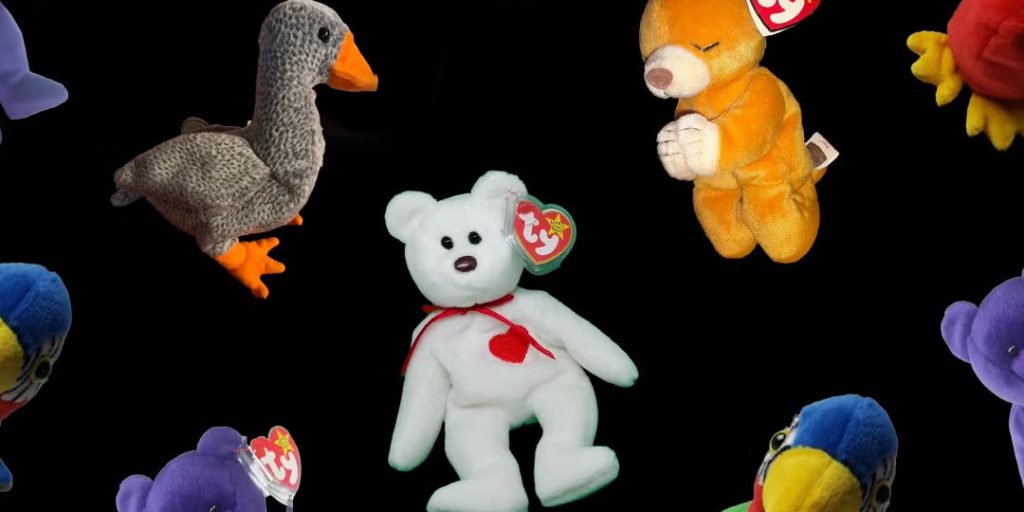
For a brief and glorious period in the 1990s, millions of people became convinced that the path to future financial security involved buying small stuffed animals and absolutely never removing the cardboard tag from their ear.
Beanie Babies weren’t simply toys.
They were investments.
At least, that’s what everyone thought.
People collected them obsessively. Certain Beanies were hunted down like treasure. Retired designs supposedly became more valuable overnight. Collectors bought protective cases for the tags because God forbid you actually let a child play with the thing.
Some people spent hundreds or even thousands on supposedly rare examples.
And if you were a child in the 1990s, there was a decent chance that at least one adult somewhere told you:
“Keep that one. It’ll be worth money one day.”
So we did.
And now, nearly thirty years later, cupboards and lofts across the world contain small armies of pristine Beanie Babies patiently waiting to fund retirements that they absolutely will not be funding.
What happened?
How did a range of tiny stuffed animals become one of the strangest speculative crazes of the 1990s?
And, most importantly, is that Princess Diana bear your mum kept in a plastic box actually worth £50,000?
I’m afraid we need to talk.
It started with Ty Warner
Beanie Babies were created by American toy manufacturer Ty Warner, founder of Ty Inc.
Warner had previously worked for toy company Dakin before launching his own business in the 1980s.
His big idea seems almost ridiculously simple now.
Small stuffed animals.
Instead of filling them entirely with traditional stuffing, the toys contained small plastic pellets — the “beans” — which made them floppy and poseable.
They weren’t supposed to sit rigidly on a shelf.
They slumped.
You could move them around.
They had names and little heart-shaped tags.
And crucially, they weren’t particularly expensive.
When Beanie Babies launched in the early 1990s, they were affordable enough that children could actually collect them.
That mattered.
Because if your child already had one Beanie Baby, buying another wasn’t a major financial decision.
Then another.
Then another.
And suddenly you’ve got 47 of them and you’re discussing whether Chocolate the Moose is going to appreciate in value.
Ty Warner understood scarcity
This is where things become interesting.
Ty didn’t simply keep manufacturing every Beanie Baby forever.
Designs were “retired.”
Once a Beanie was retired, Ty would stop producing it.
That created scarcity.
Or, more importantly, the perception of scarcity.
Collectors knew that the cute animal sitting on a shop shelf today might disappear tomorrow.
So perhaps you should buy it now.
Maybe buy two.
Actually, better get three.
One to keep, one to trade and one that nobody is ever allowed to touch because apparently this £5 stuffed bear is now part of the family pension.
Ty also avoided flooding huge national chains with unlimited stock in the early years. Beanie Babies became associated with smaller independent shops, where quantities could be limited and availability unpredictable.
That made finding them feel like a hunt.
You didn’t simply go shopping for a Beanie Baby.
You found one.
And that psychological difference helped turn ordinary toys into collectibles.
Then the internet arrived
Beanie Babies and the early internet were made for each other.
This was the 1990s.
Ordinary people were getting online for the first time. Message boards, websites and online marketplaces suddenly allowed collectors who previously would never have met to communicate and trade.
Beanie collectors could discuss retirements, track supposedly rare animals and obsess over tiny variations in tags.
And then there was eBay.
Oh dear.
Online auctions meant everyone could see Beanie Babies being listed and sold for prices far above their original retail cost.
Suddenly the idea that these toys were genuinely valuable didn’t feel like playground gossip.
There were numbers on a computer screen.
People were paying money for them.
Some rare Beanies genuinely did sell for substantial amounts.
And that helped convince everyone that perhaps their collection would eventually do the same.
The Beanie Baby stopped being a toy.
It became an asset.
People genuinely thought Beanie Babies would make them rich
This wasn’t merely children hoping their toys might someday be collectible.
Adults were investing serious money.
Price guides were published.
Collectors tracked variations.
People bought Beanies specifically to preserve rather than enjoy them.
Retirement announcements could cause demand for particular designs to explode.
There were stories of people spending extraordinary sums building collections because they believed the toys would continue increasing in value.
One infamous example involved a divorcing American couple who were photographed in court dividing their Beanie Baby collection under judicial supervision.
There they are.
Two grown adults on the courtroom floor, separating stuffed animals into piles because the collection was considered valuable marital property.
Nothing captures the Beanie Baby era quite like it.
At the height of the craze, this didn’t necessarily seem ridiculous.
That’s important to remember.
Looking back now, it’s very easy to ask how anybody could possibly believe mass-produced stuffed animals would become valuable enough to pay for university or retirement.
But people could see prices rising.
They could see other collectors making money.
They could see supposedly rare Beanies selling for hundreds or thousands of dollars.
And everyone knew somebody who knew somebody whose Beanie Baby was “worth a fortune.”
The market seemed to prove itself.
Until it didn’t.
Princess Diana made everything considerably worse
And then we got Princess the Bear.
Following the death of Diana, Princess of Wales in 1997, Ty released a purple bear called Princess in her memory, with proceeds initially connected to Diana’s memorial fund.
It became one of the most famous Beanie Babies ever produced.
Demand was enormous.
Limited early availability helped fuel the idea that Princess was extremely rare.
People bought them believing they might eventually become extraordinarily valuable.
And to this day, Princess is responsible for some of the most ludicrous Beanie Baby claims on the internet.
You’ll regularly find listings asking thousands — sometimes hundreds of thousands — for Princess bears.
Which brings us to something very important.
An eBay listing is not a valuation.
I can list a digestive biscuit for £74,000 tomorrow.
That does not mean the digestive biscuit market has experienced unprecedented growth.
You need to look at what people are actually paying.
And most Princess Beanie Babies are not funding anyone’s retirement.
Sorry, Mum.
Then there were the “errors”
If you’ve ever fallen into the Beanie Baby valuation rabbit hole, you’ll know about errors.
Oh, the errors.
Apparently your Beanie Baby is worth £26,000 because the tag contains a spelling mistake.
Or because the tush tag has a particular date.
Or because there’s no stamp.
Or because something is written in a slightly different font.
Or because the tag says Oakbrook rather than Oak Brook.
There are genuine variations between different generations of Beanie Babies, and some early versions are significantly rarer than later ones.
But the internet has turned ordinary manufacturing variations and extremely common tag characteristics into a mythology of enormously valuable “error” Beanies.
The problem is usually the same.
Someone lists one for £10,000.
Someone else sees that listing.
They own the same Beanie.
They conclude theirs is worth £10,000.
They list theirs for £10,000.
Now Google shows several £10,000 listings.
Congratulations.
We have created £40,000 of imaginary wealth without anyone actually buying anything.
Ty Warner himself became extraordinarily rich
While collectors were waiting for their stuffed animals to make them wealthy, Ty Warner had already achieved it.
The Beanie Baby phenomenon turned Ty Inc. into an enormously successful company and Warner into a billionaire.
But Warner’s story has a less cuddly chapter.
In 2013, he pleaded guilty in the United States to tax evasion connected to an undeclared offshore Swiss bank account.
Prosecutors said Warner had concealed millions of dollars overseas.
He faced the possibility of prison but was ultimately sentenced to probation, community service and a substantial fine, having already paid a much larger civil penalty.
The decision not to imprison him attracted controversy, and federal prosecutors appealed the sentence.
So yes.
The man behind the tiny animals with heart-shaped tags eventually ended up in federal court over a hidden Swiss bank account.
The Beanie Baby story really does have everything.
And then the bubble burst
Collectible markets depend on a rather important thing:
Someone else has to want the object.
Beanie Baby prices had risen because collectors believed demand would continue.
People bought them because they expected other people to want them even more later.
But by the end of the 1990s, enthusiasm was beginning to fade.
There were enormous numbers of Beanie Babies in circulation.
Collectors started losing interest.
And once people stopped believing prices would keep climbing, the entire logic of buying them as investments began to collapse.
Ty announced in 1999 that Beanie Babies would be retired at the end of the year, causing another burst of excitement.
Then the company continued making them.
The great Beanie Baby gold rush was effectively over.
Millions of people were left with collections they’d carefully protected on the assumption that scarcity would make them valuable.
Except everybody else had done exactly the same thing.
That’s the fundamental problem.
Your Beanie Babies probably aren’t worth much
I’m sorry.
I know.
You kept the tag on and everything.
Most Beanie Babies today are worth relatively little.
That doesn’t mean no Beanie Baby is valuable.
There are genuinely rare early examples, prototypes, unusual authenticated variations and particularly desirable Beanies that collectors will pay significant amounts for.
But those are exceptions.
The ordinary Beanies that were produced in enormous quantities during the height of the craze generally aren’t rare.
And keeping them in perfect condition didn’t magically create rarity because millions of other people were doing exactly the same thing.
This is the beautifully tragic irony of the entire Beanie Baby phenomenon.
Everyone was told:
Don’t play with it.
Keep the tag perfect.
Put it away somewhere safe.
It’ll be worth money someday.
So millions of people preserved them.
Which helped ensure that millions of perfectly preserved Beanie Babies still exist.
We accidentally protected them from becoming rare.
But perhaps they weren’t worthless after all
Financially?
Mostly, yes.
That £5 bear probably isn’t paying off your mortgage.
But Beanie Babies have become something else.
They’re tiny physical artefacts of an extremely specific moment in the 1990s.
They belong to the same world as dial-up internet, Argos catalogues, VHS tapes and trying to keep your Tamagotchi alive during school.
And the madness surrounding them tells us something fascinating about how people behave when collecting becomes investing.
Scarcity creates demand.
Rising prices attract new buyers.
New buyers push prices higher.
Stories about enormous profits spread.
People become frightened of missing out.
And eventually we’re sitting in a courtroom deciding who gets Squealer the Pig in the divorce.
Beanie Babies weren’t the first collectible bubble.
They certainly weren’t the last.
But they might have been the cutest.
So if you’ve still got a box of them in the loft, by all means have a look.
Maybe you’ve got something genuinely unusual.
Just don’t start planning the Caribbean retirement because somebody on eBay is asking £75,000 for the same bear.
And if yours isn’t worth anything?
Take it out of the plastic box.
Let the poor thing breathe.
It’s been waiting since 1998.


