There are some historical films where you sit down to fact-check them and discover that approximately twelve minutes in, the filmmakers decided history was more of a gentle suggestion.
And then there’s Apollo 13.
Released in 1995 and directed by Ron Howard, Apollo 13 tells the story of NASA’s disastrous 1970 lunar mission, when an oxygen tank exploded around 200,000 miles from Earth and transformed what should have been the third crewed Moon landing into a desperate attempt to bring three astronauts home alive.
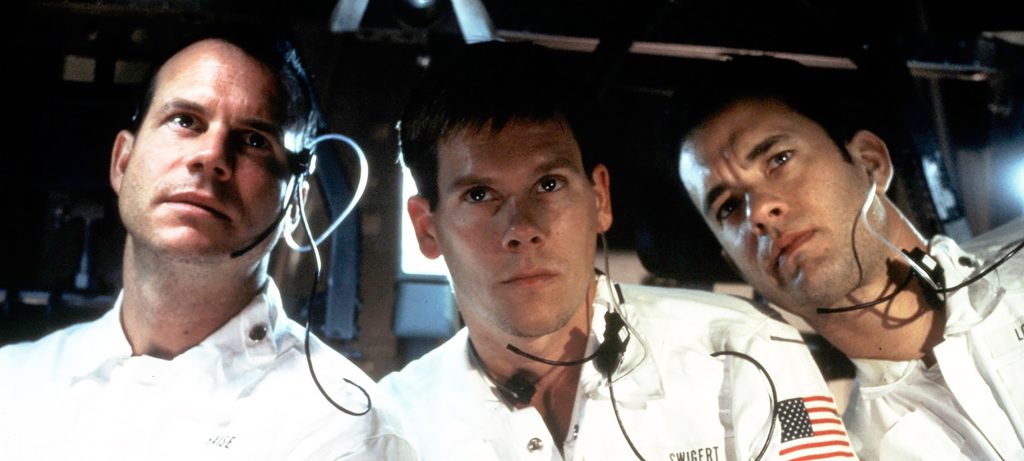
It stars Tom Hanks as Commander Jim Lovell, Bill Paxton as Fred Haise and Kevin Bacon as Jack Swigert, with Ed Harris running Mission Control as flight director Gene Kranz.
And it feels authentic.
Almost suspiciously authentic.
The spacecraft looks right. Mission Control looks right. The astronauts float rather than being dangled around on obviously 1990s wires. Much of the technical language is incomprehensible to anyone who isn’t employed by NASA, and the film simply expects us to keep up.
But Hollywood is Hollywood.
So how much of Apollo 13 actually happened?
Quite a lot, as it turns out.
First of all, Apollo 13 really was that disastrous
The basic story requires remarkably little Hollywood embellishment.
Apollo 13 launched from Kennedy Space Center on 11 April 1970 carrying Jim Lovell, Jack Swigert and Fred Haise. Lovell and Haise were supposed to land on the Moon while Swigert remained in lunar orbit.
They never got there.
On 13 April, an oxygen tank in the service module exploded.
The Moon landing was abandoned and NASA suddenly had a much more pressing objective: keeping three men alive long enough to get them back to Earth.
The film’s basic sequence of events — the explosion, loss of oxygen, shutting down the command module, using the lunar module as a lifeboat, looping around the Moon and desperately conserving electricity and water — is based firmly in reality.
If anything, the real story is slightly ridiculous in how conveniently cinematic it already was.
Jim Lovell knew this.
Before agreeing to cooperate with Ron Howard’s film, Lovell remembered an earlier television drama that had used Apollo 13 as the backdrop for a largely fictional story involving invented Mission Control personnel and their personal problems.
He hated it.
When Howard approached him, Lovell essentially warned him not to do the same thing. The real Apollo 13 story, he argued, already contained enough drama.
He was right.
“Houston, we have a problem.”
Okay.
They didn’t say that.
At least, not exactly.
The famous line has become so inseparable from Apollo 13 that it’s difficult to imagine the incident without hearing Tom Hanks calmly announcing:
“Houston, we have a problem.”
But the actual first report came from Jack Swigert, who told Mission Control:
“Okay, Houston, we’ve had a problem here.”
When Mission Control asked them to repeat the transmission, Lovell responded:
“Houston, we’ve had a problem.”
So the sentiment is completely genuine. Hollywood just changed the tense.
And Ron Howard has openly admitted it.
Speaking about the film years later, Howard recalled that the production had the real mission transcripts available. They knew perfectly well what had actually been said.
But “Houston, we have a problem” had already entered popular culture, so they chose the line everyone recognised.
This wasn’t a historical mistake.
It was a deliberate cheat.
I’ll allow it.
Ken Mattingly really was removed from the mission
Poor Gary Sinise.
Ken Mattingly was genuinely supposed to fly aboard Apollo 13.
Just days before launch, however, fellow astronaut Charles Duke was diagnosed with rubella — German measles — after exposing other members of the astronaut corps.
Mattingly was the only member of Apollo 13’s prime crew who wasn’t immune.
NASA doctors feared that he might develop the illness during the mission, so he was replaced by backup command module pilot Jack Swigert.
The film makes this understandably devastating for Mattingly, who had trained for the mission only to watch it leave without him.
And the particularly cruel part?
He never developed rubella.
Not even slightly.
Mattingly later flew to the Moon aboard Apollo 16, so at least history eventually gave the poor man his spacecraft back.
But the film makes Mattingly rather more important than he actually was
This is one of the more substantial bits of Hollywood tinkering.
Once Apollo 13 is in trouble, the film brings Mattingly back into the story as one of the key figures figuring out how to safely power up the freezing command module using the tiny amount of electricity available.
It gives Gary Sinise a lovely narrative arc: the man who was prevented from flying the mission ultimately becomes instrumental in saving it.
Great filmmaking.
Not quite what happened.
Mattingly did contribute to the recovery effort, but the procedures weren’t essentially devised by one heroic astronaut spending hours alone in a simulator. They were the work of a much larger group of NASA astronauts, engineers and controllers.
Even Mattingly later explained that the film had condensed the work of many people into individual characters.
It makes perfect narrative sense. A film can’t introduce us to every engineer who contributed to the rescue and expect us to remember 400 different men in white shirts.
But the real Apollo 13 rescue was even more collaborative than the film suggests.
Yes, they really did build that ridiculous carbon dioxide contraption
This is my favourite category of historical film fact-checking:
Things that look completely made up but aren’t.
Three men were now living inside a lunar module designed to support two men for around two days.
That created a carbon dioxide problem.
There were perfectly good lithium hydroxide canisters aboard the command module that could remove the carbon dioxide.
One slight issue.
The command module used square canisters.
The lunar module needed round ones.
NASA had managed to send men to the Moon but was now facing the interplanetary equivalent of discovering you’ve bought the wrong Hoover bag.
Mission Control had to figure out how to make one fit the other using only materials the astronauts already had aboard the spacecraft.
And yes, they did it.
Plastic bags, cardboard, spacesuit hoses and tape were among the materials used to create an improvised adapter.
NASA then transmitted instructions to the crew, who built it aboard the lunar module.
Jim Lovell himself later recalled that they put the improvised system together and “by God, it worked.”
Sometimes history simply refuses to be outdone by Hollywood.
The astronauts really were freezing
The miserable conditions aboard the spacecraft are also accurate.
To conserve the extremely limited electrical power available, the crew shut down unnecessary systems.
Temperatures plummeted.
Water condensed on surfaces inside the spacecraft. The men were exhausted, dehydrated and cold. Fred Haise also developed a urinary tract infection during the flight.
The film shows the astronauts becoming increasingly bedraggled as the mission continues, and that isn’t simply Tom Hanks and Bill Paxton being made progressively sweatier for dramatic purposes.
Apollo 13 was an extraordinarily unpleasant place to live.
The arguments aboard the spacecraft? Not so much.
Here’s somewhere Hollywood couldn’t resist itself.
At one point, Haise becomes angry with Swigert and questions whether the accident might have been his fault.
It’s an effective scene because the pressure that has been building between three exhausted, frightened men finally erupts.
Except the real astronauts didn’t do that.
Lovell later confirmed that the confrontation was fictional.
The real Apollo crews were trained precisely to avoid this kind of emotional breakdown during an emergency. Ron Howard has spoken about listening to the original recordings and noticing how controlled the astronauts remained even while their spacecraft was failing around them.
Which creates an interesting filmmaking problem.
Real-life professional competence isn’t always terribly cinematic.
So Apollo 13 gives its crew slightly more interpersonal conflict than history did.
“Failure is not an option.”
Bad news again.
Gene Kranz never said it.
Ed Harris’s version of Kranz is responsible for another of the film’s immortal lines:
“Failure is not an option.”
It beautifully encapsulates the attitude of Mission Control during the rescue.
But it wasn’t something Kranz actually said during Apollo 13.
The phrase was created for the film after the screenwriters interviewed people involved in Mission Control and tried to capture the mentality of the team.
It became so closely associated with the real Gene Kranz that he later used Failure Is Not an Option as the title of his autobiography.
Which is a fascinating little example of Hollywood and history eating one another.
A fictional line was written to represent a real man’s philosophy, became famous because an actor playing that man said it, and was subsequently adopted by the actual man.
So is it historically accurate?
No.
Does it accurately represent the attitude?
Apparently, yes.
History is annoying like that.
Mission Control was considerably calmer than Hollywood would have us believe
One of the most striking things about listening to recordings from Apollo 13 is how calm everyone sounds.
There isn’t much shouting.
Nobody dramatically throws a headset across the room.
The astronauts don’t start screaming that they’re all going to die.
NASA personnel had trained for emergencies and approached the disaster as a series of problems that needed to be solved.
That doesn’t mean nobody was frightened.
It means they were professionals.
The film heightens the tension in Mission Control because we, the audience, need to understand just how serious each new problem is.
But the real rescue depended on a huge number of people methodically working through problems one after another.
In some ways, I think that’s even more impressive.
The spacecraft is ridiculously accurate
This is where Ron Howard and his production team went slightly mad.
Rather than simply building vaguely space-looking sets, they worked extensively with NASA and astronaut Dave Scott, commander of Apollo 15, who served as technical consultant.
The sets were constructed to closely reproduce the real spacecraft.
The Mission Control consoles were painstakingly recreated.
Actual mission transcripts and recordings were studied.
And Howard didn’t want fake Hollywood weightlessness either.
So they filmed it for real.
Not in space, obviously. Universal’s insurance department probably would have had something to say about that.
Instead, the actors and crew flew aboard NASA’s KC-135 aircraft, which could perform parabolic manoeuvres producing short periods of genuine weightlessness.
Scenes had to be filmed in tiny bursts while everyone floated for real.
The result is one of the reasons Apollo 13 still looks so convincing three decades later.
There are no wires for our eyes to subconsciously notice.
Tom Hanks is floating because Tom Hanks is actually floating.
When Howard later screened the film for people at NASA, Buzz Aldrin apparently thought some of the space footage was genuine archive material.
Howard had to tell him they’d created it.
That’s about as good an endorsement as your historical space movie is ever going to get.
Jim Lovell is actually in the film
There’s a lovely cameo right at the end.
After the astronauts are recovered, Tom Hanks’s Jim Lovell walks across the deck of the USS Iwo Jima and shakes hands with the ship’s captain.
That captain is played by the real Jim Lovell.
Howard reportedly offered Lovell the role of an admiral.
Lovell preferred to play a captain because that was the rank he’d actually achieved before retiring from the US Navy.
Even when appearing for approximately twelve seconds in the Hollywood version of his own life, Jim Lovell apparently wasn’t going to accept an inaccurate promotion.
Excellent.
Marilyn Lovell also appears briefly in the film.
And the terrifying radio blackout really happened
This is one of the best sequences in the film.
Apollo 13 enters Earth’s atmosphere and communications disappear as expected.
Mission Control waits.
And waits.
And waits.
The expected blackout period passes.
Still nothing.
Everyone stares desperately at the speakers until finally the crew responds.
It feels like textbook Hollywood suspense.
Except the real blackout was actually unusually long.
Mission Control genuinely had to wait longer than expected to hear from the spacecraft.
And everyone knew that until Apollo 13 re-established communication, there was no way of knowing for certain that the crew had survived re-entry.
The film didn’t need to invent that tension.
History had already written the scene.
So, how historically accurate is Apollo 13?
Very.
Not perfectly.
Characters are amalgamated. Timelines are compressed. Arguments are invented. Ken Mattingly gets a considerably larger individual role in the rescue than he really had. Famous dialogue is altered or created entirely.
But those changes mostly serve the structure of the film rather than fundamentally rewriting what happened.
The explosion happened.
The lunar module became a lifeboat.
The astronauts really did travel around the Moon to get home.
NASA really did have to solve a potentially lethal carbon dioxide problem using an improvised collection of objects already aboard the spacecraft.
The crew really did endure freezing conditions while rationing power and water.
Hundreds of people on the ground really did spend days solving one seemingly impossible problem after another.
And three men who left Earth intending to walk on the Moon really did splash down safely in the Pacific on 17 April 1970.
Perhaps that’s why Apollo 13 works so well as a historical film.
Ron Howard understood something filmmakers occasionally forget.
Sometimes you don’t need to make history more exciting.
You just need to tell it properly.