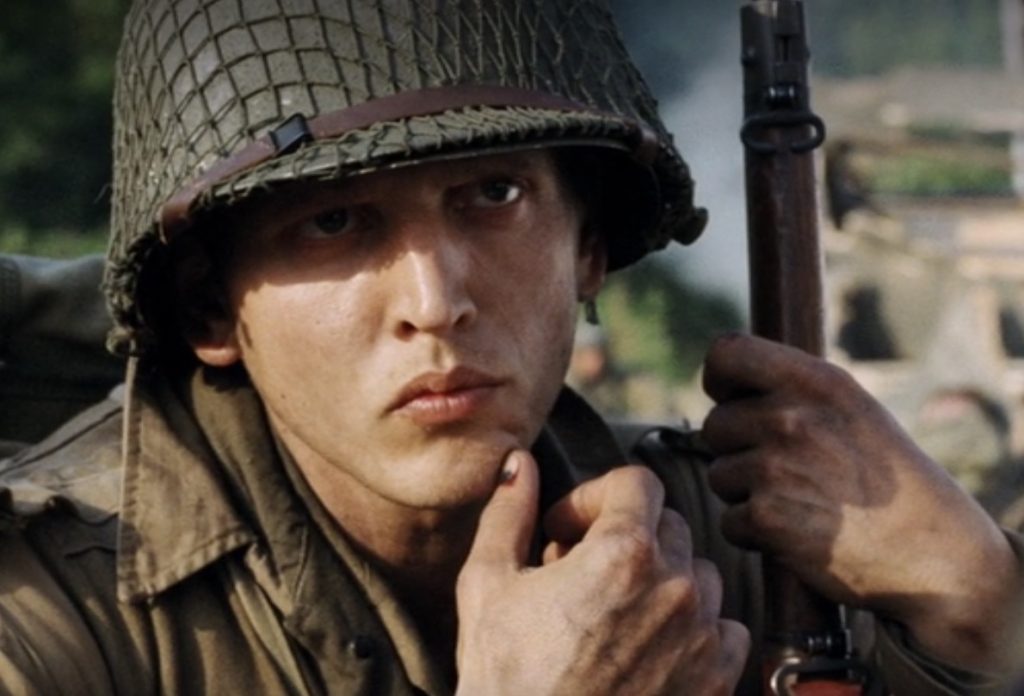
There was a period in Hollywood history when apparently no war could be fought without Barry Pepper.
Second World War? Get Barry Pepper.
Vietnam? Barry Pepper.
Clint Eastwood making a film about Iwo Jima? Has anyone called Barry?
For a good decade or so, if a group of men were standing around in military uniforms looking haunted by the terrible things they had seen, there was an excellent chance that one of them was Barry Pepper.
And it wasn’t only war films. Around the turn of the millennium, Pepper was suddenly everywhere. Saving Private Ryan. Enemy of the State. The Green Mile. Battlefield Earth. We Were Soldiers. 25th Hour. Flags of Our Fathers. Later came Seven Pounds and True Grit.
He was never quite the traditional Hollywood leading man — although I know that I personally had a huge crush on him — but he was one of those actors who seemed permanently attached to enormous films. You might not have gone to see “the new Barry Pepper movie”, but you’d go to see a massive Hollywood production and there he bloody was again.
And then, at some point, he wasn’t.
So whatever happened to Barry Pepper?
First, Barry Pepper had a very strange childhood
Before we get to Hollywood, we need to discuss the fact that Barry Pepper’s childhood sounds like the beginning of an adventure film.
Born in British Columbia, Canada, in 1970, Pepper was five when his parents took him and his two older brothers aboard a 50-foot boat the family had built themselves and sailed into the South Pacific.
For the next five years, the family travelled around places including Fiji, Tahiti and New Zealand. Pepper was educated partly through correspondence courses and partly at local schools along the way.
Which means that before Barry Pepper was pretending to survive various historical conflicts for a living, he had already spent a significant chunk of his childhood sailing around the Pacific.
Eventually the family returned to Canada and Pepper began pursuing acting, studying for several years and picking up television work throughout the 1990s.
And then Steven Spielberg happened.
Saving Private Ryan changed everything
In 1998, Pepper was cast as Private Daniel Jackson in Saving Private Ryan, the Bible-quoting American sniper who calmly picks off German soldiers while reciting scripture.
It remains probably the role most people immediately associate with him.
Pepper was still relatively unknown when Spielberg cast him. Years later, he described making Saving Private Ryan as a “seminal experience”, saying that working with Spielberg and his crew felt like being allowed behind the curtain of Oz.
It isn’t difficult to see why it transformed his career.
Because after Saving Private Ryan, Barry Pepper went on an absolutely ridiculous run.
That same year he appeared in Enemy of the State alongside Will Smith and Gene Hackman.
In 1999, he was Dean Stanton in The Green Mile alongside Tom Hanks.
And then came 2000.
Unfortunately, 2000 brought Battlefield Earth.
We do have to talk about Battlefield Earth
Look. Nobody gets through an entire Hollywood career without making at least one questionable decision.
Barry Pepper’s was Battlefield Earth.
The John Travolta science-fiction spectacular is now remembered as one of Hollywood’s most notorious disasters. It was savaged by critics and subsequently swept the Golden Raspberry Awards, winning seven Razzies.
Barry Pepper himself was named Worst Supporting Actor.
And, wonderfully, he apparently wasn’t particularly wounded by the whole thing. After discovering he’d won, Pepper joked that he wished somebody had invited him to the ceremony because he would have gone to accept the award.
Honestly, fair play.
More importantly, Battlefield Earth did not destroy his career.
Within a year, Pepper was playing baseball star Roger Maris in Billy Crystal’s HBO film 61*, a performance that earned him an Emmy nomination.
And then, naturally, it was time for Barry Pepper to go back to war.
The Barry Pepper Cinematic War Department
In 2002, Pepper appeared in We Were Soldiers as journalist Joseph Galloway, covering the Battle of Ia Drang during the Vietnam War.
Then in 2006 he joined Clint Eastwood’s Flags of Our Fathers, playing US Marine Michael Strank, one of the men associated with the famous flag-raising photograph on Iwo Jima.
By this point even interviewers had noticed.
During promotion for Flags of Our Fathers, Pepper was asked what it was about war films that attracted him, considering he’d already appeared in Saving Private Ryan and We Were Soldiers.
His answer was essentially: this wasn’t planned.
Pepper explained that he hadn’t deliberately set out to make three major war films. He was simply attracted to powerful stories and the fact that war happened to provide the backdrop wasn’t particularly important to him.
Which is perfectly reasonable.
But also: Barry.
Three times is a pattern.
Hollywood had found a man who looked extraordinarily convincing while dirty, exhausted, emotionally devastated and carrying a rifle, and Hollywood was not going to waste him.
But he was doing some seriously good work elsewhere
The funny thing about remembering Pepper as “that bloke who was always in war films” is that it slightly undersells how varied his career actually became.
There was Spike Lee’s 25th Hour in 2002. The Snow Walker in 2003. The Three Burials of Melquiades Estrada in 2005. Seven Pounds with Will Smith in 2008.
Then in 2010 he turned up in the Coen brothers’ True Grit as outlaw Lucky Ned Pepper.
Yes, his character was actually called Pepper.
I like to imagine the casting meeting lasted approximately nine seconds.
And then came one of the best performances of his career.
Barry Pepper became Bobby Kennedy
In the 2011 miniseries The Kennedys, Pepper played Robert F. Kennedy opposite Greg Kinnear’s John F. Kennedy.
And he was very good.
So good, in fact, that he won the Primetime Emmy for Outstanding Lead Actor in a Miniseries or Movie.
Just consider the people in that category for a moment.
Pepper was up against Idris Elba, Laurence Fishburne, William Hurt, Greg Kinnear and Édgar Ramírez.
Barry Pepper won.
So if you’re imagining his career following the classic Hollywood trajectory of huge films, disastrous flop, gradual disappearance — it didn’t.
More than a decade after Saving Private Ryan, he was winning an Emmy.
What happened next is more interesting.
Barry Pepper didn’t disappear. He changed lanes.
Through the 2010s, Pepper kept working.
He appeared in Broken City, Snitch and The Lone Ranger in 2013, Kill the Messenger in 2014, then joined the Maze Runner franchise as Vince in The Scorch Trials and The Death Cure.
He was in Crawl in 2019, battling alligators during a hurricane, because apparently once Hollywood stopped sending Barry Pepper to war it decided to start throwing natural disasters at him instead.
He also appeared in the acclaimed and extremely bleak The Painted Bird, Nicolas Cage crime drama Running with the Devil, Trigger Point and Awake.
But these weren’t the enormous turn-of-the-millennium studio films that had made Pepper seem unavoidable.
And there appears to be a very simple reason for that.
He stepped away from Hollywood itself.
He left Los Angeles
Pepper’s own official website says that he left Los Angeles years ago, returning to his roots and choosing to live outside Hollywood with his wife and daughter.
That changes the “Whatever happened to him?” question quite considerably.
Because Barry Pepper wasn’t sitting in Los Angeles wondering why Steven Spielberg had stopped calling.
He had gone home.
He continued acting, but his life was no longer apparently built around being permanently present in the Hollywood machine.
And frankly, when you look at his career, you can see the shift.
The relentless pace slows down. The roles become more selective. There are television projects, independent films, supporting parts and the occasional bigger production.
He also seems to have acquired perhaps the most Barry Pepper hobby imaginable.
Blacksmithing.
Pepper has his own forge at home. While working on Maze Runner: The Death Cure, he forged a knife for his character Vince which was actually used in the film.
Years later he did it again, making a knife for his character in Lawmen: Bass Reeves.
Of course he did.
You cannot spend that many years playing weathered military men and frontier types without eventually just becoming one.
And he is still acting
In 2023, Pepper appeared in the Paramount+ western miniseries Lawmen: Bass Reeves as Esau Pierce, alongside David Oyelowo.
That same year he starred in the Australian crime thriller Bring Him to Me.
In interviews promoting the latter, Pepper was still talking enthusiastically about acting and his tendency to immerse himself heavily in his characters. So this isn’t a retired actor occasionally being coaxed back onto a film set.
He’s still working.
His credits have simply become less frequent and less dominated by the gigantic mainstream films that defined the first decade of his career.
As of 2026, he’s back on screen in Newborn, and further projects are listed as being in development or production.
So, whatever happened to Barry Pepper?
Not very much, really.
And that’s rather nice.
There was no spectacular career implosion. Battlefield Earth didn’t finish him. He wasn’t secretly blacklisted. He didn’t abandon acting.
He had one of those extraordinarily concentrated Hollywood runs where, for about a decade, he worked with Steven Spielberg, Frank Darabont, Spike Lee, Mel Gibson, Clint Eastwood and the Coen brothers, appeared alongside some of the biggest actors in the world, survived one of the most infamous flops ever made and eventually won an Emmy.
Then he moved away from Los Angeles, raised his family, became more selective about his work and apparently started forging knives in his spare time.
Barry Pepper didn’t vanish.
Hollywood just stopped fighting quite so many wars around him.