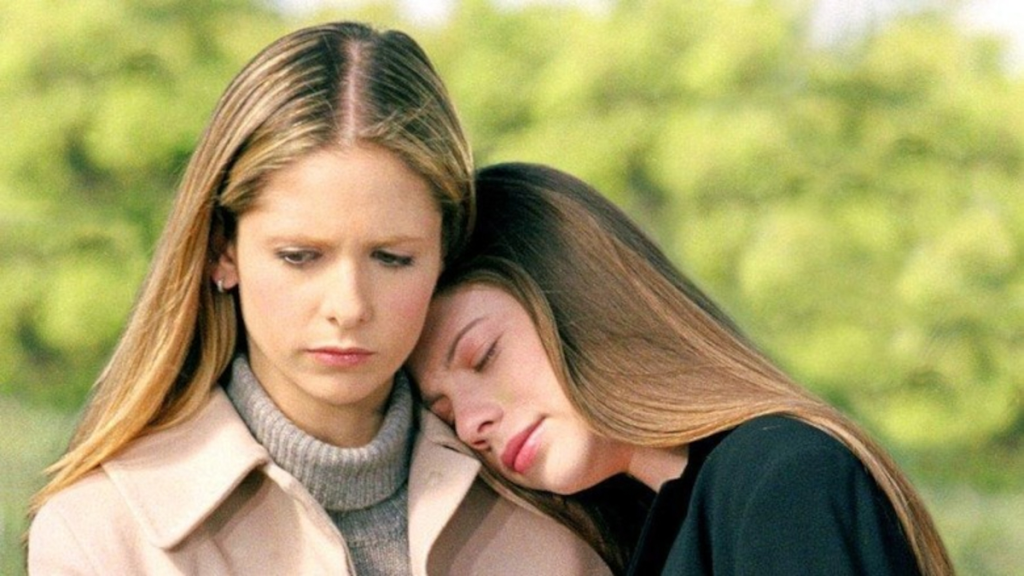
Remember when Buffy basically gaslit us that Buffy had always had a sister? With no explanations. For weeks.
There are TV plot twists.
There are shocking reveals.
And then there is whatever the hell Buffy the Vampire Slayer did when Dawn suddenly appeared.
Because if you watched Buffy when it originally aired — properly aired, one episode at a time, with no instant Wikipedia explanation and no Reddit thread immediately decoding everything — then you will remember the absolute psychological warfare of season five. One minute Buffy Summers was the only child of Joyce Summers. The next?
She apparently had a younger sister called Dawn. Just… there. Existing. Living in the house. Arguing with Buffy over who finished the cereal. Being treated by every single character as though she had always, always been part of the show.
And honestly?
It was one of the most brilliantly confusing things television has ever done.
“Hang on… who is THAT?”
If you started season five expecting business as usual, the opening episodes were genuinely disorientating. Not because Dawn was introduced dramatically. That would have made sense.
No, Dawn appears in the most casually offensive way possible. As if you are the one being weird. Buffy’s suddenly telling Dawn what to do. Joyce is parenting her. Characters reference her like she’s always existed. No one stops to explain a single thing.
No “surprise sister.”
No secret adoption reveal.
No timeline reset warning.
Nothing. Just a collective television shrug that said:
Yes? Buffy has a sister? Keep up?
It was maddening.
Kids today will never understand the confusion
And I say this with my whole chest. Streaming-era viewers simply cannot replicate this experience. Now? You’d be confused for maybe twenty minutes. Then you’d hit “next episode.” Or Google it. Or accidentally see a spoiler because your phone heard you whisper “who the hell is Dawn?”
But back then? You had a full week between episodes. A FULL WEEK. Tuesday to Tuesday for BBC viewers. To sit in your confusion. To question your memory. To debate with friends at school. To genuinely wonder if you’d somehow missed a crucial special. It was low-level shared psychological damage.
And I say that with affection.
The genius was making us feel exactly what Buffy felt
This is why the twist works so well. Because Dawn wasn’t just a random writing decision. She was part of the story.
(Obviously spoilers here for a show old enough to rent a car.)
Dawn exists because mystical forces transformed “The Key” into human form and inserted false memories into everyone’s minds to protect her. Meaning Buffy and everyone around her genuinely believed Dawn had always been there. And the show made us experience that same reality distortion.
That is such clever storytelling.
Because rather than simply telling viewers “everyone’s memories have changed,” the writers let us live inside that confusion ourselves. We weren’t outside observers. We became part of the deception. That’s such a bold narrative move.
And honestly? Slightly evil.
It shouldn’t have worked. But it absolutely did.
Let’s be honest. On paper, “surprise sibling with no explanation” sounds like terrible television. The kind of thing that happens when writers panic. It’s akin to “… and it was all a dream!”. A classic shark-jumping moment. But Buffy somehow made it brilliant because the confusion was intentional. The discomfort was the point.
You weren’t meant to feel reassured. You were meant to feel unsettled. That weird sense of something is deeply wrong here mirrored exactly what the story wanted.
And because Buffy had already trained us to expect supernatural weirdness, we stuck with it rather than immediately writing it off.
Even if we were muttering angrily at our televisions.
Dawn became weirdly essential
I’ll admit it. At first? I was offended by Dawn’s existence. Who is this child and why is she in Buffy’s house touching things? She caused drama and confusion and upset a world I felt I had already learned the rhythm of. But over time, Dawn became genuinely important to the emotional structure of the show. Because Dawn wasn’t really about adding “annoying younger sibling energy.”
She gave Buffy something new to protect.
A different kind of responsibility. A more human emotional anchor. And later, of course, Dawn becomes central to one of the show’s most devastating arcs. The Gift is one of the most memorable episodes for me and I still cry as a 38 year-old-woman when they play Buffy’s voiceover. So while the introduction felt chaotic at the time, it wasn’t gimmicky. It served a purpose.
Buffy trusted its audience in a way most shows don’t
What makes this twist still feel special is how much faith the writers had in viewers. Modern TV often explains everything immediately because executives are terrified we’ll get confused and wander off.
Buffy basically said:
“No explanation. Sit with it.”
And we did.
Confused.
Slightly angry.
Deeply intrigued.
That confidence is part of what made the show so memorable. It treated viewers like participants, not passive consumers. Even when it was absolutely messing with our heads.
Honestly? Peak television chaos
Of all the wild things Buffy the Vampire Slayer gave us — musical demons, silent gentlemen (shudder), traumatic resurrections, questionable vampire romances — Dawn’s introduction remains one of the most psychologically effective.
Because it wasn’t just a plot twist. It was an experience.
A shared “am I losing my mind?” cultural moment.
And if you were there, you know exactly what I mean.
Justice for every millennial who spent an entire week wondering whether they had somehow forgotten Buffy had a whole sister.