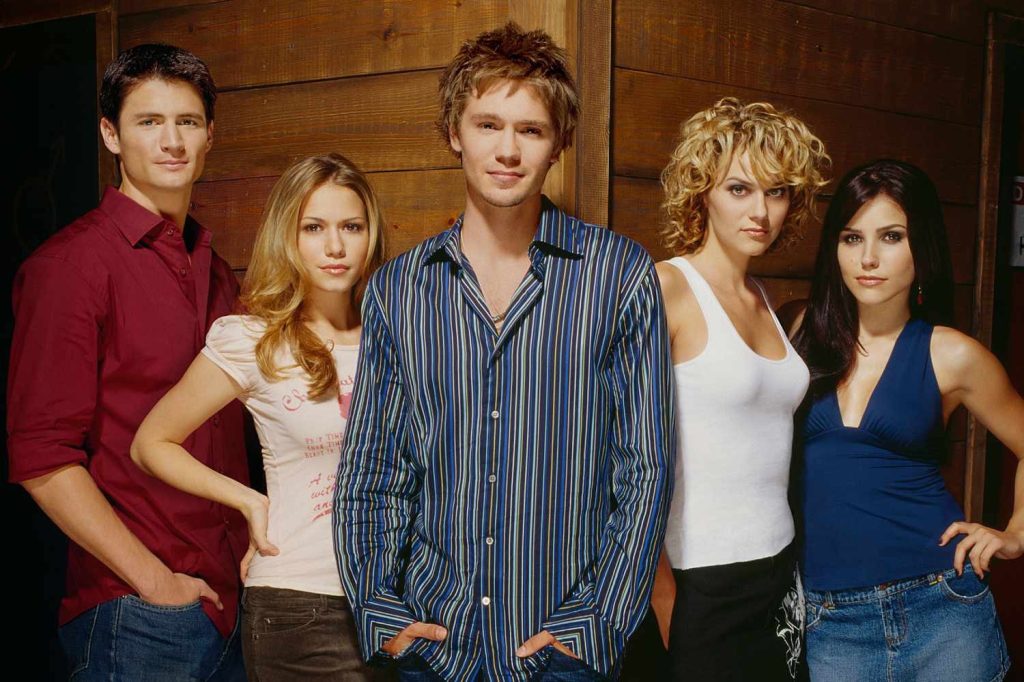
If you were a millennial with access to E4, questionable eyeliner, and even a passing emotional investment in fictional basketball players, then One Tree Hill probably has a place somewhere in your heart.
And if One Tree Hill has a place in your heart, then so does Haley James Scott.
Haley was the sensible one. The grounded one. The tutor girl who somehow landed the brooding basketball dreamboat and made us all believe that teenage marriage might actually be romantic rather than objectively a terrible life choice.
Bethany Joy Lenz was Haley for so many of us.
So discovering, years later, that while millions of us were watching her live out what looked like a glossy teen drama success story, she was actually trapped in what she has described as a high-control religious cult?
That is… a lot.
Because this is not one of those “celebrity had a rough year” stories.
This is a story about manipulation, financial control, emotional abuse, isolation, and losing years of your life while the outside world assumes you’re thriving.
So… what happened to Bethany Joy Lenz?
For anyone who somehow missed the One Tree Hill era entirely, Bethany Joy Lenz played Haley James Scott on the hit teen drama from 2003 to 2012.
She wasn’t just an actress, either. Fans will remember her music career, too, because One Tree Hill loved a musical subplot almost as much as it loved emotional rain scenes.
For years, though, Bethany’s public profile felt quieter than some of her former castmates. While Sophia Bush and Hilarie Burton remained highly visible, Bethany seemed to exist a little more at the edges of pop culture memory.
And then came the revelation that completely changed how many fans saw her story.
In 2024, Bethany released her memoir Dinner for Vampires, where she opened up about spending roughly a decade inside a high-control religious group known as the Big House Family.
Yes. A cult.
Or, more accurately and fairly, a group she herself has described in those terms.
And honestly? The details are deeply unsettling.
How did Bethany Joy Lenz end up in a cult?
This is always the question people ask, isn’t it?
“How does that even happen?”
But if we’re honest, that question often carries an unfair assumption that only gullible or unintelligent people end up in controlling environments.
That’s not how coercive control works.
Bethany has spoken about joining the group in her early twenties, during a time when she was looking for belonging, faith, stability, and community.
Which, let’s be real, is one of the most human things imaginable.
High-control groups rarely introduce themselves by saying, “Hello! Fancy surrendering your autonomy?”
They offer connection. Purpose. Certainty. Family.
Especially if the person joining is already spiritually searching, emotionally vulnerable, lonely, or simply at a crossroads in life.
Bethany has described becoming increasingly enmeshed in the group over time, with control gradually tightening around her relationships, finances, and decision-making.
That gradual part matters.
Because almost nobody wakes up one morning and signs up for “complete life domination.”
It happens inch by inch.
A request here. A sacrifice there. A reframing of what loyalty means.
Until one day your world has become much smaller and you don’t fully know how it happened.
What was the Big House Family?
The group Bethany describes was a Christian-focused communal organisation led by a controlling figure who allegedly exercised extraordinary influence over members’ lives.
According to Bethany, this control extended into personal relationships, finances, spiritual decisions, and everyday behaviour.
She has spoken about being encouraged to distrust outside influences and becoming increasingly isolated from people outside the group.
That kind of isolation is one of the most recognisable red flags in coercive environments.
Because once your only trusted voices come from inside the system, leaving becomes exponentially harder.
Bethany has also said she lost an estimated $2 million during her time in the group.
Two. Million. Dollars.
That detail alone makes your stomach drop.
Not because of celebrity wealth voyeurism, but because financial abuse is such a brutally effective control mechanism.
Take someone’s money, and you take options.
Take options, and escape becomes much harder.
Marriage, motherhood, and the breaking point
One of the most heartbreaking aspects of Bethany’s story is how deeply the group shaped her adult life.
She married a man connected to the organisation and had a daughter during this period.
And while leaving a controlling environment is never simple, motherhood appears to have shifted something fundamental.
Bethany has spoken about the moment she began thinking not just about what she was experiencing, but what her daughter might experience.
That changes the equation.
A lot of survivors describe that moment of suddenly seeing a situation more clearly when imagining it happening to someone they love.
Things they had normalised for themselves suddenly become unacceptable.
And honestly? That makes complete sense.
We can endure shocking things ourselves while becoming absolute lions for our children.
Eventually, she left.
But leaving is not the neat cinematic ending people imagine.
Escaping control doesn’t mean instantly becoming emotionally free.
There’s grief. Shame. Confusion. Anger. Identity rebuilding.
Because when a group has shaped your worldview, relationships, faith, finances, and choices for years, walking out the door is only the beginning.
Why this story shocked One Tree Hillfans
Part of why this story hit so hard is the sheer disconnect between image and reality.
To viewers, Bethany Joy Lenz was living the dream.
Hit TV show.
Music career.
Fan adoration.
Convention appearances.
A beloved character.
From the outside, it looked enviable.
And yet that public image existed alongside something deeply painful and hidden.
There’s something especially unsettling about that contrast because it reminds us how little we actually know about public figures.
We consume polished fragments.
We build narratives.
We assume visibility equals freedom.
It doesn’t.
And perhaps there’s also something weirdly emotional about learning this happened to someone attached to a nostalgic comfort show.
Because One Tree Hill lives in this warm little cultural memory box for so many millennials.
Finding out one of its stars was privately enduring coercive control while we were all busy obsessing over Team Nathan or Team Lucas is jarring in a very specific way.
Where is Bethany Joy Lenz now?
Thankfully, this story is not frozen in its darkest chapter.
Bethany has rebuilt her life, spoken openly about her experiences, and used her memoir to reclaim her narrative.
That takes an enormous amount of courage.
Because telling the truth about coercive control often comes with shame people should never have to carry.
But stories like hers matter.
Not because they satisfy celebrity curiosity.
Because they help people recognise warning signs.
Because they challenge lazy assumptions about who gets manipulated.
Because they remind us that abuse doesn’t always look the way we expect.
And because sometimes the most unsettling stories are the ones hiding behind the most familiar faces.
Honestly, if you grew up with One Tree Hill, this revelation feels less like celebrity gossip and more like discovering an old classmate had been quietly surviving something unimaginable.