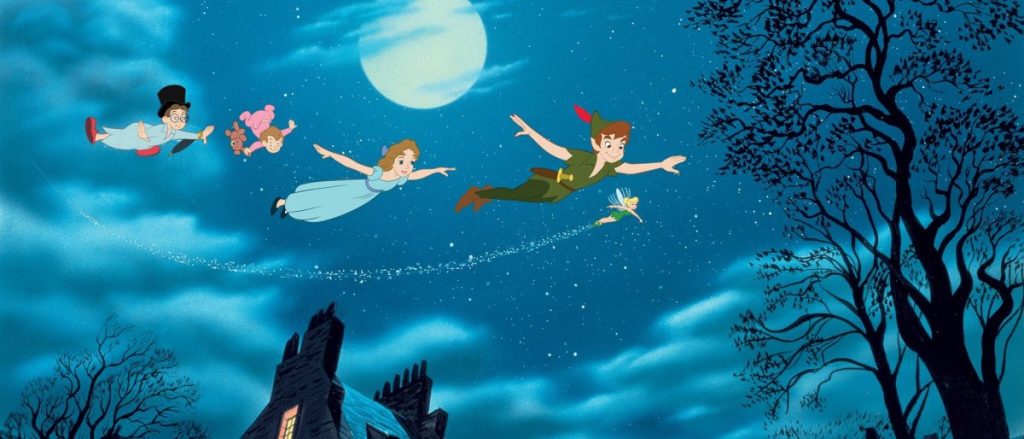
We all remember Peter Pan as the boy who could fly, fight pirates, and never grow up. To a child, he’s the ultimate fantasy — freedom, fun, and endless adventure. But rewatch it as an adult, and Neverland starts to feel different.
Beneath the laughter and fairy dust, there’s something deeply sad about a boy frozen in time, running from the very thing that makes us human: change.
Was Peter Pan truly a celebration of youth — or a story about emotional avoidance and grief? Let’s explore the real story behind J.M. Barrie’s most famous creation, and how Disney’s 1953 classic turned heartbreak into heroism.
The Origins of Peter Pan
Peter Pan was created by J.M. Barrie, a Scottish author and playwright born in 1860. His imagination was shaped by a haunting event — the death of his older brother David, who died in an ice-skating accident at 13. Barrie was six years old. His mother, devastated, found small comfort in believing that David would never grow up and would remain a boy forever. That idea would stay with Barrie for life.
Years later, Barrie befriended the Llewelyn Davies family — five young boys who became his muses and surrogate sons. Together they played elaborate make-believe games in Kensington Gardens, which inspired the first appearance of Peter Pan in The Little White Bird (1902), and later the full play Peter Pan; or, The Boy Who Wouldn’t Grow Up (1904).
“To die will be an awfully big adventure.” — J.M. Barrie
That famous line sounds whimsical until you know its origin. For Barrie, childhood and death were intertwined — both permanent states that ended pain, change, and growing up. Peter Pan wasn’t simply a mischievous boy; he was the embodiment of lost innocence frozen in time.
Neverland: Fantasy or Escape?
Neverland is one of literature’s most iconic dreamscapes — full of pirates, mermaids, fairies, and eternal youth. But beneath the glitter lies a darker truth. Neverland is not paradise; it’s stasis. Time doesn’t move. People don’t age. Nothing ever changes.
In Barrie’s world, imagination is both freedom and a trap. Peter can fly anywhere but refuses to move forward. The Lost Boys play make-believe because they have no memories of real mothers or lives. Neverland is escape — not liberation. It’s the mind of someone who can’t let go of childhood because reality hurts too much.
The Psychology of Peter Pan
The phrase “Peter Pan syndrome” was coined in the 1980s to describe adults who resist responsibility and emotional maturity. But Barrie captured the idea long before psychology had a term for it. His Peter is not heroic — he’s self-centred, forgetful, and incapable of empathy. He forgets his friends, his adventures, even Wendy. His eternal youth comes at the cost of connection.
Psychologically, Peter represents the fear of time — the wish to pause life before loss, heartbreak, or mortality can touch us. He’s what happens when joy becomes denial. And for Barrie, who lost his brother and struggled with belonging, that denial was both comfort and curse.
The Dark Undercurrent
The tragedy behind Peter Pan deepens when we look at the real Llewelyn Davies boys. They inspired Neverland — and they suffered their own heartbreak. George died in World War I. Michael drowned at Oxford. Two others struggled with mental health. Barrie outlived nearly all of them.
To some scholars, Peter Pan became Barrie’s way of keeping the boys alive. By immortalising them as Lost Boys who never aged, he could freeze a perfect moment of innocence. But it also meant the story could never end — because endings, like growing up, require letting go.
Peter’s refusal to age isn’t freedom — it’s grief disguised as magic.
Disney’s Version: From Tragedy to Technicolor
When Disney adapted Peter Pan in 1953, they transformed a melancholy meditation on childhood into a swashbuckling adventure. Peter became playful rather than tragic; Neverland became escapism rather than limbo. Yet even in its colourful form, traces of Barrie’s sadness remain. The ending — with Wendy watching Peter fly away while she grows up — still aches with unspoken loss.
Of course, the Disney version isn’t without flaws. The depiction of the “Indians” is painfully racist by modern standards, and the women are flattened into stereotypes — jealous, vain, or motherly. But at its heart, Disney’s Peter Pan still preserves the emotional truth that makes the story timeless: the impossibility of holding on to childhood forever.
What Peter Pan Really Teaches Us
Peter Pan is not simply a symbol of freedom — he’s a warning about what happens when we refuse to grow. J.M. Barrie wrote from the wound of loss, and through Peter, he gave that wound wings. Neverland may look magical, but it’s a world built on denial — where nothing ends, nothing heals, and nothing changes.
Growing up is painful, yes — but it’s also how we build meaning. Maybe that’s why Wendy chooses to return home while Peter stays behind. Because in the end, growing up doesn’t mean losing magic. It means learning how to keep a little of it with us as we move forward.
“When the first baby laughed for the first time, its laugh broke into a thousand pieces, and they all went skipping about, and that was the beginning of fairies.” — J.M. Barrie
Bonus FAQ
Who inspired Peter Pan?
The character was inspired by the Llewelyn Davies boys, whom J.M. Barrie befriended in London. Their games and imagination directly shaped the world of Neverland.
Was J.M. Barrie’s life really tragic?
Yes. Barrie lost his brother at a young age and outlived most of the boys who inspired Peter Pan. His writing often reflected themes of grief and suspended time.
What does Neverland represent?
Neverland represents both imagination and escapism — a timeless dream where childhood never ends, but neither does denial or loss.
Did Disney change the tone of the story?
Absolutely. Disney softened Barrie’s darker psychology into adventure and humour, though the core sadness still lingers beneath the magic.
When was Disney’s Peter Pan released?
1953.
Sources & Further Reading
- Barrie, J. M. Peter Pan; or, The Boy Who Wouldn’t Grow Up. London: Hodder & Stoughton, 1904.
- Birkin, Andrew. J. M. Barrie and the Lost Boys: The Real Story Behind Peter Pan. Yale University Press, 2003.
- Chaney, Lisa. Hide-and-Seek with Angels: A Life of J. M. Barrie. Arrow Books, 2005.
- Hollindale, Peter. “A Hundred Years of Peter Pan.” In Children’s Literature in Education 36, no. 3 (2005): 197-215.
- Jack, R. D. S. The Road to the Never Land: A Reassessment of J. M. Barrie’s Dramatic Art. Aberdeen University Press, 1991.
- BBC Arts. “The Tragic Real-Life Story Behind Peter Pan.” BBC Culture, 2019.
- The British Library. “J. M. Barrie and Peter Pan.”
- Smithsonian Magazine. “The Real Story Behind Peter Pan.”
These sources were consulted for historical accuracy and literary interpretation. Additional context was drawn from public domain editions of Barrie’s works and modern analyses of early 20th-century literature.


