It’s one of the most common questions people ask after revisiting Disney’s Alice in Wonderland as adults: was Alice actually on drugs?
Between the talking caterpillar puffing smoke rings, a mushroom that changes her size, and swirling, colour-drenched nonsense, it’s easy to see why this question still comes up seventy years later. But before we start handing out psychedelic mushrooms in teacups, let’s step back and look at where it all began — with a shy mathematician and a story told on a quiet summer’s day.
Who Was Lewis Carroll?
The man behind Alice was Charles Lutwidge Dodgson, better known by his pen name Lewis Carroll.
He was a lecturer in mathematics at Christ Church, Oxford, known for his love of puzzles, logic, and wordplay.
In 1862, Carroll took a boating trip with the Liddell family — including a curious young girl named Alice Liddell. To entertain her, he spun a story about a little girl who followed a white rabbit down a hole and tumbled into a world where logic bent back on itself. That tale became Alice’s Adventures in Wonderland (1865), followed by Through the Looking-Glass (1871).
Carroll lived in Victorian England — a time of strict manners, religious debate, and enormous social change. Though laudanum (an opiate-based medicine) was common in that era, there’s no credible evidence Carroll was using drugs or intended his story as a drug allegory. His “trips” were logical and linguistic, not chemical.
Enter Disney: Wonderland in Technicolor
When Walt Disney released his animated adaptation in 1951, it was bright, chaotic, and full of dreamlike sequences that felt far ahead of their time.
Audiences didn’t quite know what to make of it. The film wasn’t a huge hit at first — but by the 1960s, a new generation rediscovered it. Suddenly, Alice in Wonderland was being screened at “trip festivals” alongside lava lamps and psychedelic rock. It became an accidental counterculture icon.
Why? Because the way the animators portrayed Wonderland looked exactly like how people described psychedelic hallucinations.
The Mushroom and the Caterpillar
Scene: Alice meets a blue caterpillar lounging atop a mushroom, calmly smoking from a hookah. He asks, “Who are you?” and tells her that one side of the mushroom will make her grow and the other will make her shrink.
Why people think it’s about drugs:
It’s the most obvious symbol — a talking caterpillar on a mushroom that literally alters perception and size. The hazy smoke, the slow drawl of the Caterpillar’s voice, and Alice’s shifting form all resemble what we now associate with a “trip.”
The psychedelic connection:
Psilocybin mushrooms can cause hallucinations where objects seem to expand, shrink, or “breathe.” Users often describe altered self-perception, losing sense of scale, and profound questions about identity — all things Alice experiences here.
Carroll’s real meaning:
This scene isn’t about substances at all — it’s about growing up. Alice is caught between childhood and adulthood, feeling too small one moment and too big the next. The Caterpillar’s famous question, “Who are you?” speaks to her confusion over identity and the constant change of growing older.
The Cheshire Cat
Scene: A grinning cat fades in and out of sight, speaking in riddles like “We’re all mad here.”
Why people think it’s about drugs:
The disappearing grin, shifting colours, and reality-bending dialogue echo hallucinations and “deep thoughts” during psychedelic experiences.
The psychedelic connection:
People on LSD or mushrooms often report seeing objects morph, vanish, or pulse with colour. The Cat’s nonsensical wisdom feels like those “profound truths” that seem meaningful while tripping.
Carroll’s real meaning:
Carroll loved paradoxes. The Cat’s grin without a cat is a logical impossibility, like something existing and not existing at once. It’s also a satire of social madness — Carroll suggesting that everyone in society is a little mad, just in their own way.
The Mad Tea Party
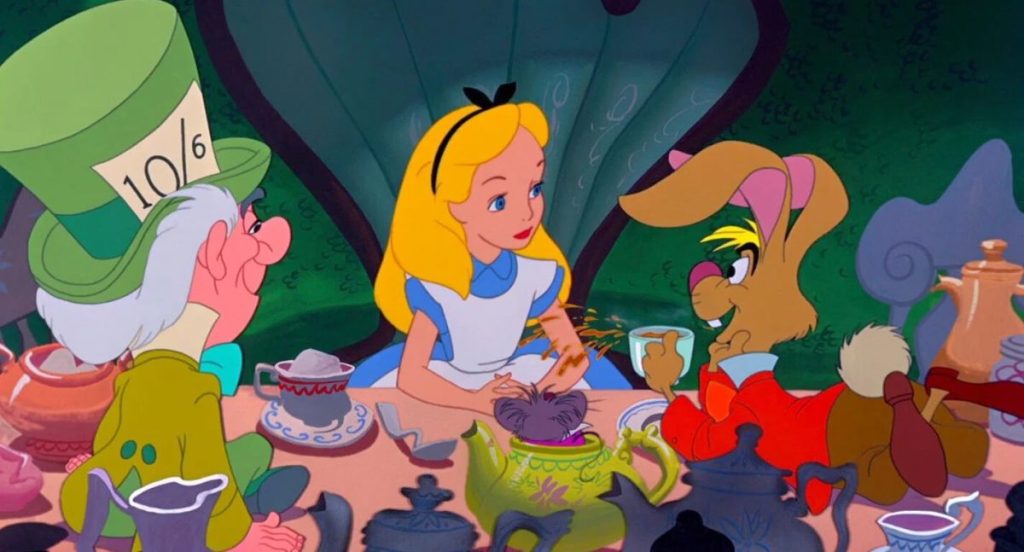
Scene: Alice sits down with the Mad Hatter and March Hare for a tea party that never ends. Time has stopped at six o’clock, and conversation loops endlessly.
Why people think it’s about drugs:
The chaotic chatter, constant laughter, and repetitive nonsense feel like a looping thought cycle — something that happens during a psychedelic trip.
The psychedelic connection:
During hallucinations, people can feel “stuck” in a moment, with time distorted or frozen. The tea party’s perpetual six o’clock mirrors that warped sense of time.
Carroll’s real meaning:
This is Carroll mocking Victorian etiquette. Tea time was a sacred social ritual, symbolising order and politeness. He flips it into chaos — a never-ending tea where manners are meaningless. It’s satire, not psychedelia.
The White Rabbit
Scene: The anxious White Rabbit hurries through Wonderland, muttering, “I’m late! I’m late!”
Why people think it’s about drugs:
“Following the white rabbit” has become slang for diving into altered consciousness — or into something unknown and mind-bending.
The psychedelic connection:
Entering Wonderland is like entering a trip: curiosity drives Alice deeper into an unfamiliar mental space, where logic breaks down and reality twists.
Carroll’s real meaning:
The Rabbit represents time and anxiety — the adult world’s obsession with punctuality and productivity. Alice’s chase is symbolic of curiosity, but also the first step away from childhood’s freedom into the regimented logic of adulthood.
The Queen of Hearts
Scene: A temperamental queen who shrieks “Off with their heads!” at the slightest offence.
Why people think it’s about drugs:
Some see her as the embodiment of a “bad trip” — chaotic, overwhelming, and threatening.
Carroll’s real meaning:
She’s a caricature of irrational authority. Carroll, a mild-mannered academic, had little patience for the absurd hierarchies of Victorian power. The Queen represents those in charge who act without reason or compassion.
Wonderland as a Whole
The entire story feels like a dream where logic collapses — language turns inside out, animals talk, and meaning constantly shifts. It’s no wonder people later saw it as a metaphor for psychedelic experience.
But Carroll’s Wonderland isn’t about escaping reality — it’s about understanding it differently. His genius was turning childhood confusion into fantasy. Instead of teaching children the rules of the world, he showed how absurd those rules could be.
The Real “Trip”: Language, Logic, and Growing Up
Carroll wasn’t tripping on mushrooms — he was tripping on language.
He delighted in paradox, wordplay, and mathematical riddles. Wonderland is full of logical impossibilities that invite readers to question what “makes sense.”
Even Alice’s identity crisis — shrinking, growing, and asking “Who am I?” — reflects the universal experience of growing up and trying to fit into a world that often makes no sense.
The 1960s Rebirth: When Wonderland Got Psychedelic
A century after the book’s release, the 1960s counterculture rediscovered Alice in Wonderland. Young people experimenting with LSD and mushrooms found uncanny parallels with Carroll’s world: the dissolving boundaries of self, the paradoxical wisdom, the rebellion against authority.
Jefferson Airplane even immortalised it in their 1967 hit “White Rabbit”:
One pill makes you larger, and one pill makes you small…
Disney’s colourful, kaleidoscopic animation — once criticised as too strange — suddenly made sense to a new audience. Wonderland had accidentally become a visual metaphor for psychedelic exploration.
So… Was Alice on Drugs?
Not in the way people think.
Lewis Carroll wasn’t hinting at opium, LSD, or magic mushrooms. He was exploring curiosity, confusion, and identity through logic, language, and imagination.
But the reason the drug theory endures is simple: the human mind under pressure — whether by imagination or by chemicals — often conjures the same images. Distortion, wonder, nonsense, and transformation.
In the end, Carroll didn’t need a mushroom to create Wonderland. His imagination was wild enough on its own.