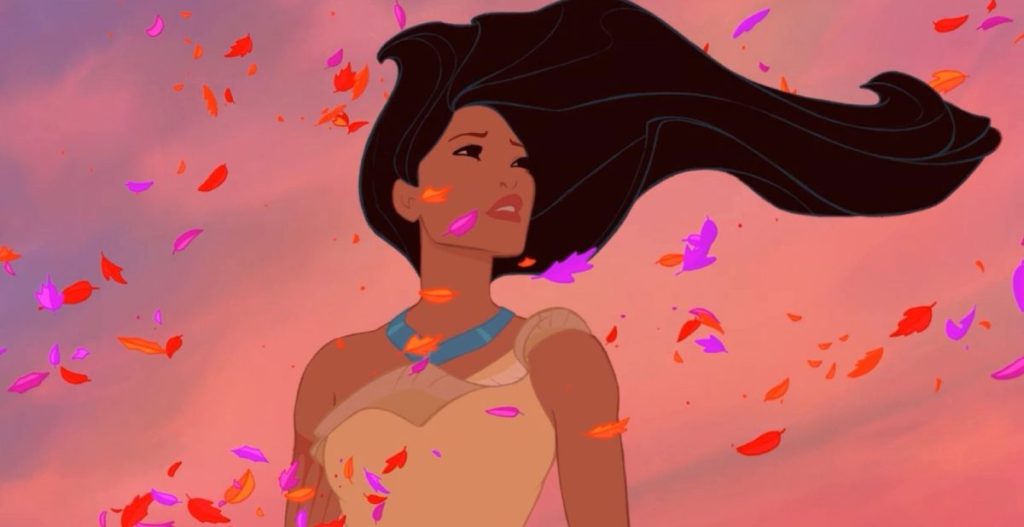
When Disney released Pocahontas in 1995, it was billed as the studio’s most mature and dramatic animated film to date. The animation was lush, the soundtrack soared with Oscar-winning songs, and the romance between the Powhatan princess and English explorer John Smith captivated audiences.
But beneath the artistry lies one of Disney’s most controversial retellings. The true story of Pocahontas is far from a sweeping love ballad — it’s a tale of colonisation, cultural clash, and tragedy. Let’s take a closer look at how the Disney classic compares with history.
What is Disney’s Pocahontas about?
The film follows Pocahontas, the spirited daughter of Chief Powhatan, as she explores her identity and her people’s relationship with nature. When English settlers land in Virginia, Pocahontas encounters John Smith and they fall in love despite their differences.
Together they attempt to bring peace between their peoples, clashing with her father and the greedy Governor Ratcliffe. The film ends with Pocahontas saving Smith’s life and choosing to remain with her people rather than sail to England.
It’s a story of forbidden love, cultural understanding, and the power of nature — but also a highly sanitised version of colonial history.
Who was the real Pocahontas?
The woman we know as “Pocahontas” was born around 1596, the daughter of Wahunsenacawh, better known as Chief Powhatan, who ruled over the Powhatan Confederacy in what is now Virginia.
Her real name was Amonute, though she was also called Matoaka. “Pocahontas” was a nickname that meant something like playful one or mischievous child.
Far from the adult Disney heroine, the real Pocahontas was about 10 to 12 years old when the English first arrived in 1607.
Disney’s romantic story vs. real events
In the film, Pocahontas and John Smith share a sweeping romance, complete with secret meetings and soaring duets. This central love story is one of Disney’s biggest inventions.
Historically, there is no evidence of a romantic relationship between Pocahontas and Smith. Their bond — if it existed at all — was more likely one of cautious curiosity than passion. The real Pocahontas was a child, not a woman of marriageable age.
By ageing her up and creating a love story, Disney transformed a tale of colonial power struggles into a romantic narrative more palatable for family audiences.
The portrayal of John Smith
Disney presents John Smith as brave, golden-haired, and noble, a man who learns to respect the land and its people through his love for Pocahontas.
In reality, John Smith’s reputation is more complicated. His own writings claimed Pocahontas once saved his life from execution, but many historians believe he exaggerated or fabricated the story. Smith was also known for arrogance and embellishment, and his accounts of his adventures were often self-serving.
Disney’s version simplifies him into a romantic hero, brushing aside the darker truths of colonisation.
What really happened to Pocahontas?
The real story is far more tragic than Disney’s ending.
In 1613, Pocahontas was kidnapped by English settlers during a conflict with her people. Held for ransom, she converted to Christianity and was renamed Rebecca. During captivity, she married John Rolfe, a tobacco farmer, which helped ease relations between the English and the Powhatan Confederacy for a time.
In 1616, she travelled to England, where she was presented to English society as proof of a “civilised savage.” She never returned home. In 1617, on the eve of her return voyage to Virginia, she died at Gravesend at around 21 years old.
FYI: We lost Pocahontas’ bones. Yup. Britain lost Pocahontas. Multiple people have called for her return to her homeland, many people have spent thousands attempting to recover her grave but… we lost her. Colonisation at its finest.
Why is Disney’s Pocahontas so controversial?
The film has faced criticism since its release.
- It romanticises a child into a love interest for John Smith.
- It downplays the violence of colonisation and the exploitation of Indigenous peoples.
- It perpetuates stereotypes, presenting Native Americans as “noble savages” living in harmony until Europeans arrive.
- It rewrites a story of kidnapping, forced conversion, and tragedy into one of mutual understanding and happy endings.
While some viewers appreciate the film for its music, artistry, and attempts at multicultural themes, many Indigenous voices argue that it distorts history in harmful ways.
Legacy of the film
Despite the controversies, Pocahontas remains part of the Disney Renaissance era. It won two Academy Awards for its music (Colors of the Wind and Best Original Score) and introduced many children to the name Pocahontas, even if the real story was far more complex.
Today, the film is often revisited through a critical lens, serving as a reminder of how entertainment can reshape historical memory.
Final Thoughts
Disney’s Pocahontas is visually stunning and musically rich, but when it comes to history, it strays far from reality. By transforming a young girl caught in the crossfire of colonisation into a romantic heroine, the film obscures the true struggles faced by Pocahontas and her people.
The real story is not a fairy tale — but by looking beyond the animation, we can honour Pocahontas for who she truly was: a young woman whose short life was caught between two worlds during one of history’s most turbulent moments.
Sources & Further Reading
- Camilla Townsend, Pocahontas and the Powhatan Dilemma (2005)
- Helen C. Rountree, Pocahontas, Powhatan, Opechancanough: Three Indian Lives Changed by Jamestown (2005)
- David A. Price, Love and Hate in Jamestown (2003)
- Smith, John. The Generall Historie of Virginia, New-England, and the Summer Isles (1624)
- National Park Service – Pocahontas: Her Life and Legend
- Historic Jamestowne – Biography of Pocahontas