In all of the Y2K trends, there is something slightly amiss… everything looks too clean.
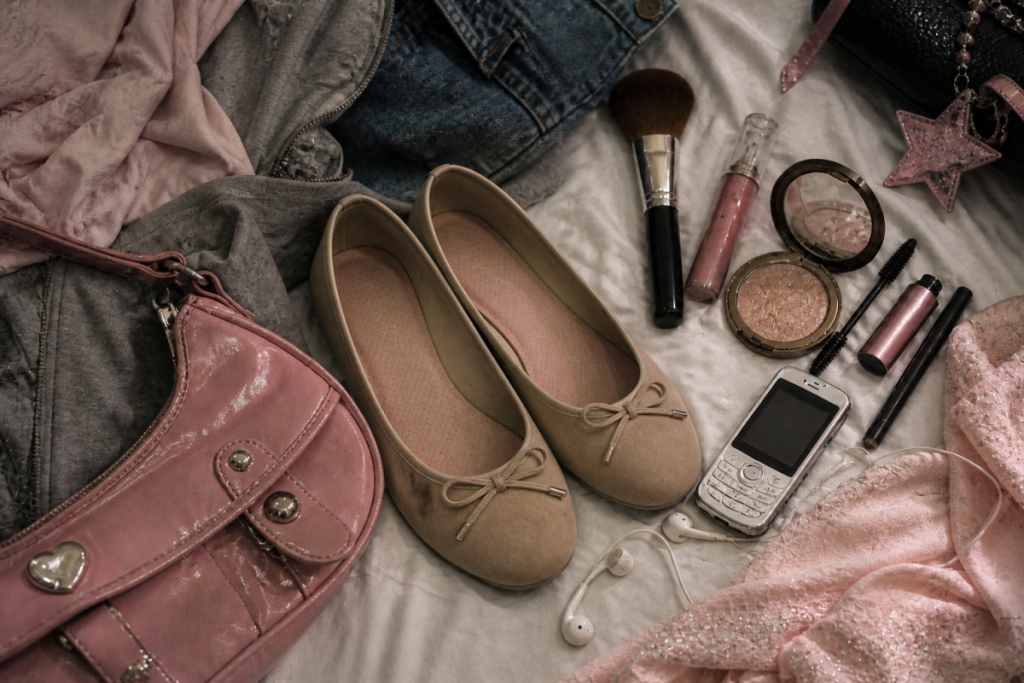
If you lived through the 2000s you may remember the muddy makeup, the smelly ballet flats, the cheap synthetic clothing that never dried properly and mysteriously smelt damp all the time.
So why was the first half of the 2000s so smelly?
Because it wasn’t just in our heads.
The Era of “Product Overload” (But Not Good Products)
2010 sat in a really awkward in-between moment. We had access to beauty products, but not good ones in the way we do now.
Haircare was absolutely drenched in mousse, wax, and hairspray. The goal wasn’t softness or health—it was hold. Crunchy curls, stiff layers, heavy fringe shaping. You’d style your hair into place and then essentially shellac it there.
The problem is, those products didn’t absorb or disappear. They sat on the hair. They built up. And unless you were doing a proper clarifying wash (which most people weren’t), it just layered over time.
So even freshly washed hair could look… tired.
Add in heat damage from straighteners that were used daily with little to no protection, and you ended up with that signature look: dry ends, greasy roots, and a texture that never quite made sense.
Makeup That Wasn’t Designed for Skin
Makeup in 2010 was heavy in all the wrong ways.
Foundations were often matte but not breathable. Dream Matte Mousse, we are looking at you girl. They clung to dry patches, separated around the nose, and oxidised into that slightly orange, muddy tone we all recognise in old photos.
Contour wasn’t really a thing yet in the mainstream, but bronzer absolutely was—and it was often applied generously and without much blending. Pair that with thick eyeliner, heavy mascara, and powder that sat on top of the skin rather than melting into it, and everything just looked… dense.
There was no “skin-like finish.” No glow. No hydration.
Just layers.
The Ballet Flats Situation (We All Know)
We need to talk about the shoes.
Specifically: the ballet flats.
Everyone had them. Usually from somewhere like Primark for £4. Usually worn without socks. Usually made of that thin, slightly plasticky material that looked cute for about five minutes and then immediately betrayed you.
They didn’t breathe. At all.
So you’d wear them all day (in my case an 8 hour retail shift), your feet would get warm, there was no airflow, and by the time you took them off… yeah. There’s a reason this is such a shared memory.
And because they were cheap and constantly on rotation, they didn’t get the kind of care or airing out that might have saved them. They just existed in this permanent cycle of wear → slight dampness → repeat.
Then you had the “tricks and tips” such as putting talc in the shoes to absorb the sweat and making even more of a mess.
If 2010 had a smell, ballet flats were definitely contributing.
The “Effortless” Look That Took Too Much Effort
This is where it gets ironic.
A lot of the 2010 aesthetic was trying to be casual. Messy buns, undone waves, smudged eyeliner, “I just threw this on” outfits.
But the reality? It took work to look like that.
Hair was backcombed, sprayed, pinned, and pulled apart. Eyeliner was intentionally smudged but still carefully applied. Clothes were layered in a way that was meant to feel thrown together but was actually quite deliberate.
And when you combine heavy products with a deliberately “undone” finish, you land right in that uncanny space where everything looks slightly off.
Not polished. Not natural. Just… somewhere in between.
Fast Fashion and Fabric That Didn’t Breathe
Let’s talk about the clothes for a second.
A lot of early 2010s fashion leaned heavily into cheap, synthetic fabrics. Polyester, acrylic blends, clingy jersey materials that trapped heat and didn’t allow airflow.
You’d have tight layering—vest tops under tops, cardigans over everything, scarves as accessories rather than necessity—and none of it really breathed.
And the worst part? Everything took forever to dry. Radiators full of damp clothes, slightly thick fabrics holding onto moisture, that faint smell that never quite left no matter how “clean” something was.
So even when things were freshly washed, they didn’t feel fresh.
You were basically living in a constant state of low-level damp.
We Didn’t Know What We Know Now
This is probably the biggest piece.
We didn’t have the same level of accessible knowledge around skincare ingredients, hair health, product build-up, or even hygiene routines beyond the basics.
There was no TikTok breaking down why your scalp needed exfoliating. No widespread conversation about double cleansing. No easy access to ingredient transparency or tailored routines.
You used what you had. You followed what magazines said. You copied what your friends were doing.
And collectively, we were all just a bit… off.
So Did 2010 Actually Smell?
Not literally.
But it felt like it did. Because everything around us did.
It was the combination of heavy products, low-quality formulas, synthetic fabrics, questionable footwear choices, and an aesthetic that sat awkwardly between polished and undone.
It was a time before everything became hyper-refined, hyper-informed, and hyper-optimised.
And that slightly grimy, damp, unfinished feeling?
That was the texture of the era.