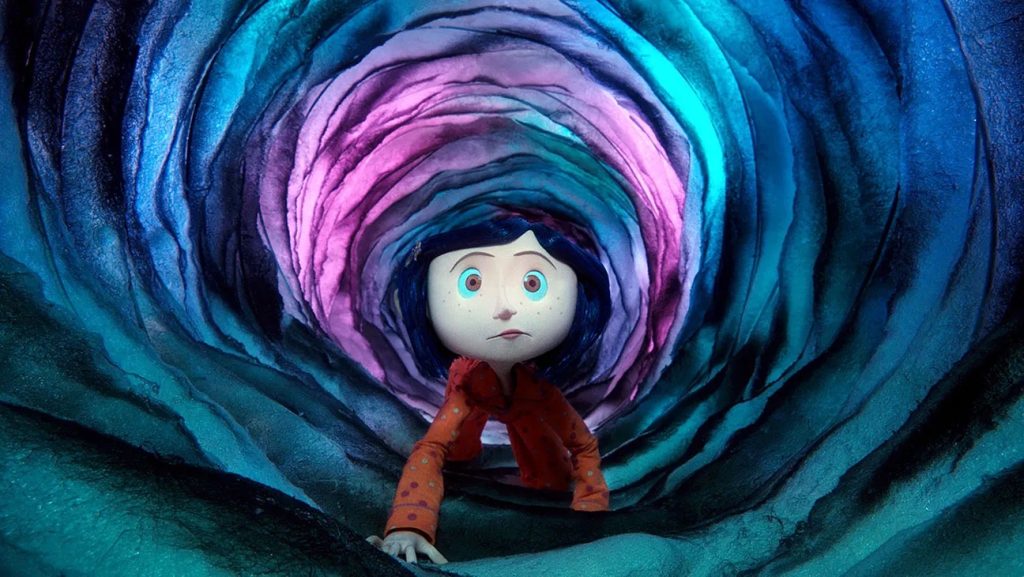
There’s something uniquely unsettling about Coraline. Not loud horror, not jump scares — but that slow, creeping feeling that something isn’t quite right. Both the original book by Neil Gaiman and the film adaptation directed by Henry Selick tell the same story on the surface.
A bored, lonely girl. A hidden door. A better world that turns out to be anything but.
But the deeper you look, the more the two versions begin to diverge — and nowhere is that difference more powerful than in the Other Mother.
Two Versions of the Same Story
At their core, both versions of Coraline follow the same structure. Coraline discovers a parallel world where everything seems improved: her parents are attentive, the food is better, the world is more colourful and alive.
But it’s a trap.
And while that idea remains consistent, the way each version builds that trap feels completely different.
The book is quiet. It relies on suggestion, on unease, on the sense that something is wrong long before it’s confirmed. The film, on the other hand, leans into spectacle — it dazzles you first, then pulls the rug out from under you.
Neither approach is better. They just speak in different languages.
Coraline Herself
Even Coraline feels slightly different between versions.
In the book, she is younger, quieter, and more introspective. Her bravery feels like something she has to grow into. She doesn’t perform it — she discovers it.
In the film, she’s more expressive. More openly frustrated. More sarcastic. Her loneliness is louder, which makes the temptation of the Other World feel more immediate.
It also makes her easier to read — and that matters, because in the film, she’s not alone in the same way.
Wybie and the Loss of Isolation
One of the most noticeable changes is the addition of Wybie — a character who doesn’t exist in the book.
His presence gives Coraline someone to talk to, someone to bounce off, someone to share the experience with. It makes the story more accessible, especially for younger viewers.
But it also softens something important.
In the book, Coraline is alone.
That isolation is part of the horror. There’s no one to validate what she’s seeing, no one to help her process it. The silence makes everything feel heavier, more claustrophobic.
The film trades some of that isolation for connection — and in doing so, slightly reshapes the emotional weight of the story.
The Cat: A Quiet Constant
One thing that remains across both versions is the cat.
In the book, he’s distant, almost unknowable. He helps Coraline, but never fully aligns himself with her. He exists outside the rules of both worlds, moving between them with ease, understanding far more than he ever explains.
In the film, he’s warmer, more present, and a little more humorous — but he still carries that same sense of knowing.
He’s one of the only beings who understands the Other Mother.
And survives her.
The Other Mother: Where Everything Changes
This is where the two versions truly split.
In the book, the Other Mother is quiet. Still. Controlled. She doesn’t need to impress Coraline — she simply exists, offering comfort in a way that feels just slightly wrong. Her kindness feels practised, not genuine. Like something rehearsed over and over again.
She doesn’t explain herself. She doesn’t rush. And she doesn’t need to.
She feels ancient.
Her horror comes from patience. From inevitability. From the sense that she has done this before, and will do it again.
In the film, she is something else entirely.
She performs.
She builds entire spectacles to impress Coraline — blooming gardens, theatrical shows, vibrant worlds designed to overwhelm the senses. She adapts to Coraline, studies her reactions, and escalates her efforts to keep her engaged.
And when Coraline resists, she changes.
The warmth disappears. The world decays. And her true form is revealed in something far more dramatic, far more monstrous, and far more personal.
Where the book’s Other Mother is a quiet predator…
The film’s is a manipulator.
The Doll: How She Knows
And this is where things become truly unsettling.
Because the Other Mother doesn’t just tempt Coraline.
She knows her.
In both versions, Coraline’s doll appears in the real world — a small, almost insignificant object that mirrors her exactly. But it isn’t just a toy.
It’s a tool.
In the film, this is made explicit. The doll watches Coraline, follows her, gathers information. It’s how the Other Mother learns about her life.
And once you realise that, something clicks into place.
The Other Mother didn’t guess what Coraline wanted.
She saw it.
The Gloves: A Small Detail That Changes Everything
There’s a moment that seems minor, almost throwaway — Coraline wanting the gloves in the shop.
It’s not a big wish. Not something life-changing. Just a small, private disappointment.
And yet, in the Other World, the Other Mother knows about them.
That’s the moment where the horror deepens.
Because it means she didn’t just observe Coraline at home. She saw her out in the world. In a random, ordinary moment that should have been private.
She saw what Coraline wanted.
She saw how she felt.
And she used it.
Control vs Consumption
The difference between the two versions of the Other Mother comes down to this:
In the book, she feels instinctive. Like a creature that collects, traps, and consumes. Coraline is not special — she is simply the next.
In the film, she feels intentional. Focused. She studies Coraline specifically, builds a world around her desires, and actively tries to win her over.
One is a force of nature.
The other is a calculated manipulator.
Why It Feels So Unsettling
Because the Other Mother crosses a boundary most stories don’t.
She doesn’t just exist in her own world.
She reaches into yours.
She watches. Learns. Adapts.
By the time Coraline opens the door, the Other Mother already knows exactly who she is — what she wants, what she’s missing, and what it will take to keep her.
Final Thought
Both versions of Coraline tell the same story, but they leave you with different fears.
The book leaves you wondering if something ancient is still out there, waiting patiently for the next child to find the door.
The film leaves you with something more personal.
The idea that something has already been watching you — quietly, carefully — learning what you want…
And building a world designed just for you.