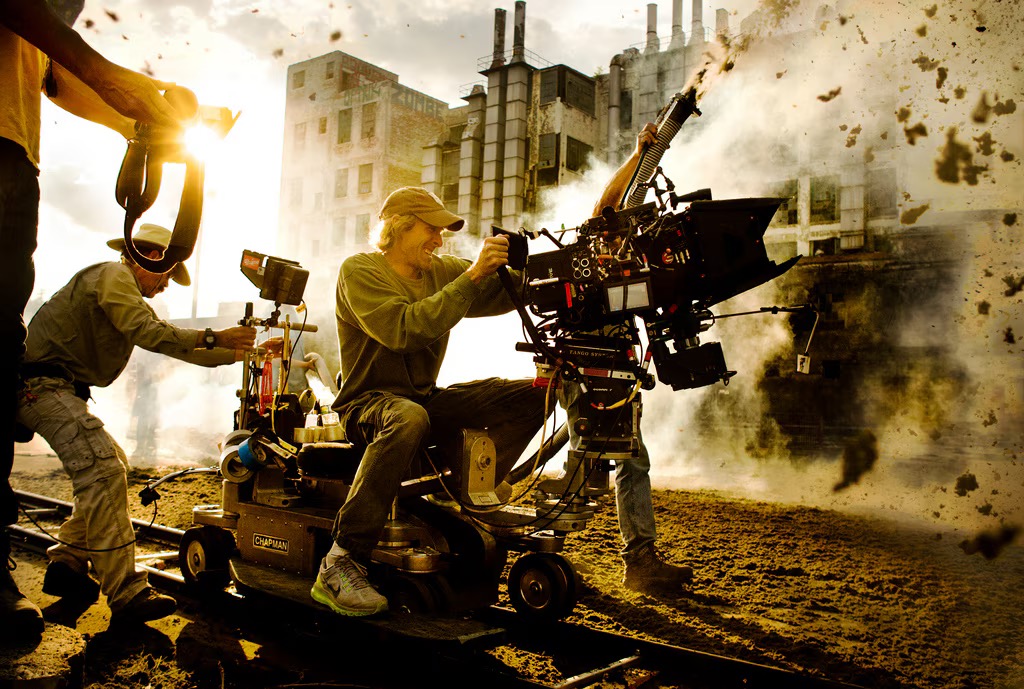
Remember watching a movie that had ten explosions per scene, cool automobiles and at least one hero scene where the star of the movie emerges from a wall of fire? Yep, that was the Michael Bay era.
It was the time when a Michael Bay film didn’t just release — it arrived like an event. His name alone told audiences exactly what they were about to experience: huge explosions, glossy visuals, dramatic slow motion, and a kind of cinematic excess that felt almost rebellious in its refusal to be subtle.
For a while, that was blockbuster cinema.
So what changed?
The Era of Controlled Chaos
In the late 90s and early 2000s, Bay carved out a very specific identity. Films like Bad Boys, The Rock, and Armageddonweren’t just action films — they were experiences. They moved fast, they looked expensive, and they leaned fully into spectacle without apology.
Critics often pushed back, but audiences didn’t care. These films were endlessly watchable. They had personality, quotable moments, and just enough emotional grounding to keep everything from feeling empty.
Bay understood something fundamental: cinema could be overwhelming in a way that felt good.
Transformers: The Turning Point
When Transformers released in 2007, it felt like a perfect match. Bay’s style met cutting-edge CGI, and suddenly he had the tools to go even bigger than before. The first film struck a balance — chaotic, yes, but still anchored by recognisable characters and clear stakes.
Then came the sequels.
Each instalment pushed further into spectacle. More robots, more destruction, more visual noise. But as the scale increased, clarity often decreased. The action became harder to follow, the emotional beats thinner, and the films began to feel less like stories and more like extended set pieces.
What started as thrilling gradually became exhausting.
Audience Expectations Shifted
The real shift wasn’t just about Bay — it was about the audience.
By the 2010s, blockbuster cinema had evolved. Viewers still wanted scale, but they also wanted cohesion. The rise of long-form storytelling, especially through shared cinematic universes, changed what people expected from big-budget films. Spectacle alone wasn’t enough anymore; it needed to be tied to character arcs and narrative payoff.
At the same time, other directors were redefining action. Films began to favour clarity over chaos, intentionality over excess. Even when they were loud, they were structured in a way that made them easier to follow and emotionally invest in.
Bay’s style didn’t disappear — it just stopped aligning with where mainstream cinema was heading.
The Problem with “Bayhem”
There’s a term often used to describe his approach: “Bayhem.”
It’s that signature mix of rapid cuts, spinning cameras, overlapping explosions, and relentless movement. At its best, it’s exhilarating. At its worst, it becomes visual overload.
Earlier in his career, Bay balanced this well. There were clear focal points, strong visual compositions, and moments of stillness that grounded the chaos. But as technology advanced and CGI became more dominant, that balance shifted. The frame became busier, and the audience had less space to orient themselves within it.
The result was something that looked impressive but sometimes felt disconnected.
He Didn’t Disappear — He Stepped Aside
Michael Bay never really went away. He simply moved out of the centre of the conversation.
Projects like Pain & Gain showed a different, more character-driven side of him. 13 Hours leaned into a grittier, more restrained tone. Even later action films like Ambulance demonstrated that when the scale is tightened, his style can still feel sharp and engaging.
He also transitioned more into streaming-era filmmaking, where success doesn’t always translate into the same cultural visibility as a theatrical blockbuster.
So What Actually Happened?
The simplest answer is this: Michael Bay didn’t fundamentally change — cinema did.
The industry shifted toward interconnected storytelling, tighter scripts, and action that prioritises clarity. Bay remained committed to excess, to sensory overload, to a style that was once dominant but is now more niche.
And that doesn’t make his work irrelevant. If anything, it makes it distinct.
Final Thought
There’s something almost refreshing about a Michael Bay film now.
In an era where so many blockbusters feel carefully engineered, his films still feel chaotic, impulsive, and unapologetically loud. They don’t always land, but they never feel restrained.
And maybe that’s the real answer.
Michael Bay didn’t fade away.
He just became a reminder of a time when bigger was better, louder was the point, and going to the cinema meant being completely, unapologetically overwhelmed.