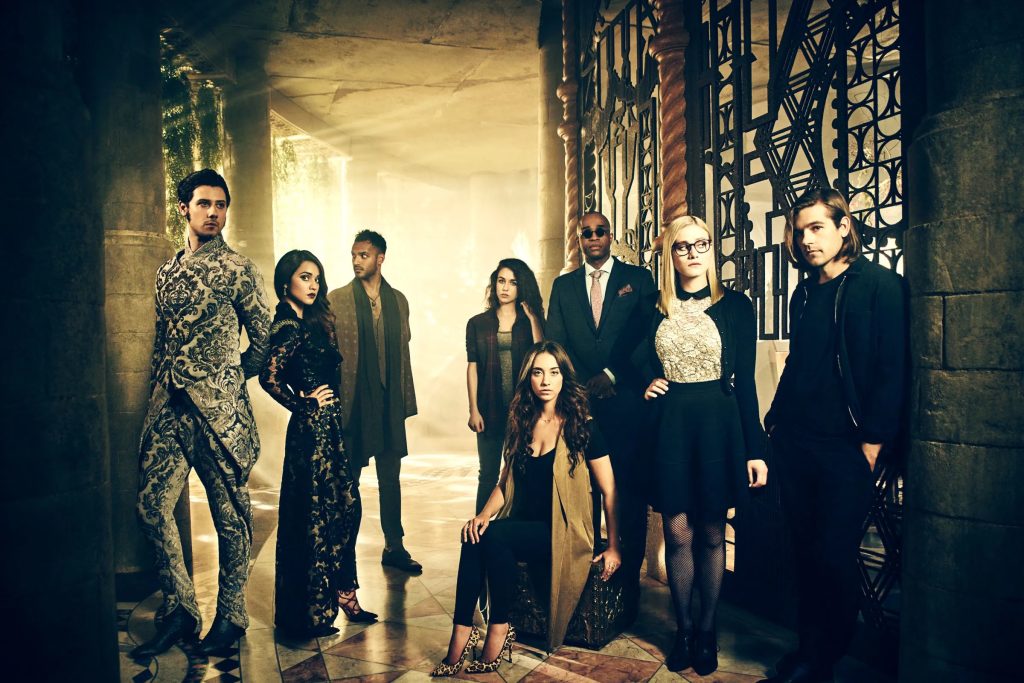
Ever watched The Magicians and thought, “Hang on… I’ve seen this before”? You’re not imagining it.
The first time I watched the series I couldn’t stop comparing it to The Chronicles of Narnia. At first I assumed it was just giving off similar fantasy vibes, but the more I watched, the more obvious the parallels became.
Eventually I looked it up.
Turns out author Lev Grossman has openly said that Narnia was one of the biggest inspirations behind The Magicians.
So no—you’re not crazy. Fillory really is heavily inspired by Narnia.
Let’s look at the evidence.
1. The magical world
This is the obvious one.
Narnia has… well… Narnia.
The Magicians has Fillory.
Both are magical kingdoms filled with talking animals, mythical creatures, ancient magic, royalty, prophecies and world-ending threats. Both are places the protagonists dreamed about long before discovering they were real.
2. The children already know about it
Before Quentin ever visits Fillory, he’s obsessed with the Fillory and Further books.
Just like generations of readers grew up wishing they could visit Narnia, Quentin grows up wishing Fillory existed.
The books inside The Magicians serve almost exactly the same role that The Chronicles of Narnia does for us.
3. The Chatwins are basically the Pevensies
The fictional Chatwin children are remarkably similar to the Pevensie siblings.
A group of English children.
Sent away from home.
Discover a magical world.
Become heroes.
Return changed forever.
It’s difficult to miss the inspiration.
4. You enter through furniture
Narnia famously begins with a wardrobe.
Fillory?
A grandfather clock. And then other seemingly ordinary items become magical, much like the Pevensies disappearing through a subway or a painting.
It’s a different piece of furniture, but the same basic idea: an ordinary household object becomes the doorway to another world.
5. The in-between world
One of the biggest moments that made me laugh was discovering the Neitherlands.
In The Magicians, magical fountains each lead to different worlds.
If that sounds familiar, it’s because The Magician’s Nephew features the Wood Between the Worlds, where each pond/pool leads to another universe. This is where the original children who visit Narnia — and witness its birth — try to trap Queen Jadis before accidentally taking her to Narnia, where she would go on to become the White Witch.
It’s essentially the same concept with different scenery.
6. Magic transport
Even the way people travel echoes Lewis.
Characters in The Magicians use magical buttons to move between worlds.
Lewis used magical rings in his first book.
Different objects.
Same storytelling purpose.
7. Not everyone gets to come back
One of the saddest themes in both series is that magical worlds aren’t places you can visit forever.
Eventually, some characters realise they can never return. While Susan is said to have grown beyond Narnia, the strong Christian story in the books lead many to believe that she has fallen out of grace with Narnia because she stopped believing in God or living by Christian values.
In Fillory however, Quentin Chitin can no longer return after he sacrifices his kingship and is forced to leave. Martin Chitin is so desperate to stay and escape the terrible reality he is living in that he goes on to become the villain of the world.
While there are different outcomes, that bittersweet feeling—that childhood magic can’t last forever—is central to both stories.
8. The adults are… different
This is where The Magicians deliberately goes in the opposite direction.
C. S. Lewis filled Narnia with wise, trustworthy adults. The worst people we come across are from other worlds bought into Narnia through various means of magic. For these examples we have the aforementioned Jadis and Uncle Andrew. Fillory has Christopher Plover.
In The Magician’s Nephew, Uncle Andrew represents humanity at its most selfish. Obsessed with power and magical discovery, he manipulates children into carrying out dangerous experiments, convinced that ordinary moral rules simply don’t apply to him.
Christopher Plover feels like that same archetype taken to its darkest possible conclusion.
Like Uncle Andrew, he exploits children to satisfy his own desires, but Grossman amplifies those traits into something far more disturbing, turning a morally corrupt adult into an outright abuser. It’s another example of The Magicians taking a familiar Narnia character type and reimagining it through a much darker, adult lens.
Lev Grossman asks:
“What if the adults were deeply flawed instead?”
Instead of noble mentors, The Magicians gives us emotionally damaged professors, questionable authority figures and adults who often make terrible decisions.
It’s almost like someone took Narnia and filtered it through adulthood.
9. It’s Narnia after growing up
This is probably the biggest difference between the two series.
Narnia is about childhood wonder.
The Magicians asks what happens when those children become adults carrying depression, trauma, messy relationships and impossible expectations.
It’s less interested in escaping reality than asking why we want to escape it in the first place.
Lev Grossman has openly talked about the inspiration
The similarities aren’t accidental.
Grossman has said that writing The Magicians was partly about coming to terms with the fact that he would never get to visit Narnia or Hogwarts. He has also said that while writing the novel he kept a stack of the Narnia books beside his desk. In another interview, he explained that his work on The Magicians really began when he first picked up The Lion, the Witch and the Wardrobe as a child, and that he has always been deeply drawn to C. S. Lewis’s writing.
He’s also spoken about wanting to respond to Lewis’s ideas about childhood and adulthood, rather than simply imitate them.
So if you’ve spent the whole series thinking, “This feels suspiciously like Narnia,” congratulations.
That was entirely intentional.
In many ways, calling The Magicians a copy of Narnia seems unfair.
It’s more accurate to call it a conversation with Narnia.
Lev Grossman takes many of the ideas that made C. S. Lewis’s world unforgettable—hidden magical kingdoms, portals, child heroes and impossible adventures—and asks what those stories might look like if they happened to flawed adults instead.
Once you notice the similarities, it’s almost impossible to unsee them.
This post is based primarily on the TV show series 1 and is not a full overview of the lore or complete series of books or series.