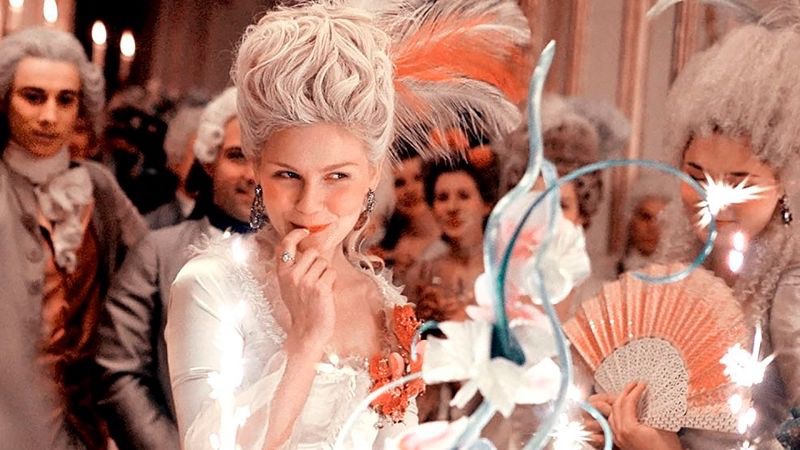
Sofia Coppola’s 2006 film Marie Antoinette has always divided audiences. Some people see it as a beautiful but shallow fashion show set to indie music. Others see it as one of the most human portrayals of Marie Antoinette ever put on screen.
After revisiting the film, I found myself asking a different question: just how much of it actually happened?
The answer surprised me. While Coppola takes plenty of artistic liberties, many of the moments that seem too strange to be true are actually rooted firmly in history. I decided to answer it based upon major scene, characters and plot lines that made me wonder, and have given them a rating out of 10 for their historical accuracy!
The Border Handover Ceremony
One of the earliest scenes shows Marie Antoinette arriving at the French border and being told she must leave everything Austrian behind. Her clothes are removed, her attendants are dismissed, and she is effectively transformed into a French princess before she even meets her future husband.
As dramatic as it feels, this really happened.
When the fourteen-year-old Austrian archduchess crossed into France in 1770, she underwent a formal handover ceremony. Austrian possessions were removed, Austrian attendants left her service, and she emerged on the French side as the Dauphine of France. The symbolism was important. The girl who had been Maria Antonia of Austria was expected to disappear. From that point onwards, she would be Marie Antoinette of France.
The film captures the loneliness of this moment remarkably well.
Historical Accuracy: 8.5/10
Was Versailles Really Such a Culture Shock?
The film presents Versailles almost as another world. Marie Antoinette wanders through gilded halls looking overwhelmed by the scale and extravagance of it all.
The reality is slightly more complicated. Marie Antoinette was already a princess. She grew up surrounded by wealth, palaces, servants and ceremony. Gold walls and elaborate gowns would not have shocked her.
What likely did shock her was Versailles itself.
The French court operated on a level of ritual that was extraordinary even by eighteenth-century standards. Every aspect of daily life was governed by etiquette. People watched you wake up, watched you eat, watched you get dressed, and watched you go to bed. Rank determined who could hand you a garment or enter a room. Privacy barely existed.
The film suggests she was overwhelmed by the luxury. In reality, she was probably overwhelmed by the rules. We can see this herself when she remarks how ridiculous it is that she must stand naked waiting to be dressed by the correct person.
Historical Accuracy: 8/10
The Marriage That Wasn’t Consummated
One of the central themes of the film is the failure of Marie Antoinette and Louis to produce an heir. This is absolutely accurate.
Marie Antoinette and the future Louis XVI married in 1770, but their marriage was not consummated for around seven years (historians estimate). The issue became a source of gossip throughout Europe. Ambassadors reported on it. Courtiers speculated about it. Marie Antoinette’s mother worried about it constantly.
The exact reason remains debated. Older historians often blamed a physical condition suffered by Louis, while many modern historians believe awkwardness, anxiety, youth and immense pressure were more likely explanations.
Whatever the cause, the pressure shown in the film was very real.
Historical Accuracy: 9/10
The Letters From Maria Theresa
Throughout the film, Marie Antoinette receives letters from her mother urging her to secure the marriage and produce an heir.
If anything, the film understates this.
Maria Theresa was not simply a worried mother. She was one of the most powerful rulers in Europe and had effectively sent her daughter to France as part of a diplomatic alliance. She received regular reports from the Austrian ambassador and closely monitored Marie Antoinette’s marriage, spending, friendships and behaviour.
Some of the surviving correspondence is surprisingly blunt. Modern readers might find it invasive, but producing children was viewed as part of Marie Antoinette’s duty.
The pressure she experienced was immense.
Historical Accuracy: 10/10
Madame du Barry and the Silent Feud
The tension between Marie Antoinette and Madame du Barry is another area where the film closely follows history.
Madame du Barry was the mistress of Louis XV and occupied an awkward position at court. Many nobles considered her socially inferior despite her influence with the King. For months, Marie Antoinette refused to speak to her.
This became a diplomatic issue. Eventually, after significant pressure, Marie Antoinette finally addressed her with the famously underwhelming line:
“There are a great many people at Versailles today.”
That single sentence ended months of tension. The film simplifies the politics behind the feud but gets the basic story right.
Historical Accuracy: 8.5/10
Did Marie Antoinette Really Sneak Out to Masquerade Balls?
The glamorous scenes of masked balls and late-night adventures in Paris feel almost too cinematic to be true. They were not.
Marie Antoinette genuinely enjoyed escaping Versailles and attending entertainments in Paris. She frequented masked balls and sought opportunities to break away from court routine.
The film suggests she first meets Count Axel von Fersen at one of these events. This is possible and is often repeated by biographers, but it cannot be proven with certainty.
What is certain is that Fersen existed, that he became very close to Marie Antoinette, and that historians continue to debate the nature of their relationship.
Historical Accuracy: 7/10
Was Fersen the Father of Her Children?
The film strongly hints at a romance between Marie Antoinette and Fersen, leading many viewers to wonder whether any of her children were actually his.
There is no convincing evidence that they were.
Marie Antoinette had four children, and historians generally accept that Louis XVI was their father. While there is ongoing debate about whether Marie Antoinette and Fersen were lovers, there is no reliable evidence linking him to the parentage of the royal children.
This remains one of history’s most enduring rumours, but it is still just that: a rumour.
Historical Accuracy of the Film’s Implication: 6/10
The Children and the Family Portrait
The film includes a moving scene in which a baby disappears from a family portrait.
This is based on reality.
Marie Antoinette had four children, though only one survived into adulthood. Her youngest daughter, Sophie, died before reaching her first birthday.
The portrait shown in the film was inspired by a real painting created by Élisabeth Vigée Le Brun. After Sophie’s death, the cradle remained in the portrait as a symbol of loss.
It is one of the film’s most subtle and effective historical details.
Historical Accuracy: 9/10
The Petit Trianon and the Queen’s Hamlet
The film shows Marie Antoinette retreating from court life to a private rural paradise.
This existed.
The Petit Trianon and the Queen’s Hamlet were genuine retreats within the grounds of Versailles. Marie Antoinette preferred them because they allowed her to escape the rigid etiquette of court life.
Contrary to popular myth, she was not literally pretending to be a peasant. Nobody involved believed she was. However, the optics were not ideal. At a time when many ordinary people struggled financially, the Queen was creating an expensive vision of country life for her own enjoyment.
To her, it was a sanctuary. To her critics, it was proof that she was detached from reality.
Historical Accuracy: 10/10
The Costumes, Wigs and Fashion
One area where the film deserves enormous credit is the costume design.
The silhouettes, hairstyles, wigs and fabrics are remarkably faithful to eighteenth-century fashion. In some cases, the real hairstyles were even more extravagant than those shown on screen.
Where the film takes liberties is in colour and styling. Sofia Coppola deliberately uses soft pastels and a modern aesthetic to make Marie Antoinette feel youthful and relatable.
It is not a museum recreation, but it successfully captures how fashion functioned at Versailles.
Marie Antoinette was the celebrity influencer of her day, and the film understands that perfectly.
Historical Accuracy: 8.5/10
Was the Film Really Shot at Versailles?
Perhaps the most surprising fact about the entire production is that much of it was filmed in the actual locations associated with Marie Antoinette.
The production was granted extensive access to Versailles, including the Hall of Mirrors, the Petit Trianon and the Queen’s Hamlet.
While some interiors were recreated elsewhere, many of the locations viewers see on screen are the real places where Marie Antoinette lived.
In some respects, the film’s locations are more historically accurate than parts of its script.
Historical Accuracy: 10/10
The Fall of Versailles
The film ends with the royal family leaving Versailles after the palace is invaded by a revolutionary crowd.
This is historically accurate.
The royal family, including the children, were present during the October Days of 1789. Protesters entered the palace and Marie Antoinette narrowly escaped danger when members of the crowd reached her apartments.
The family was then forced to relocate to Paris.
Contrary to popular belief, they were not immediately imprisoned or executed. Several years passed between their departure from Versailles and their eventual deaths during the Revolution.
The film deliberately stops before the darkest chapters begin.
Historical Accuracy: 9/10
The Balcony Scene: Did Marie Antoinette Really Face the Crowd?
One of the most powerful moments in the film comes when Marie Antoinette steps out onto the balcony of Versailles to face an angry crowd. It feels like the kind of dramatic scene that Hollywood might invent, but it is actually based on a real event during the October Days of 1789.
After protesters entered the palace and several royal guards were killed, tensions were running dangerously high. Marie Antoinette was one of the most unpopular figures in France, and there were genuine concerns for her safety. Historical accounts suggest that she initially appeared on the balcony with her children. The crowd reportedly shouted for the children to be taken away, and Marie Antoinette then returned to face them alone.
What makes the moment so remarkable is that she did not hide or attempt to flee. Instead, she stood calmly before a crowd that contained people who openly blamed her for France’s problems. Later accounts describe her maintaining her composure even as some in the crowd pointed weapons in her direction. While some details have undoubtedly become wrapped up in legend over the centuries, historians generally agree that her appearance on the balcony helped calm the situation and remains one of the bravest moments of her life.
The film captures the emotional truth of the event beautifully. There is no dramatic speech or miraculous change of heart from the crowd. Instead, the scene focuses on the simple act of a young queen standing alone and facing people who hated her. Whatever opinions people hold about Marie Antoinette, this was a moment of genuine courage.
Historical Accuracy: 9/10
Why the Film Never Uses “Let Them Eat Cake”
One of the smartest decisions Sofia Coppola made was leaving out the famous quote entirely.
Marie Antoinette almost certainly never said “Let them eat cake.”
Versions of the story existed before she even arrived in France. Historians generally agree that the quote was later attached to her because it perfectly fit the image her critics wanted to create.
It remains one of the most famous misattributions in history.
By avoiding it, the film is actually more accurate than many popular portrayals of Marie Antoinette.
Historical Accuracy: 10/10
Final Verdict
For a film that is often criticised for being style over substance, Marie Antoinette is surprisingly respectful of the historical record.
No, it is not a documentary. Timelines are compressed. Events are simplified. Modern music and visual choices deliberately create a contemporary feel. Yet beneath the pastel colours, macaron towers and indie soundtrack lies a surprisingly accurate emotional portrait.
What Sofia Coppola captures better than many traditional historical dramas is that Marie Antoinette and Louis XVI were, in many ways, just children handed responsibilities they were never prepared for. Watching the film today, it is difficult not to see two awkward teenagers struggling beneath expectations they could never realistically meet.
The film also highlights something Coppola consistently does well: showing the experience of being a woman trapped within systems she did not create. The pressure to produce an heir, the public scrutiny, the judgement, the gossip, and the expectation that Marie Antoinette somehow solve problems beyond her control all feel painfully real.
By the end, the Queen is no longer a caricature or a historical villain. She is simply a young woman trying to navigate an impossible situation.
As historical dramas go, Marie Antoinette is far more accurate than many people give it credit for. It may not always get every detail right, but it understands something more important: what it might have felt like to be Marie Antoinette.