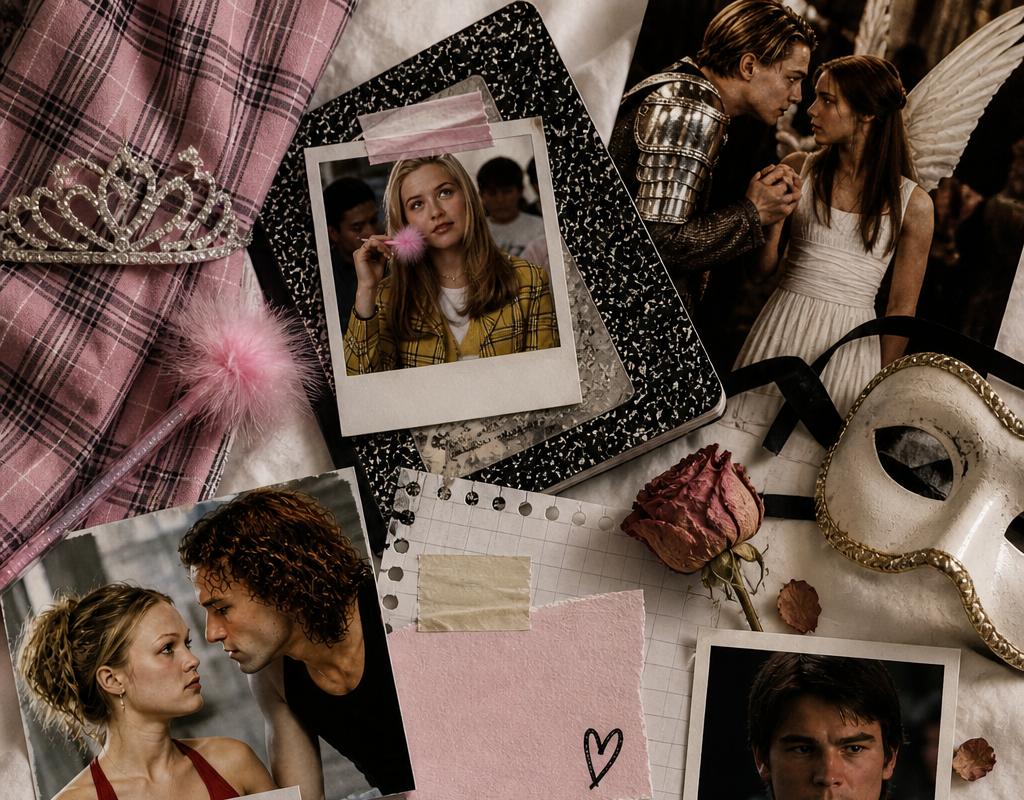
At some point in the late 90s and early 2000s, Hollywood quietly decided that the best way to make Shakespeare appealing… was to pretend it wasn’t Shakespeare at all.
And honestly? It worked.
You had teens watching The Taming of the Shrew without realising it. People quoting Emma through Clueless. Entire generations absorbing classic literature through high school drama, rom-coms, and beachy coming-of-age films.
It wasn’t labelled as educational. It wasn’t framed as important.
It was just… cool.
So why did this trend happen—and why did it disappear?
Shakespeare, But Make It High School
There was a very specific formula to these films.
Take a classic story. Strip it down to its emotional core. Then drop it into an American high school and let the characters do the rest.
10 Things I Hate About You is probably the clearest example. It’s The Taming of the Shrew, but instead of arranged marriage and social obedience, you get teenage rebellion, dating rules, and a very 90s version of feminism.
It doesn’t feel like homework. It feels like a rom-com.
Then you’ve got Clueless, which is actually Emma. Matchmaking, social hierarchy, misguided confidence—it’s all there, just dressed in designer outfits and Beverly Hills slang.
And She’s the Man—the Amanda Bynes one you were thinking of—is straight-up Twelfth Night. Disguises, mistaken identity, gender swapping, romantic confusion. Shakespeare loved chaos, and that film leans all the way into it.
None of these films hide what they’re doing. But they also don’t announce it.
They trust that the story still works, even if you’ve never heard of the original.
The Baz Luhrmann Effect
Then there’s Romeo + Juliet.
Not an adaptation in the “modern rewrite” sense, but something arguably more influential.
Baz Luhrmann kept the original language—every word—but dropped it into a hyper-stylised, modern setting. Guns instead of swords. Neon lights. MTV editing. Absolute chaos.
And somehow, it made Shakespeare feel fast, emotional, and completely watchable for a younger audience.
It proved something important: the stories didn’t need fixing. They just needed reframing.
Why It Worked So Well
The truth is, Shakespeare was never meant to be this untouchable, academic thing.
His plays were messy, dramatic, funny, full of miscommunication, bad decisions, and people falling in love too quickly.
Which is… basically every teen film ever made.
The 2000s adaptations worked because they recognised that similarity instead of fighting it. They didn’t try to modernise Shakespeare by making him serious.
They made him relatable.
A Shortcut Into “Classic” Stories
There’s also something else going on here.
These films acted as a kind of cultural bridge.
You could watch Clueless at 12, enjoy it for what it is, and only later realise you’d already understood the structure of Emma without trying.
Same with 10 Things I Hate About You. Same with She’s the Man.
They removed the barrier of “this is old, this is difficult, this is important.”
Instead, they said: this is just a story. And you already get it.
So Why Did It Stop?
That’s the interesting part.
Because we don’t really do this anymore.
Modern adaptations tend to go one of two ways:
- extremely faithful and serious
- or completely detached from the original source
That middle ground—the clever, accessible, teen-friendly reinterpretation—feels like it got left behind.
Part of it is probably that teen films themselves changed. The early 2000s had a very specific tone: slightly exaggerated, slightly stylised, but still grounded in character.
Now everything leans either hyper-realistic or fully conceptual.
And maybe we also lost a bit of confidence in the idea that audiences would quietly get it without being told.
Not All of Them Were Lighthearted
Most people remember this trend through the fun ones. The rom-coms. The high school chaos. The glow-up moments and soundtrack-heavy montages.
But not all of these adaptations were soft or playful.
O—starring Josh Hartnett—is Othello. And it doesn’t sugarcoat it.
It takes the same core themes—jealousy, manipulation, insecurity—and drops them into a modern school setting, but instead of turning it into something light, it leans fully into the darkness.
And honestly, it’s uncomfortable in a way the others aren’t.
There’s no wink to the audience. No sense that everything will be fine by the end. It plays out exactly how you’d expect a modern version of Othello to play out—tense, obsessive, and quietly devastating.
Which is interesting, because it shows that the trend wasn’t just about making classics “fun.”
It was about testing whether these stories still held up in completely different contexts.
And O kind of proves that they do… even when they’re stripped of all the theatrical distance and placed somewhere painfully familiar.
The Strange Legacy of the Trend
What’s funny is how many people don’t even realise they’ve already experienced these stories.
They think Shakespeare is difficult. Boring. Not for them.
But they’ve already watched it. Probably more than once.
Just with better outfits, a leading heart-throb and a killer soundtrack.