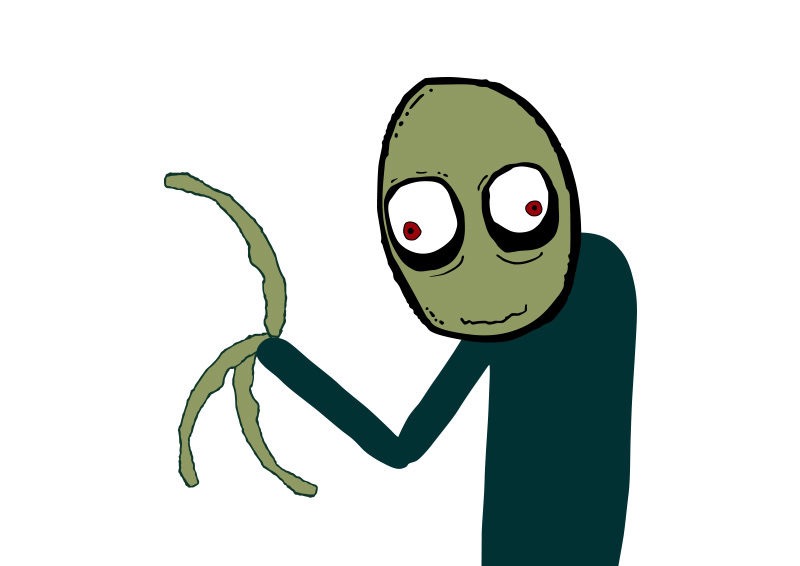
If you were anywhere near the internet in the mid-2000s, there’s a decent chance you stumbled across Salad Fingers at some point amidst the badgers, mushrooms and lemonade guzzling ducks.
And you may have had the exact same reaction as everyone else: what the hell did I just watch?
No context. No explanation. Just a thin green man with long fingers, whispering softly about rusty spoons.
For many millennials, Salad Fingers became one of those strange shared online memories — something you watched once, were mildly traumatised by, and then brought up years later with friends just to confirm that yes, it really did exist and you didn’t imagine it.
So what actually is Salad Fingers? And why did it become such a weirdly iconic piece of internet history?
The Man Behind the Madness
Salad Fingers was created by British animator David Firth.
The first episode appeared online in 2004 on the animation website Newgrounds, which at the time was one of the biggest hubs for experimental Flash cartoons.
Firth was already known in online animation circles for creating surreal, unsettling humour. His work often blends:
- dark comedy
- strange characters
- unsettling sound design
- dream-like logic
Salad Fingers quickly became his most famous creation.
So… What Actually Happens in It?
Trying to describe the plot of Salad Fingers is a bit like trying to explain a dream after you wake up.
Technically, it follows a thin, green, socially awkward creature called Salad Fingers who lives in a strange, empty world that vaguely resembles a post-apocalyptic wasteland.
He talks softly to himself, interacts with inanimate objects, and occasionally meets other strange characters — though many viewers suspect some of them may exist only in his imagination.
The most famous moment comes from the very first episode when he says, in that unsettling whisper:
“I like rusty spoons…”
And suddenly millions of viewers realised the internet had discovered a new flavour of creepy.
Why It Feels So Disturbing
Part of what makes Salad Fingers so memorable is that it doesn’t follow normal storytelling rules.
Nothing is clearly explained.
The world feels abandoned and empty.
The characters behave oddly.
Objects seem more meaningful than people.
The animation style also contributes heavily to the unsettling feeling: thin lines, muted colours, and jerky movement give the entire series the atmosphere of a strange fever dream.
The sound design is arguably even creepier. Whispering voices, uncomfortable pauses, and eerie background noises create the sense that something is deeply wrong — even when nothing obvious is happening.
Theories About What It Means
Because the series never gives clear answers, fans have spent years trying to interpret what’s really going on.
One common theory suggests the world of Salad Fingers is set after some kind of nuclear apocalypse, and the characters we see are either survivors with severe psychological damage or figments of Salad Fingers’ fractured mind.
Another theory argues that the show is intentionally structured like a dream, where objects and memories blend together without logic.
In reality, David Firth has always kept things deliberately vague. Much of the unsettling power of the series comes from the fact that the viewer is never sure what’s real and what isn’t.
A Weird Internet Time Capsule
Looking back now, Salad Fingers feels like a perfect snapshot of early internet culture.
Before social media algorithms, before polished YouTube channels, and long before TikTok, the web was full of strange, experimental projects made by people simply uploading bizarre ideas to see what would happen.
And sometimes those strange ideas stuck.
Two decades later, the whisper about rusty spoons is still instantly recognisable to anyone who grew up in that era of the internet.
Which might be the strangest part of all.
Something so weird, so unsettling, and so utterly unexplainable somehow became one of the most memorable pieces of online animation ever made.
And honestly?
We’re still not entirely sure why.
But we do know one thing.
If someone quietly says “rusty spoons” in a whisper… a whole generation immediately knows exactly what they mean.
Salad Fingers FAQ
The internet’s most searched questions about our creepy long fingered friend.
Because it’s built to feel like a bad dream. The design, the whispery voice, empty setting, strange pauses, body language and unsettling sound all create the sense that something is wrong even when nothing obvious is happening. Firth has said he wanted to make surreal nonsense that entertains, and that surrel-comedy gap is exactly what makes it so unnerving.
David Firth made it because the idea amused him and his friends. In interview, he said he wanted surreal comedy that did not play as either purely wacky or purely gross, but as entertaining nonsense. The original seed was a joke from his friend while Firth was playing guitar.
David Firth created it, wrote it, animated it and voices Salad Fingers himself. Christian Webb is tied to the original conception/in-joke around the name, but Firth is the main creator and performer.
The name came from an in-joke. Firth said a friend told him he had “Salad Fingers” while he was playing guitar, and the name stuck. That joke then became the basis for the character.
Canonically, because he enjoys strange textures and has “a love of rusty spoons.” Firth described him as a green man who likes the feeling of different textures against his skin, and the official Newgrounds series description also says he enjoys rusty spoons. Beyond that, there is no deeper confirmed explanation.
There is no official lore explanation for the colour. He is simply described by Firth as “a green man,” so the green look is part of the character design rather than something with a confirmed backstory.
Mostly because of David Firth’s surreal design style. The stretched limbs, odd face and thin body make him look fragile, unhealthy and uncanny, which fits the dreamlike horror-comedy tone. Firth has also said older children’s books and artists like David Lynch, Tim Burton, Chris Morris and The League of Gentlemen influenced him.
Officially, it does not have one single locked meaning. Firth has said people often assume it is all carefully planned and decoded piece by piece, but that is “not true at all.” So yes, it can mean something to viewers, but there is no confirmed master explanation.
The character name came from the guitar joke, while the series’ wider tone was influenced by old children’s books, music and creators such as David Lynch, Tim Burton, Chris Morris, South Park and The League of Gentlemen. There is no official statement that Salad Fingers is based on one specific real person.
There is definitely lore-ish atmosphere, but not a neatly explained backstory. Firth said viewers should try to work things out from what Salad Fingers says and from background details, but he also made clear the series was not mapped out into one fixed canon. So yes, there is story texture, but it is intentionally vague.
His most famous line is about rusty spoons. The official YouTube result for episode one quotes him saying he likes rusty spoons and likes to touch them. That line is the one most people instantly remember.
My personal favourite is the episode where he defeats an opponent and puts their head on his own as a hat. He then proceeds to tell us that he is the Queen of France. Love it!
He is generally presented as male. Firth refers to the character as “a man” and “he” in interview.
It is really not a kids’ series. It is an internet horror-surreal comedy with disturbing imagery, self-harm-adjacent moments, body horror and deeply unsettling themes. Firth even joked in interview that children would be upset by it. So while it is not a formal cinema-rated series in the usual sense, it is best treated as older-teen/adult viewing.
The first episode debuted on 1 July 2004, and it was first posted on Newgrounds. Newgrounds’ own history page says it was submitted in July 2004, and reference material for the series lists 1 July 2004 as the first air date.
It arrived on YouTube later, after beginning on Newgrounds. The official YouTube channel shows the earliest uploads as about 18 years old, which fits a 2007 move onto YouTube, but the exact upload date is harder to verify cleanly from official search snippets alone. What is certain is that Newgrounds came first.
It became a major early-internet phenomenon in the mid-2000s and has remained a cult favourite ever since. Newgrounds notes it grew after being featured on the front page, and later sources describe it as one of the first big viral Flash-era oddities.
There are 14 episodes currently available in the official run. The official 2025 YouTube anthology is labelled as containing all 14 full episodes, and episode 14 is “Crows.”
It has not ended. Episode 14 exists, and Firth has described the episodes as self-contained rather than one finished continuous story with a final ending.
There is no confirmed canonical death for Salad Fingers. As things stand, he is not officially dead, and the series is ongoing.
It was made as Flash animation. In the early interview, Firth explicitly says the series was produced using Flash, and he talks about how using Flash helped him make episodes faster and post them online.
The best-known “friends” are the finger-puppet companions like Hubert Cumberdale, Marjory Stewart-Baxter and Jeremy Fisher, but in true Salad Fingers fashion the line between real companions, toys and hallucinations is blurry. Since Firth says the show is not one fully mapped-out canon, it is safer to say these are recurring companion figures rather than straightforward friends in a normal story sense.
There is no official diagnosis. Viewers often read the character through mental-health language because of hallucination-like scenes and distorted reality, but it would be wrong to claim a real diagnosis without the creator stating one.
He is not a real being, and he is not originally a creepypasta. He is a surreal animated web character from an early Flash-era series. Whether he is human is left ambiguous; he is best described as a humanoid creature. He is definitely meant to be scary or at least deeply unsettling.