Every few years, someone decides it’s time to tell The Odyssey again.
Assassin’s Creed. Stephen Fry. Epic: The Musical. Some dude called Homer?
This time, it’s Christopher Nolan.
Suddenly, people who have never given ancient Greece a second thought are asking the same questions: Who was Odysseus? Was he real? And what’s the deal with all the monsters?
The answer, as with so much ancient history, is a little complicated. Let’s revisit my second year of university besties and delve into my Ancient Greek studies to tell his story.
Was Odysseus a real person?
Probably not.
Odysseus is generally considered a mythological figure rather than a historical king. He’s the central hero of The Odyssey, an epic poem traditionally attributed to Homer and thought to have been written sometime during the eighth century BC.
That doesn’t necessarily mean Homer invented everything from scratch.
Like many myths, The Odyssey almost certainly contains echoes of a much older world. The story is set in the Late Bronze Age, around the time many historians associate with the legendary Trojan War, several centuries before Homer himself was likely writing.
By the time the poem was written down, these stories had already been passed from one generation to the next for hundreds of years. Historical memories, local legends and outright fantasy had become tangled together until separating one from the other became almost impossible.
So while historians don’t believe there really was a Cyclops lurking on a Mediterranean island, they also wouldn’t dismiss the possibility that some parts of the story preserve distant memories of real people, real places and real events.
So why is everyone talking about Troy?
Because that’s where most people first meet Odysseus.
He was one of the Greek leaders during the Trojan War and, according to later tradition, the mastermind behind the famous Trojan Horse.
Ironically, though, that’s not actually what The Odyssey is about.
The war is already over.
The city has already fallen.
The famous horse has already done its job.
The real story begins afterwards.
The longest commute in history
Odysseus should have been home within weeks.
Instead, it takes him another ten years.
Along the way he encounters one of mythology’s greatest collections of monsters and magical beings: the one-eyed Cyclops Polyphemus, the enchantress Circe, the deadly Sirens, the six-headed Scylla, the whirlpool Charybdis and the nymph Calypso, who keeps him stranded on her island for years.
Most of these adventures happen because Odysseus has earned the anger of Poseidon, god of the sea. Every time he thinks he’s finally heading home, another storm, monster or divine grudge pushes him further off course.
It sounds like fantasy because it is fantasy.
But beneath the monsters sits something surprisingly human.
It’s a story about trying to get home after war.
Not your typical hero
Modern audiences often expect heroes to be physically unstoppable.
Odysseus isn’t.
His greatest weapon is his brain.
He lies.
He disguises himself.
He talks his way out of impossible situations.
Sometimes he succeeds because he’s clever.
Sometimes he creates his own disasters because he’s too clever.
After escaping the Cyclops, for example, he simply can’t resist boasting about who he is. It’s a moment of pride that allows Polyphemus to call upon Poseidon for revenge, turning an already difficult journey into a decade-long nightmare.
He’s brave, but he’s also arrogant.
He’s loyal to his family, yet not always faithful to his wife.
He’s resourceful, stubborn, emotional and deeply flawed.
In many ways, he feels far more like a real person than a perfect legend.
But what about Penelope?
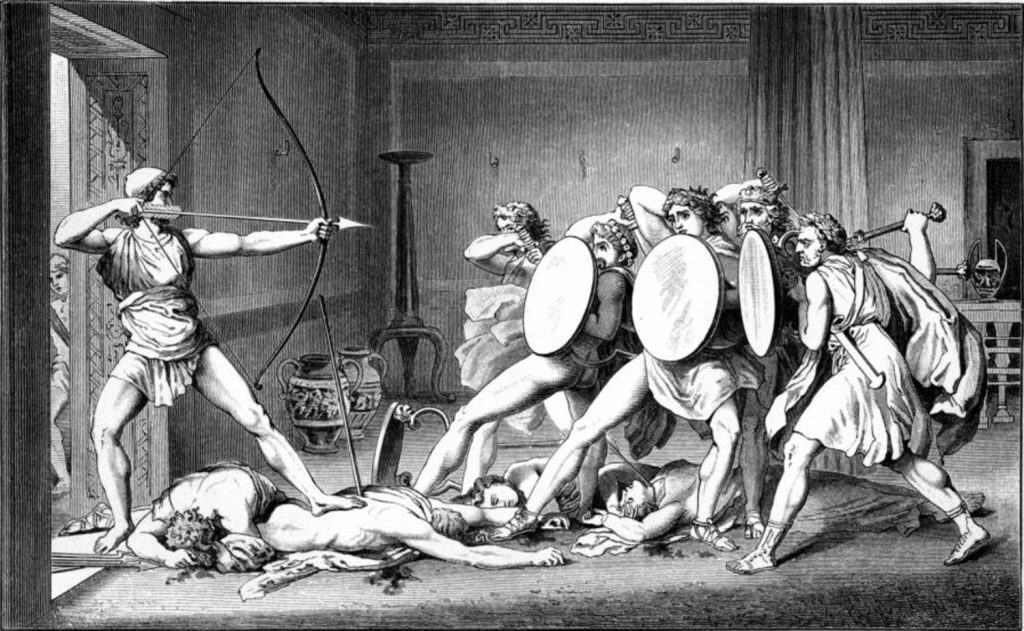
While Odysseus is busy fighting monsters, Penelope is fighting a very different battle.
She has spent twenty years ruling Ithaca alone while everyone assumes her husband is dead.
More than a hundred suitors descend on the palace, each hoping to marry her and claim the throne.
Rather than choosing one, she famously promises to decide once she has finished weaving a burial shroud. Every night, after everyone has gone to bed, she secretly unpicks the day’s work, allowing the task to continue for years.
It’s one of the greatest acts of quiet resistance in classical literature.
Without swinging a sword or slaying a single monster, Penelope manages to protect both her household and her husband’s kingdom through patience, intelligence and determination.
So… how historically accurate is The Odyssey?
As a history, not very.
As a window into how ancient Greeks understood heroism, honour, family and the gods?
Extremely.
That’s an important distinction.
The monsters almost certainly never existed.
The gods aren’t historical figures directing human events.
And nobody seriously believes a witch transformed sailors into pigs.
But myths were never meant to function as history books. They were stories that explored human fears, hopes and values, wrapped in unforgettable adventures.
For historians, The Odyssey is valuable not because it tells us exactly what happened in Bronze Age Greece, but because it tells us what later Greeks believed mattered enough to remember.
Reality Check
Odysseus himself almost certainly never existed in the way modern audiences imagine.
But the world that created him did.
Behind the Cyclopes, sea monsters and angry gods lies a fascinating glimpse into ancient Greece, where oral storytelling preserved memories of a distant past long before history was written down.
Nearly three thousand years later, we’re still following one man’s impossible journey home.
Perhaps that’s because, underneath all the mythology, The Odyssey isn’t really about monsters at all.
It’s about resilience, identity, loss, and the hope that no matter how long the road becomes, home is still waiting at the end of it.
If you are interested in this topic, I would 100% suggest reading Stephen Fry’s book on the subjects. Fry has a great way of making Greek epics less…. epic to digest!