If I told you that Disney’s Robin Hood contains some surprisingly accurate lessons about medieval poor relief, you would probably assume I’d finally spent too much time reading settlement examinations.
And yet, here we are.
Long before I became fascinated by the history of welfare, charity, and the Poor Law, I was sitting cross-legged in front of the television watching a fox in a green hat rob a lion and hand money to rabbits. At the time, I thought I was watching a fun Disney adventure.
Looking back, I was unknowingly getting a crash course in how medieval people understood poverty.
“Alms! Alms! Alms for the Poor!”
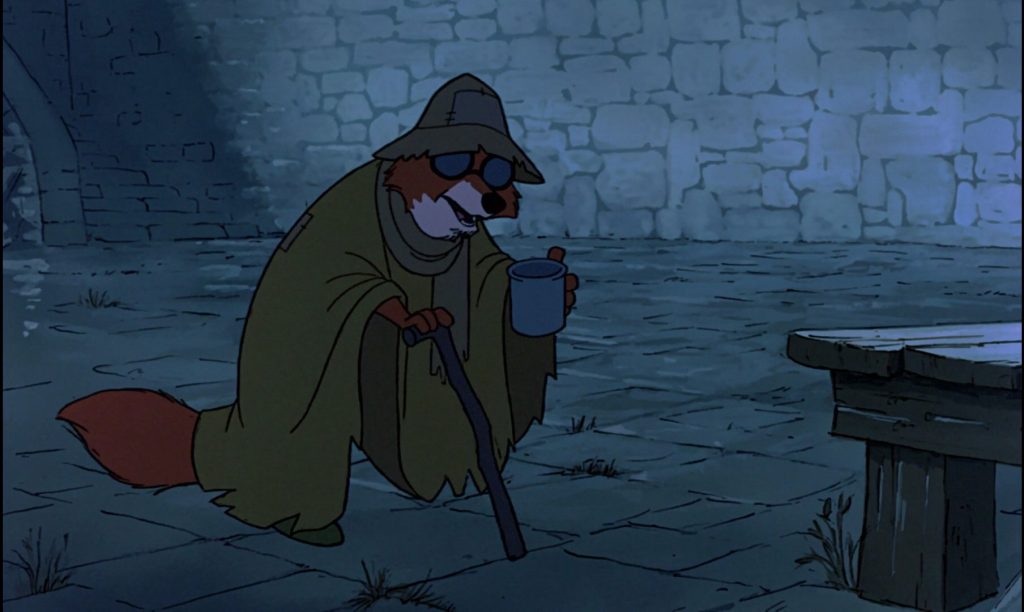
If you’ve watched Disney’s Robin Hood recently, you’ll probably remember one of the film’s recurring characters: a blind beggar carrying a tin cup through the streets of Nottingham.
“Alms! Alms! Alms for the poor!”
As a child, I thought it was just a funny character moment. As a historian adult, I recognised the lesson I had learnt. Because this wasn’t simply a Disney invention.
Begging was a real part of medieval life. Those unable to support themselves often relied upon charity from individuals, churches, monasteries, and local communities. Unlike our modern welfare systems, there was no national safety net waiting in the wings.
If you could not work because of age, illness, disability, or misfortune, survival often depended upon the generosity of others. The little beggar in Robin Hood isn’t just comic relief. He’s a reminder that poverty was a visible and unavoidable part of everyday medieval life.
Friar Tuck and the Poor Box
Then we come to Friar Tuck. Most children remember him as Robin’s cheerful friend with a habit of eating well and getting into trouble. But Friar Tuck also represents something important that often gets overlooked.
The medieval Church was one of the largest providers of charity in England. Monasteries distributed food. Churches collected alms. Religious houses cared for travellers, widows, the sick, and the poor.
The collection box seen in the church reflects a genuine historical tradition. People donated money, food, and goods which could then be used to support those in need. This wasn’t welfare as we understand it today. It was charity rooted in religious belief.
Helping the poor was considered an act of Christian duty. Giving alms was seen as a way of serving God. When Prince John seizes church funds in the film, audiences instinctively understand why it’s wrong. He’s not just taking money.
He’s taking support away from the people who rely on it. Food from baby’s mouths.
Robin Hood and Redistribution
Of course, we can’t talk about poverty in Robin Hood without talking about Robin himself.
The famous phrase “steal from the rich and give to the poor” doesn’t appear in every version of the legend, but it has become the defining image of the character.
Why?
Because audiences instinctively understand the injustice. The people of Nottingham are starving. Taxes are crushing them. Meanwhile Prince John sits on a mountain of wealth. Alan-A-Dale sings about how every town has its ups and downs, but that Nottingham has seen more than most. Robin Hood becomes a fantasy solution to a very real historical problem. What happens when wealth becomes concentrated in the hands of a few while ordinary people struggle to survive?
Robin’s answer is simple. Give some of it back. The fact that this idea remains popular centuries later perhaps says something about how timeless those concerns are.
Poverty Was Not Always Seen As Failure
One of the most interesting things about medieval attitudes to poverty is that poverty itself was not automatically viewed as a moral failing. Today, discussions about welfare often become tangled up with questions about responsibility, deservingness, and personal choices.
Medieval people could certainly be judgemental too, but there was also a strong religious tradition that viewed the poor as deserving of compassion. Many believed that helping the poor was not optional. It was a duty.
The poor provided an opportunity for the wealthy to demonstrate charity and Christian virtue. That’s one reason why almsgiving appears so frequently in medieval records. It’s also why the beggar in Robin Hood feels so familiar within the setting.
He belongs there. He reflects a society where poverty was visible and charity was expected.
The World Before the Poor Law
It’s tempting to imagine medieval charity as a kinder, simpler system than the welfare debates we know today. After all, Robin Hood is full of acts of generosity. Friar Tuck collects alms, Robin helps struggling families, and ordinary people share what little they have with one another.
Yet the film also hints at a harsher reality.
During Alan-a-Dale’s haunting performance of Not in Nottingham, we see the town’s prison filled not with dangerous criminals but with ordinary people who have fallen foul of Prince John’s rule. Among them are Friar Tuck and an elderly owl couple whose greatest offence appears to be poverty itself. Their presence is a reminder that medieval attitudes towards the poor were often complicated and contradictory.
On one hand, Christian teaching encouraged charity, compassion, and care for those in need. On the other, poverty could arouse suspicion. People who relied on begging or assistance were not always viewed sympathetically. Medieval communities, like our own, often distinguished between the “deserving” and “undeserving” poor, although those categories were not always clearly defined.
In many ways, these two sides of the film reflect the two sides of medieval society. There was genuine generosity and a strong tradition of helping those who had fallen on hard times. Yet there was also fear, judgement, and punishment. Poverty could inspire compassion, but it could also attract blame. The poor were often caught somewhere between being seen as neighbours in need and being treated as a problem to be controlled.
That tension would continue for centuries and eventually shape the Poor Laws themselves. Long before settlement examinations, workhouses, and parish overseers, England was already wrestling with the same question: when someone falls into poverty, should society help them or punish them?
Centuries of wrestling with these questions eventually produced a more unified approach to helping the poor, laying the foundations for what would become one of my favourite areas of history: the Poor Law.
Disney’s Unexpected History Lesson
As children, most of us watched Robin Hood and saw talking animals.
A heroic — and inexplicably handsome — fox. A villainous lion. A lovable friar. A blind beggar.
Looking back, I see something else.
I see medieval poverty. Religious charity. Almsgiving. Social inequality. The foundations of English poor relief.
It’s funny to think that one of my earliest introductions to welfare history may have come from a Disney film.
Then again, some of the best history lessons happen when we don’t realise we’re learning them.