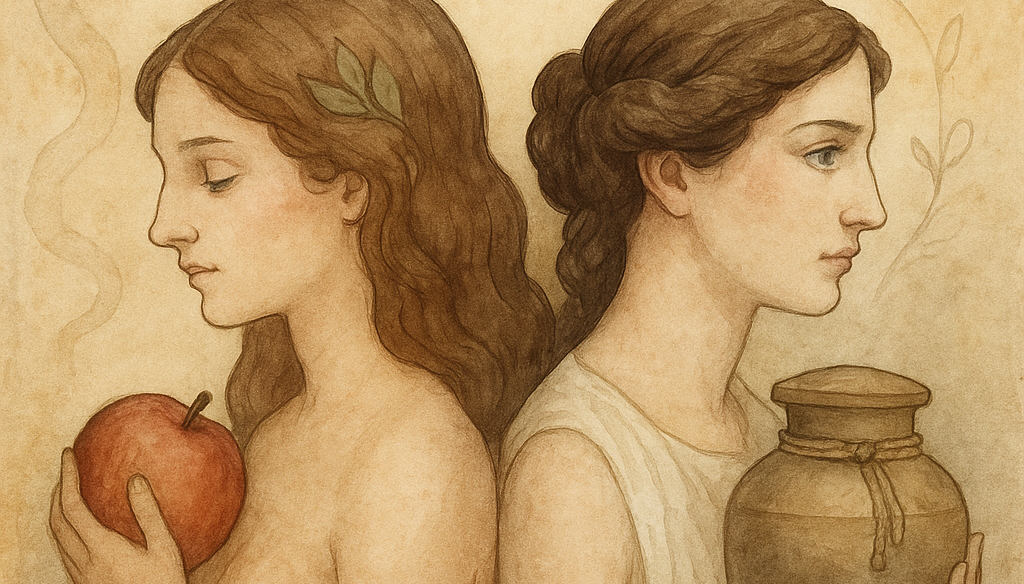
Across cultures, myths and sacred stories have long introduced a “first woman.” In the Hebrew Bible she is Eve, drawn from Adam’s rib and placed in Eden. In Greek myth she is Pandora, shaped from clay and adorned with irresistible gifts.
Different worlds, different storytellers — yet both women bear a heavy burden. Each is remembered as the one who let hardship into human life.
Born as Companions or Punishments
Eve’s story is tender at first. She is created to be Adam’s companion, “bone of his bone,” the mother of all who would follow. Pandora’s creation, however, is not born of love but of vengeance. Ordered by Zeus to punish humanity for stealing fire, the gods design her beauty as a trap — a dazzling surface with calamity hidden beneath.
Already, their purposes reveal a divide. Eve is meant as completion. Pandora is meant as downfall. Yet both are defined by how their stories serve men.
The Forbidden and the Unsealed
For Eve, the fruit of knowledge becomes the dividing line between innocence and exile. For Pandora, it is the jar she is told never to open. Both acts are framed as moments of feminine weakness: curiosity, temptation, disobedience. And in both myths, the consequence is the same — the world changes forever. Death, toil, and suffering seep into human life.
But notice how neither story asks why these objects were placed within reach in the first place. A tree heavy with fruit, a sealed jar in a mortal’s home — both are traps, laid in plain sight.
Blame, Carried by Women
Eve’s bite becomes original sin in later Christian thought, making women bearers of inherited guilt. Pandora’s jar makes her the mother of misfortune. Across centuries, these tales whispered the same warning: women are dangerous, their choices destructive, their desires suspect.
They are stories less about women’s nature and more about male fear — fear of curiosity, of knowledge, of power beyond control.
Reclaiming Their Names
Today, many choose to read Eve not as a sinner but as a seeker of truth. Pandora, too, is remembered not only for releasing sorrow but for keeping hope inside the jar. To tell their stories again is to shift the focus from blame to agency, from curse to complexity.
They were never simply villains. They were mirrors of the anxieties of the cultures that created them. And now, in retelling, they can become mirrors of resilience instead.
From Warnings to Symbols of Strength
In the hands of their original storytellers, Eve and Pandora were warnings — reminders of the danger of women’s independence. Yet today, they have been reimagined as symbols of strength.
Eve can be seen as the first woman to choose knowledge, refusing blind obedience in favour of awareness. Her decision transforms her from passive companion into an active seeker of truth, a reading that resonates with modern feminist theology.
Pandora, too, has been reclaimed. Instead of the figure who unleashed suffering, she becomes the guardian of hope — the one who reminds humanity that even in hardship, something bright remains. In art and literature, Pandora is often re-envisioned not as a curse, but as a woman who embodies resilience and the power of curiosity.
Together, Eve and Pandora have stepped out of the shadows of blame to become emblems of women reclaiming their stories. Their myths, once used to diminish, can now inspire — proving that even the oldest tales can be rewritten with new meaning.