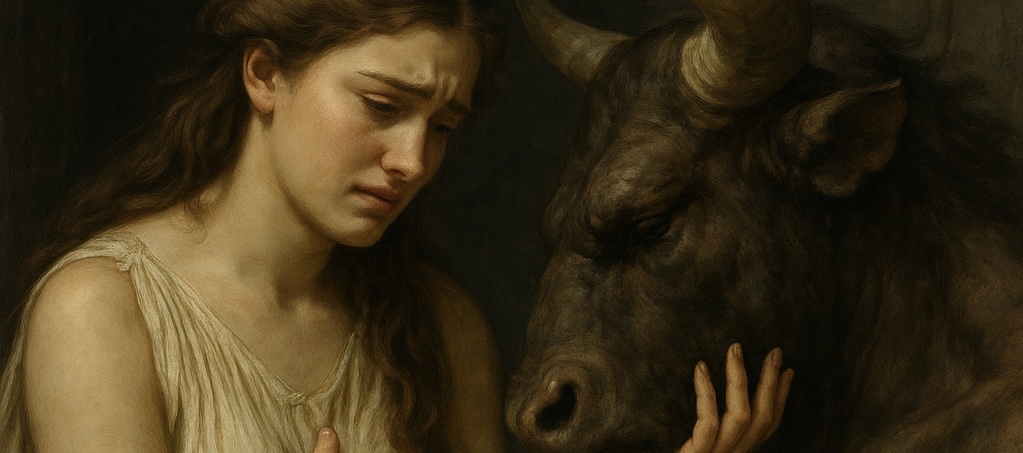
Ariadne
Now part of the complete mythical retellings collection, We Are the Fall.
They tell it wrong.
They say I gave him the thread for love,
for the thrill of escape,
for a hand to carry me from my father’s shadow.
But they never asked me why.
I was born to walls within walls,
to the sound of doors locking behind me,
to the slow tread of hooves in the dark below.
I knew my brother by the echo of his weeping.
I knew him by the silence that followed.
The Labyrinth was not a prison for his victims.
It was his cage.
It was the hunger they fed him, the fear they stitched into his skin.
I gave Theseus the thread,
yes —
but not for his triumph,
not for the songs he would sing of himself.
I gave it to end the sorrow stitched into the stones.
I gave it to stop the long mourning of the walls.
I gave it so my brother would no longer wake in blood,
no longer dream of fields he would never walk.
I wove my own freedom into that coil, yes —
but first,
I wove his mercy.
Author’s Note
In classical mythology, Ariadne is remembered as the daughter of Minos who helped Theseus escape the Labyrinth and the minotaur, only to be abandoned by him and later wed to Dionysus. Traditional retellings emphasize betrayal and rescue, but little attention is given to Ariadne’s motivations.
This reinterpretation reframes Ariadne’s gift of the thread not as an act of romantic devotion, but as one of compassion. It restores her agency: a woman choosing mercy over cruelty, seeking to end the suffering of her ‘monstrous‘ brother rather than simply aiding a hero.
Here, Ariadne’s story becomes one of sorrow, love, and deliberate liberation — not from betrayal, but from a world that asked her to accept suffering as fate.
If you enjoyed this mythical retelling, you may enjoy one of the other poems in the complete collection, available here.
