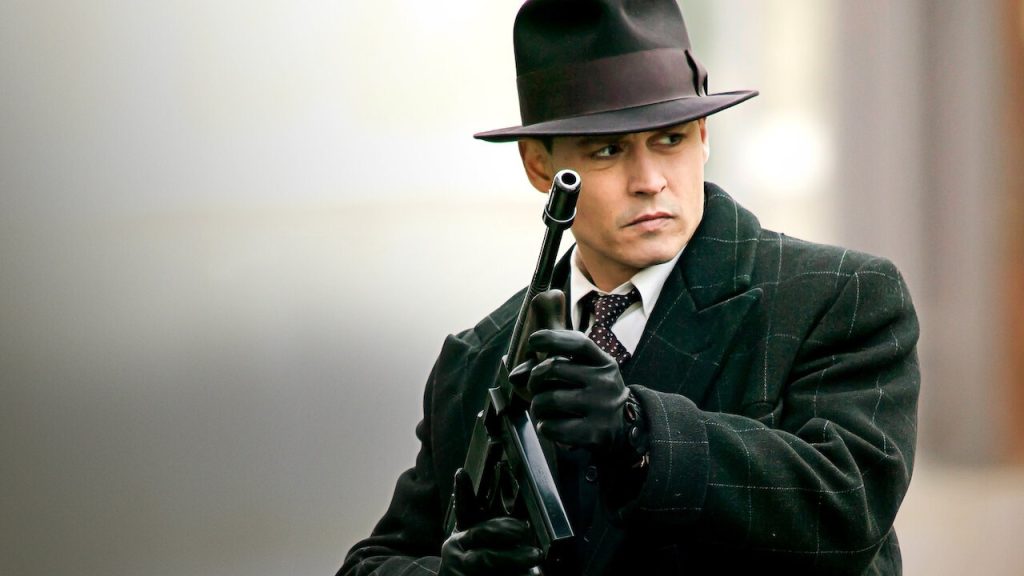
Johnny Depp, Christian Bale, a notorious American gangster and one of the most famous manhunts in American history. Public Enemies (2009), directed by Michael Mann, has everything you could want from a historical crime drama.
But how much of it actually happened?
Having watched the film, I was particularly interested in how accurately it portrayed John Dillinger himself, his relationship with Billie Frechette, his fellow criminals and the FBI agents hunting him.
And then there is his death. Was Dillinger really shot outside a cinema? What film had he been watching? Did he really whisper a final message for Billie?
Perhaps most interestingly, did one of America’s most wanted criminals genuinely walk into the police headquarters investigating him, look around at the evidence collected against him and leave without anybody noticing?
Let’s look at the history behind Public Enemies and separate the facts from the Hollywood storytelling.
Was John Dillinger Really Like Johnny Depp’s Character?
John Herbert Dillinger was born on 22 June 1903 in Indianapolis, Indiana. During the Great Depression, he became one of America’s most notorious bank robbers, eventually earning the title of Public Enemy Number One.
Between 1933 and 1934, Dillinger and his associates carried out a series of robberies, prison escapes and violent confrontations with law enforcement.
Johnny Depp portrays Dillinger as charismatic, confident, charming and occasionally surprisingly gentle. He is a man who enjoys expensive clothes, fast cars and the excitement of his criminal lifestyle.
Interestingly, this is not entirely a Hollywood invention.
The real Dillinger was widely described as charismatic and personable. He became something of a celebrity during the Depression, when public resentment towards banks helped romanticise the image of the outlaw.
However, there is an important distinction between being popular and being a good person.
Dillinger was an armed criminal whose activities endangered innocent people. His gang was responsible for violence and deaths, and the romantic image of a charming bank robber does not tell the whole story.
The film leans heavily into his more appealing characteristics, encouraging audiences to see him as an antihero rather than simply a dangerous criminal.
Nevertheless, Depp’s portrayal does reflect an important part of Dillinger’s historical reputation. His charm was real, even if the film sometimes makes him more sympathetic than the historical evidence warrants.
Were Dillinger’s Bank Robberies Accurate?
The bank robberies are among the more historically grounded elements of Public Enemies.
Dillinger really did participate in carefully planned armed robberies, often involving stolen vehicles, accomplices and rapid escapes.
His gang used powerful firearms, including Thompson submachine guns, and sometimes took hostages to protect themselves during their escapes.
The film also captures the changing nature of American crime during the 1930s. Faster cars, increasingly sophisticated weapons and criminals crossing state borders presented significant challenges for law enforcement.
However, not every robbery unfolds exactly as it did historically.
Some events are compressed, conversations are invented and the involvement of individual gang members is occasionally altered.
One particularly important difference concerns Dillinger’s personal responsibility for killings. Although the film depicts him shooting several people, historians have generally linked him personally to far fewer deaths. One frequently cited case is the killing of police officer William Patrick O’Malley during a January 1934 bank robbery in East Chicago, Indiana.
The film’s portrayal of the gang’s violence is therefore more accurate than its suggestion that Dillinger personally committed every killing shown.
Did Dillinger Really Escape Prison With a Wooden Gun?
One of the most extraordinary parts of Dillinger’s story is also one of the most famous.
On 3 March 1934, Dillinger escaped from the supposedly secure jail at Crown Point, Indiana.
According to the traditional account, he used a fake pistol, commonly described as being carved from wood, to intimidate guards and escape.
The precise construction of the gun and some details of the escape have been disputed, but the basic story of Dillinger bluffing his way out with a fake weapon became an important part of his legend.
He even escaped in a sheriff’s car.
Director Michael Mann later explained that the actual escape involved Dillinger taking more guards hostage than the film depicted. He said the filmmakers reduced the number because the real account seemed almost too unbelievable for audiences.
It’s a wonderful example of historical events being stranger than fiction.
However, the film’s opening prison break also combines or alters elements of separate events. Dillinger helped organise a September 1933 escape from Indiana State Prison, but he was already imprisoned elsewhere when it happened.
So although the film draws on genuine escapes, their presentation is not always chronologically accurate.
Was Billie Frechette a Real Person?
Yes. Billie Frechette, portrayed by Marion Cotillard, was a real woman and an important part of Dillinger’s life.
Her full name was Evelyn Frechette, and she was of Menominee Native American heritage.
She and Dillinger became romantically involved in 1933, and she accompanied him during part of his time as a fugitive.
Their relationship was genuine, although the film understandably dramatises their conversations and private moments.
In April 1934, Frechette was arrested for harbouring Dillinger. She was subsequently convicted and sentenced to two years in prison.
Dillinger was not able to rescue her.
The film portrays their relationship as a tragic romance, with Billie remaining emotionally central to Dillinger’s story right up to his death.
However, this is where the historical account begins to differ.
After Billie’s arrest, Dillinger became romantically involved with another woman, Polly Hamilton.
In fact, it was Polly, not Billie, who accompanied Dillinger to the cinema on the night he died, as we do see in the film although her role and appearance is significantly downplayed. In reality, it was Polly’s image that was found in the pocket watch on Dillinger — not Billie as it is shown in the film.
That detail becomes particularly important when considering the film’s emotional ending.
Was Baby Face Nelson Really Part of Dillinger’s Gang?
Yes. George ‘Baby Face’ Nelson, whose real name was Lester Joseph Gillis, was a real criminal who worked alongside Dillinger.
Played by Stephen Graham, Nelson is portrayed as aggressive, reckless and considerably more volatile than Depp’s Dillinger.
This characterisation broadly reflects Nelson’s reputation as an exceptionally violent gangster.
Nelson participated in robberies and was involved in the notorious confrontation at Little Bohemia Lodge in Wisconsin in April 1934.
However, the film makes a significant historical change concerning his death.
In Public Enemies, Nelson dies during the events surrounding Little Bohemia.
In reality, he survived.
Dillinger was killed in July 1934, while Nelson remained alive until 27 November 1934, when he was fatally wounded during a gunfight with federal agents near Barrington, Illinois.
This means the film kills Nelson approximately four months too early.
It also changes the circumstances of his death, making the Little Bohemia confrontation more dramatically conclusive than it really was.
What Really Happened at Little Bohemia Lodge?
The Little Bohemia shootout is one of the film’s most memorable sequences, and it is based on a genuine event.
On 22 April 1934, federal agents attempted to capture Dillinger and several associates who were staying at Little Bohemia Lodge in Wisconsin.
The operation went badly wrong.
Agents mistakenly fired on a vehicle containing innocent civilians leaving the lodge, killing one man and injuring others.
The gunfire alerted the criminals, several of whom escaped.
Baby Face Nelson subsequently encountered federal agents during the wider operation. He killed agent W. Carter Baum and wounded two other lawmen.
Dillinger himself escaped the raid.
The film recreates much of the chaos and violence, although it changes the fate of some participants.
It is also worth noting that Michael Mann filmed at the actual Little Bohemia location, demonstrating the production’s considerable commitment to visual authenticity.
Was Christian Bale’s FBI Agent Melvin Purvis Real?
Christian Bale portrays Melvin Purvis, one of the most recognisable federal agents involved in the pursuit of Dillinger.
Purvis was absolutely real.
He served as the Special Agent in Charge of the Bureau of Investigation’s Chicago office and became closely associated with the campaign against America’s most notorious gangsters.
The film portrays him as determined, disciplined and increasingly troubled by the violence surrounding the investigation.
Although these private emotions are necessarily dramatised, the historical Purvis was indeed a significant figure in the manhunt.
However, Public Enemies exaggerates how personally responsible he was for bringing Dillinger down.
Following the disastrous Little Bohemia raid, federal agent Samuel Cowley was appointed to oversee the continuing investigation.
Purvis remained involved, but the operation was not simply a personal contest between him and Dillinger.
In reality, the investigation depended on numerous agents, informants and local police officers.
There is also no established historical basis for the film’s dramatic face-to-face conversation between Dillinger and Purvis while Dillinger is in custody.
Their rivalry works beautifully as a cinematic narrative, but the historical relationship was not quite so personal.
One detail the film does get right is that Purvis did not personally shoot Dillinger.
He was present during the operation outside the Biograph Theatre, but other agents fired the shots.
Following Dillinger’s death, Purvis became nationally famous. His popularity reportedly created tensions with FBI director J. Edgar Hoover, and he eventually resigned from the Bureau in 1935.
Did John Dillinger Really Walk Into the Police Station Investigating Him?
This is perhaps the scene I was most curious about.
In Public Enemies, Dillinger casually enters the Chicago police headquarters, walks into the room dedicated to investigating him and examines the photographs and evidence displayed around the office.
He even asks an officer about the baseball game playing on the radio.
Nobody recognises him.
It’s an extraordinary scene, particularly because it suggests that Dillinger was so confident, or perhaps so arrogant, that he could walk directly into the headquarters of the people hunting him.
But did it actually happen?
Interestingly, director Michael Mann and Johnny Depp have described the scene as being based on a real incident.
However, there is a difference between a filmmaker saying something happened and having reliable historical evidence that confirms it.
I could not find a contemporary police report or independently verified eyewitness account establishing that Dillinger entered the detective bureau and inspected the investigation into himself.
And that raises an obvious question.
If Dillinger walked into the room unnoticed, examined the evidence and left without being apprehended, how would anybody have known he had been there?
He could theoretically have told somebody afterwards, but that would still leave us relying on an account rather than independently established evidence.
It is certainly possible that the scene originated from an anecdote about Dillinger’s audacity. However, without stronger documentation, I would be reluctant to present it as a confirmed historical event.
For now, I would classify it as an unverified story dramatised for the film, rather than something we can confidently say happened.
It’s a fantastic scene, but historical accuracy requires more than a fantastic story.
Did Dillinger Really Die Outside a Cinema?
Yes, and this is one of the most historically accurate parts of the film.
On 22 July 1934, Dillinger attended the Biograph Theatre in Chicago with his girlfriend Polly Hamilton and a woman named Anna Sage.
They were watching Manhattan Melodrama, a 1934 crime film starring Clark Gable, William Powell and Myrna Loy.
There is something remarkably cinematic about this detail.
Dillinger, one of America’s most wanted gangsters, spent his final evening watching a film about a criminal whose lifestyle ultimately catches up with him.
But Dillinger did not know that Anna Sage had informed federal agents of his whereabouts.
Sage, who was facing deportation to Romania, hoped that cooperating with authorities might help her remain in the United States.
She became associated with the famous description of the ‘Woman in Red’, although the clothing she wore that evening was actually orange.
Agents positioned themselves outside the cinema and waited for Dillinger to emerge.
Melvin Purvis was among them.
When Dillinger left the theatre, Purvis used a prearranged signal involving lighting a cigar to alert the other agents.
Dillinger apparently realised something was wrong and attempted to escape.
Agents opened fire.
He was struck and collapsed on the pavement.
The general circumstances of the shooting, including the cinema, the film he had watched and the informant who betrayed him, are all historically documented.
Was Dillinger Really Shot Through the Head?
Yes, although the precise path of the fatal bullet is more complicated than simply saying he was shot in the head.
Historical descriptions of Dillinger’s wounds indicate that the fatal bullet entered from behind, near the base of his neck, travelled upwards and exited beneath his right eye.
This was an extremely serious wound involving the head and upper neck.
He also sustained other gunshot injuries during the confrontation.
The film’s depiction of Dillinger being shot and collapsing outside the theatre therefore reflects the broad circumstances of his actual death.
However, the exact positioning of the agents, the sequence of shots and Dillinger’s final movements have been reconstructed from historical accounts.
There is also an important distinction concerning who killed him.
Purvis did not fire the fatal shot.
Agent Charles Winstead is generally credited with shooting Dillinger, although historical accounts of the gunfire have not always agreed on every detail.
Dillinger was just 31 years old when he died.
Did Dillinger Really Say ‘Bye Bye Blackbird’ Before He Died?
The final scene of Public Enemies is particularly emotional.
After Dillinger is shot, he appears to whisper something to agent Charles Winstead.
Later, Winstead visits Billie Frechette in prison and tells her that Dillinger’s final words were ‘Bye bye, blackbird’.
The implication is that Dillinger was thinking of Billie as he died, giving their relationship a tragic and romantic conclusion.
But there is no reliable evidence that Dillinger actually said those words.
According to the FBI’s own historical account, several witnesses reported seeing Dillinger’s lips move as he lay dying.
However, nobody was close enough to establish whether he was speaking or simply breathing his last breaths.
His final words, if he spoke any, remain unknown.
The message to Billie is therefore a fictionalised conclusion to their relationship.
And there is another detail that makes the film’s ending particularly misleading.
When Dillinger died, he was carrying a gold ring bearing an inscription expressing Polly Hamilton’s love for him, along with a pocket watch containing her photograph — not Billie’s.
This does not mean he had forgotten Billie or that their relationship had been insignificant.
It does, however, demonstrate that his romantic life was considerably more complicated than the film suggests.
There is no established historical evidence that Charles Winstead visited Billie in prison to deliver Dillinger’s final message.
The ending works beautifully as a piece of filmmaking, but it should not be mistaken for documented history.
Did Pretty Boy Floyd Really Die Before Dillinger?
Another historical figure appearing in Public Enemies is Charles Arthur ‘Pretty Boy’ Floyd, portrayed by Channing Tatum.
Floyd was a real bank robber and notorious American outlaw.
However, the film places his death before Dillinger’s, with Melvin Purvis involved in the confrontation.
In reality, Floyd was killed on 22 October 1934, three months after Dillinger’s death.
Purvis did participate in the operation that resulted in Floyd’s death, but the film changes the chronology to incorporate the event into its narrative.
Floyd’s death, like Baby Face Nelson’s, demonstrates how the filmmakers rearranged historical events to tell a more concentrated story about the federal campaign against organised criminals.
How Historically Accurate Is Public Enemies Overall?
Public Enemies is an interesting example of a film that is often extremely accurate in its physical details while taking considerable liberties with its historical narrative.
Michael Mann made a significant effort to recreate the world of John Dillinger.
The production filmed at several genuine historical locations, including Crown Point jail, Little Bohemia Lodge and the Chicago street where Dillinger was killed.
The clothing, vehicles, weapons and architecture help create an unusually convincing portrayal of 1930s America.
Bryan Burrough, whose nonfiction book Public Enemies inspired the film, praised Mann’s dedication to historical authenticity.
But accuracy in the surroundings does not automatically mean accuracy in the events.
The film alters the chronology of several deaths, simplifies the investigation, dramatises personal relationships and invents conversations that cannot be historically verified.
Most significantly, it constructs an emotional ending around Billie Frechette that is not supported by the available evidence.
None of this necessarily makes Public Enemies a bad historical film.
It successfully captures the atmosphere of the Depression-era gangster phenomenon and introduces audiences to several genuine figures and events.
However, I think the distinction between historical reconstruction and historical storytelling is particularly important here.
The film is so visually convincing that its fictional elements can easily feel just as authentic as the documented ones.
And perhaps that is what makes historical films like Public Enemies so interesting to examine.
The real John Dillinger did rob banks, escape custody, evade federal agents and die outside a Chicago cinema after watching Manhattan Melodrama.
Those details hardly needed Hollywood embellishment.
But whether he ever strolled unnoticed through the police headquarters investigating him, or whispered one final romantic message to Billie Frechette, is another matter entirely.
The historical Dillinger was already an extraordinary character. The Hollywood version simply made sure he had an extraordinary ending, too.