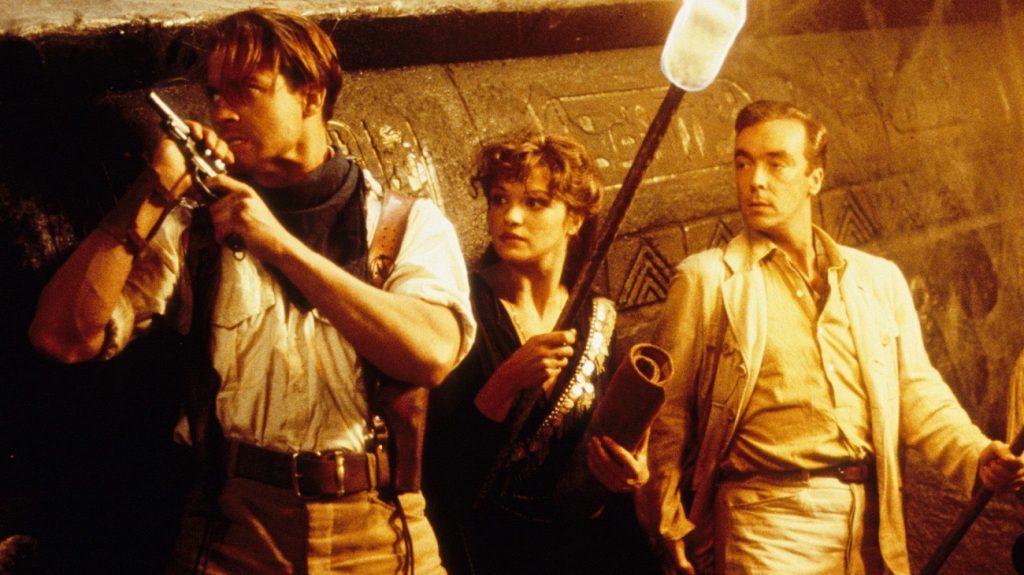
Thanks to all new shots of the OG stars filming the latest instalment, The Mummy is having something of a moment again.
Not that it ever really went away. The 1999 film has spent more than two decades occupying that very particular corner of millennial culture reserved for films we will happily rewatch whenever they appear on television. Brendan Fraser has a shotgun. Rachel Weisz has a library. There are ancient curses. What more could we possibly need?
But with The Mummy back in the conversation, there is one question that feels particularly worth revisiting.
Just how historically accurate is it?
Because beneath the flesh-eating scarabs, resurrected priests and enormous sand faces, The Mummy uses a surprising amount of genuine Egyptian history.
Unfortunately, it then rearranges approximately 1,500 years of that history to suit itself.
So, let us return to Hamunaptra and see what The Mummy actually gets right.
First Problem: That Isn’t Thebes
We encounter our first historical problem approximately thirty seconds into the film.
That is impressive, even by Hollywood standards.
The opening takes us back to ancient Egypt in 1290 BC and introduces us to Thebes, the city ruled by Pharaoh Seti I.
Except the landscape we’re looking at includes the Great Pyramids and the Sphinx.
Those are at Giza.
Ancient Thebes was much further south, around modern Luxor. The film has essentially picked up some of Egypt’s most recognisable monuments and moved them several hundred kilometres because they make the establishing shot look suitably Egyptian.
There is another problem.
By 1290 BC, those pyramids weren’t exactly new.
The Great Pyramid had already been standing for well over a thousand years. Yet the film appears to show work still taking place around the Sphinx.
We have barely begun and ancient Egyptian chronology is already begging for mercy.
Seti I Was Real
The film does at least begin with a genuine pharaoh.
Seti I ruled during Egypt’s Nineteenth Dynasty in the thirteenth century BC. The film’s date of around 1290 BC therefore puts us in approximately the right period for his reign.
He was also a significant pharaoh. Seti campaigned militarily, commissioned major building projects and was the father of one of the most famous Egyptian pharaohs of all: Ramesses II.
So far, so good.
Unfortunately, the moment Imhotep walks into the room, everything falls apart.
Imhotep Was Real Too. Just Not ThisImhotep.
Perhaps the most interesting thing about The Mummy is that Imhotep isn’t an invented name.
There really was an Imhotep.
And he was extremely important.
The historical Imhotep lived during Egypt’s Third Dynasty and served Pharaoh Djoser, more than a thousand years before Seti I. He held numerous important positions and is famously associated with the Step Pyramid of Djoser at Saqqara, one of the earliest monumental stone structures in Egypt.
His reputation continued long after his death. Imhotep eventually became revered and then deified, becoming particularly associated with wisdom and healing.
What he wasn’t doing was having a secret affair with Seti I’s mistress.
The difference between the historical Imhotep and Seti I is somewhere in the region of 1,300 years.
To put that into perspective, this is roughly the historical equivalent of writing a story in which Charlemagne becomes embroiled in a scandal at Buckingham Palace.
They’re both historical.
They’re just not remotely contemporary.
And Then There Is Anck-su-namun
The film does something similar with Anck-su-namun.
The character appears to have been inspired by Ankhesenamun, another real woman from ancient Egyptian history.
And if that name sounds familiar, there is a reason.
Ankhesenamun was the wife of Tutankhamun.
She lived during the Eighteenth Dynasty, decades before Seti I came to the throne, and centuries upon centuries after the historical Imhotep.
So the film has essentially collected recognisable names from different parts of Egyptian history and placed them together.
Imhotep? Real.
Ankhesenamun? Real.
Seti I? Real.
Their murderous supernatural love triangle?
Less so.
Hamunaptra, City of the Dead
Sadly, anyone hoping to book an archaeological holiday to Hamunaptra is going to be disappointed.
It doesn’t exist.
There is no known ancient Egyptian city matching the film’s mysterious lost “City of the Dead”, and Hamunaptra itself is fictional.
However, the idea behind it isn’t entirely ridiculous.
Ancient Egypt had enormous necropolises containing tombs, temples and other funerary structures. The Theban necropolis, including the Valley of the Kings, is an obvious real-world comparison for the kind of vast landscape of death and burial imagined by the film.
The Egyptians also strongly associated the west with death and the afterlife, partly because this was where the sun disappeared each evening before its symbolic rebirth.
So no, Rick O’Connell couldn’t really have ridden across the desert and discovered Hamunaptra.
But vast Egyptian landscapes dedicated to the dead?
Those were very real indeed.
The Medjai Were Actually Real
This is one of my favourite pieces of accidental education hidden inside The Mummy.
The Medjai — more commonly written by historians as Medjay — were real.
Their historical identity changed considerably over time. The term was originally associated with people from Nubia, but by the New Kingdom it had become associated with security and policing.
Medjay could guard important sites, including royal tombs.
Which means the film’s idea of the Medjai as highly trained guardians isn’t completely invented.
What is invented is the idea that they became a secret society spending thousands of years preventing archaeologists from accidentally resurrecting Imhotep.
That part would admittedly have made Egyptology considerably more exciting.
Mummification: Surprisingly Not Terrible
This is where The Mummy starts doing something rather interesting.
Because for a film in which a man is mummified alive with flesh-eating beetles, some of its depiction of Egyptian funerary practices is surprisingly well informed.
During the punishment of Imhotep and his priests, we see elements recognisable from genuine mummification practices, including wrapping and what appears to be the removal of the brain through the nose.
Even the jackal-headed figures performing funerary rituals aren’t complete Hollywood invention. Jackal imagery was, of course, associated with Anubis, the god closely connected with embalming and the dead, and there is evidence for masks being used during Egyptian funerary rituals.
There was genuine Egyptological consultation behind the film, including work by Egyptologist Dr Stuart Tyson Smith.
And you can tell.
The broad story is complete fantasy, but there are tiny details scattered throughout it that somebody clearly cared about getting right.
The Canopic Jars: So Close
Then somebody apparently stopped listening to the Egyptologist.
When Anck-su-namun is prepared for resurrection, the film shows her organs preserved in canopic jars.
Excellent.
Canopic jars were genuinely used during Egyptian mummification to preserve internal organs.
There were four of them.
The film gives us five.
Traditionally, the Four Sons of Horus were associated with protecting the liver, lungs, stomach and intestines.
The heart was generally left inside the body because it had enormous religious importance. Egyptians regarded it as central to a person’s identity and consciousness, and it would eventually be judged in the afterlife.
In the famous Weighing of the Heart ceremony, the heart was weighed against the feather of Ma’at, representing truth and order.
If you failed that particular examination, your prospects for eternity were not especially promising.
So the film understands the concept of canopic jars remarkably well.
It just apparently decided four wasn’t dramatic enough.
What About the Book of the Dead?
This is another wonderful mixture of fact and fantasy.
The Egyptian Book of the Dead absolutely existed.
However, it wasn’t one definitive book sitting somewhere waiting for an enthusiastic librarian to read it aloud.
What we now call the Book of the Dead was a collection of funerary spells and religious texts designed to assist a deceased person on their journey through the afterlife.
Different copies could contain different selections of spells. They might be written on papyrus and placed within a burial.
In fact, “Book of the Dead” isn’t even what the ancient Egyptians called it. The modern name was coined by nineteenth-century Egyptologist Karl Richard Lepsius. The Egyptian title is usually translated along the lines of Book of Coming Forth by Day.
And the actual material is arguably more interesting than the film’s version.
These spells could help the deceased overcome dangers, transform themselves, retain control of their body and identity, interact with gods and successfully navigate judgement.
So the underlying idea that ancient Egyptians believed written words possessed power capable of helping someone overcome death?
Very Egyptian.
The idea that Evelyn can accidentally read a passage aloud and resurrect a murderous priest who has been dead for three thousand years?
Slight exaggeration.
The Book of Amun-Ra Is Another Matter
The film also gives us its golden Book of Amun-Ra, sometimes called the Book of the Living.
This one belongs firmly on the fiction pile.
There is no known ancient Egyptian equivalent of the magical golden book depicted in the film.
Which is probably for the best.
Egyptologists have enough paperwork without discovering the instruction manual for reversing death.
And No, Scarabs Will Not Eat You
Scarabs are everywhere in The Mummy, and there is a very good historical reason for using them.
The scarab beetle was enormously important in ancient Egyptian religion and symbolism. It became associated with regeneration, transformation and rebirth, particularly through the god Khepri and the movement of the sun.
Scarab amulets were incredibly popular.
Ancient Egyptians absolutely would recognise the scarab as a powerful religious symbol.
They would probably be somewhat confused by Hollywood’s decision to turn them into ravenous carnivorous beetles capable of tunnelling through human flesh.
Scarabs are mostly dung beetles.
Admittedly, “Imhotep is sentenced to spend eternity with some beetles rolling balls of dung around his coffin” doesn’t carry quite the same horror.
The Hom-Dai
Which brings us to Imhotep’s spectacularly horrible punishment.
After attempting to resurrect Anck-su-namun, Imhotep is subjected to the Hom-Dai: his tongue is cut out, he is wrapped like a mummy, placed alive inside a sarcophagus and covered with flesh-eating scarabs.
He is then cursed for all eternity.
It is horrifying.
It is memorable.
It is also fictional.
There is no known ancient Egyptian punishment called the Hom-Dai.
More importantly, mummification was a sacred funerary process intended to preserve the body of the deceased. Turning it into an elaborate method of execution rather misses the point.
But The Mummy needs a mummy.
And “Imhotep died peacefully at eighty-seven after a distinguished career in royal administration” would have made Brendan Fraser’s job considerably easier.
The Ancient Egyptian Language Is One of the Film’s Best Details
One of the more impressive aspects of the production is something many viewers probably never think about.
The filmmakers actually consulted Egyptologist Stuart Tyson Smith on the Egyptian dialogue and hieroglyphic elements used in the film.
Obviously, nobody has an audio recording of someone chatting away in ancient Egyptian in 1290 BC. Reconstructing pronunciation involves scholarly interpretation.
But the production didn’t simply have Arnold Vosloo make vaguely ancient-sounding noises.
There was genuine Egyptological thought behind it.
The same applies to some of the hieroglyphs appearing throughout the film.
It creates a strange situation in which The Mummy can be astonishingly careless about 1,300 years of chronology while simultaneously caring about whether a background inscription looks convincing.
And I rather love it for that.
What About the 1920s Setting?
This might actually be one of the smartest decisions the film makes.
Most of The Mummy takes place in 1926.
And if you’re going to tell a story about Western archaeologists, Egyptian tombs, fabulous treasures and supposedly deadly curses, the 1920s are pretty much perfect.
Howard Carter discovered the tomb of Tutankhamun in 1922.
The discovery became an international sensation. Tutankhamun and ancient Egypt exploded into popular culture, while newspapers enthusiastically helped spread stories about a supposed “curse of the pharaohs” following the death of Lord Carnarvon in 1923.
By the time The Mummy is set, the Western world really was experiencing an enormous fascination with ancient Egypt.
Archaeology itself was also very different from the profession we know today. European and American expeditions had spent decades excavating Egyptian sites, while enormous quantities of Egyptian material had entered foreign museum collections.
So Evelyn working among Egyptian antiquities, wealthy foreigners financing expeditions and adventurers descending on archaeological sites all fit remarkably comfortably into the period.
The supernatural mummy does not.
The cultural obsession with finding him absolutely does.
So, How Historically Accurate Is The Mummy?
Not very.
But that answer also feels slightly unfair.
If we judge The Mummy purely by chronology, it is an absolute disaster. Imhotep is more than a millennium out of place. Ankhesenamun has been pulled from another dynasty. The film relocates the pyramids to Thebes, invents Hamunaptra, invents the Hom-Dai, adds an extra canopic jar and turns harmless scarab beetles into tiny flesh-eating monsters.
And yet there is a surprising amount of genuine history underneath it all.
The Medjay existed.
Imhotep existed.
Seti I existed.
Ankhesenamun existed.
The Book of the Dead existed.
Canopic jars, excerebration, funerary spells, scarab symbolism and the religious importance of preserving the body all have genuine foundations in ancient Egyptian culture.
Even the film’s 1920s obsession with Egypt fits perfectly into the world created by the discovery of Tutankhamun’s tomb.
That is perhaps why The Mummy works so well.
It doesn’t really recreate ancient Egyptian history.
It raids it.
It takes genuine people, beliefs, rituals, objects and ideas from across thousands of years of Egyptian civilisation, throws them into one enormous supernatural adventure and trusts Brendan Fraser and Rachel Weisz to make us stop asking questions.
And, frankly, it works.
Historically accurate?
Absolutely not.
Historically inspired?
Much more than it first appears.