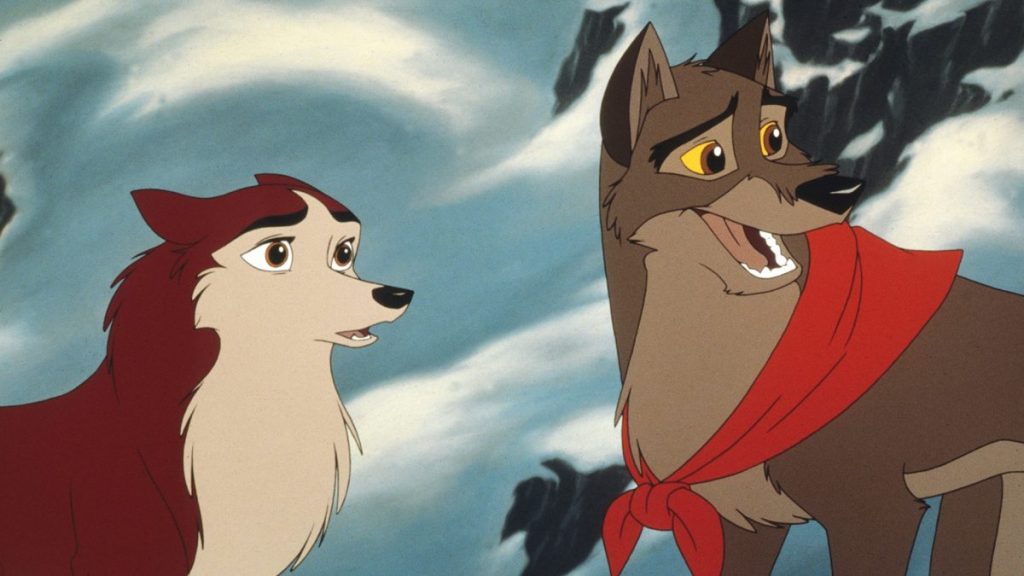
Before Balto became one of those well-worn VHS treasures of the nineties, it was actually a bit of a box office underdog. Released in December 1995, just weeks after Toy Story, it quietly padded into cinemas and earned around $11 million in the U.S.—a modest return that couldn’t compete with Pixar’s shiny new frontier.
Yet somehow, Balto survived. It became one of those films every millennial child seemed to discover on video years later, clutching our hearts with its snowy heroics, the wolfdog who saved a town, and that soaring James Horner score that made us feel something even when we didn’t know why.
Produced by Steven Spielberg’s London studio, Amblimation, and directed by Simon Wells, Balto marked the end of an era. It was the studio’s final animated feature before many of its artists moved on to help form DreamWorks Animation. So in a way, Balto walked—or rather, ran—so the DreamWorks dragons and princes could fly.
The Real History
The film takes its inspiration from the true story of the 1925 serum run to Nome, Alaska, when an outbreak of diphtheria threatened the town’s children. With no planes or modern transport available and temperatures plummeting below −50°C, a relay of dog sled teams carried antitoxin over six hundred miles of frozen wilderness. The event became a sensation in newspapers around the world and turned the lead dog of the final leg, Balto, into an instant celebrity. He even toured the United States, starred in newsreels, and was immortalised in bronze in New York’s Central Park. His statue still stands there today, the inscription praising the courage of all the sled dogs that saved the stricken town.
But, as history buffs often find, the story is more complex than the myth. Balto was indeed a real dog—half wolf only in the film’s imagination—but he didn’t run the longest or most treacherous part of the journey. That honour belongs to another husky, Togo, and his musher Leonhard Seppala, who covered nearly two-thirds of the route through the worst of the storm. Balto’s musher, Gunnar Kaasen, led the final dash into Nome, which made his team the ones reporters saw crossing the finish line. The cameras rolled, the name stuck, and the legend was born.
The Hollywood Way
In Balto, the real expedition becomes a kind of snow-dusted fairytale about belonging and bravery. The film turns Balto into an outcast half-wolf living on the edge of society, mocked by the purebred sled dogs and ostracised by humans. None of that happened, of course, but it makes for a strong narrative hook—a literal underdog fighting for his place in the pack. The story condenses the entire relay into a single heroic sprint, simplifies the cast of mushers into archetypes, and replaces grim human peril with a friendlier ensemble of comic-relief sidekicks: a Russian goose, a pair of polar bear brothers voiced by Phil Collins, and an overly dramatic villain dog named Steele.
It’s pure Hollywood frost, but it works. The film may stretch the facts, but it keeps the spirit of the 1925 event alive—the courage, the isolation, and the sheer willpower that kept the serum moving when all else failed. It’s also worth noting that the real Balto wasn’t an outcast at all; he was one of Seppala’s dogs, steady and reliable, if not the star athlete. The movie simply gave him the kind of cinematic makeover that turns steady and reliable into misunderstood and extraordinary.
The Legacy
While Balto didn’t win over box offices, it found its audience in the years that followed. For a generation of children, it became our introduction to the idea that history could be both inspiring and messy—that heroes aren’t always who we expect them to be. It’s also a fascinating footnote in animation history: Amblimation’s farewell before DreamWorks rose from its snowy ashes. And even though Balto went on to spawn two direct-to-video sequels without Spielberg or the original crew, the 1995 film remains the one we remember—the one that made us believe a half-wolf could save the world with nothing but courage, loyalty, and a really good soundtrack.
So yes, the movie bends the truth like a snowdrift in the wind. But beneath the fiction lies a real story of human determination and canine endurance. The serum run to Nome was a relay of heroes, both two- and four-legged, and Balto—real or reimagined—remains their most enduring symbol.
“Dedicated to the indomitable spirit of the sled dogs that relayed antitoxin six hundred miles over rough ice, across treacherous waters, through Arctic blizzards from Nenana to the relief of stricken Nome.”
— Inscription on the Balto statue, Central Park, New York.
Bonus Balto FAQ!
Balto was released on 22 December 1995 in the United States and early 1996 internationally. It was one of the last major traditionally animated adventure films of the 1990s before CGI took over the industry.
The film was produced by Amblimation, Steven Spielberg’s London-based animation studio, and distributed by Universal Pictures. It was directed by Simon Wells, who later went on to work with DreamWorks on The Prince of Egypt and The Time Machine.
Balto is voiced by Kevin Bacon, with Bob Hoskins as Boris the goose, Bridget Fonda as Jenna, Phil Collins as the polar bears Muk and Luk, and the fantastic Jim Cummings in various additional roles. The cast gave the film a surprising amount of Hollywood talent for its time.
Yes. Universal produced two direct-to-video sequels: Balto II: Wolf Quest (2002) and Balto III: Wings of Change (2004). These were not made by the original Amblimation team and have a noticeably different animation style and tone.
No, Balto is not a Disney film. It’s a Universal Pictures release made by Amblimation, which was Steven Spielberg’s animation studio before he co-founded DreamWorks Animation.
No. Although Balto has a similar look and tone to Don Bluth’s work, he wasn’t involved in it. Bluth had already left Amblin to form his own studio years earlier, making films like The Land Before Time and An American Tail separately from Balto’s team.
The soundtrack was composed by James Horner, the legend known for Titanic, The Land Before Time, and Braveheart. His sweeping orchestral score gives Balto its emotional heart and is often praised as one of the film’s strongest elements.
Not initially. Balto earned around $11 million at the U.S. box office—modest compared to other animated releases of the time—but became a beloved VHS classic and built a strong cult following over the years.
Yes, but loosely. The real Balto was a Siberian Husky who led the final leg of the 1925 serum run to Nome, Alaska. However, the movie simplifies the event and turns Balto into a half-wolf outcast hero, while the true journey involved many mushers and dogs, with another sled dog, Togo, covering most of the distance.