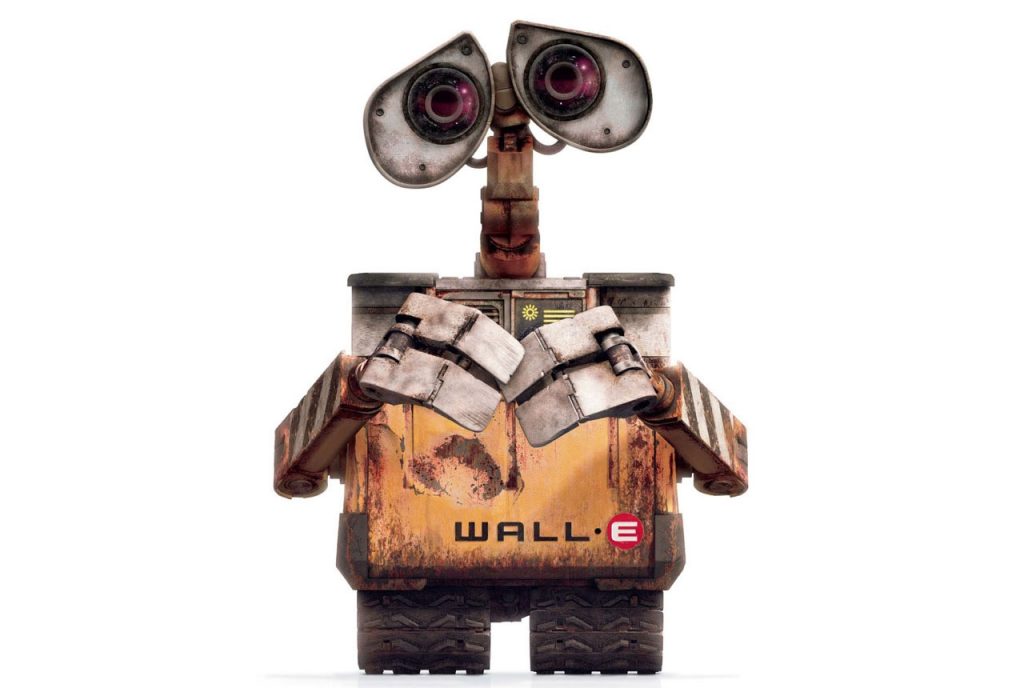
He’s the lovable little robot with the name everyone loves to imitate. Waaaall-E! A clunky machine who rolls through mountains of trash with a cockroach sidekick, teaching kids about the dangers of overconsumption while secretly making us all want to hug our recycling bins. On the surface, it’s a heart-warming love story wrapped in an eco-friendly message.
BUT—
Beneath the charm lies a different story—one where our adorable trash-compacting hero displays some deeply unhealthy behaviours. It’s time for me to ruin yet another one of your childhood favourites, as we deep dive into the mental health issues of everyone’s favourite trash compactor on wheels.
Obsession and Attachment Issues
The Hello Dolly! Obsession
WALL·E doesn’t just enjoy Hello, Dolly! —he replays the same few seconds endlessly, mimicking them with robotic precision. This isn’t casual viewing. It’s compulsion, a ritualised rehearsal for a romance he’s never experienced.
Hoarding His Loneliness
From Rubik’s cubes to sporks, WALL·E collects human relics and arranges them like a museum of lost intimacy. While it’s played as cute, it’s a clear case of emotional hoarding—filling a void with objects instead of the real relationships he craves.
(Unhealthy) Attachment at First Sight
Enter EVE. WALL·E meets her and immediately becomes dependent. He abandons his own directive—literally his reason for existing—just to follow her around. The co-dependency is loud!!
When she powers down, he looks after her, ensuring her every need is met. Even putting himself in dangers multiple times to do so, we literally see him being electrocuted when Eve watches her own security footage back. Sweet? Maybe. Healthy? Not really.
Crossing Boundaries
WALL·E never gives EVE space. He follows her constantly, intrudes on her missions, and reshapes his entire identity around her presence. In human terms, this isn’t “romantic devotion”—it’s the classic hallmarks of anxious, boundary-blind attachment.
Pixar’s Framing Device
To be fair, Pixar doesn’t present WALL·E as threatening. Instead, the narrative softens everything through empathy: he’s the last active bot on Earth, starved of company, clinging to scraps of culture for comfort. His behaviour is framed as innocent curiosity, not dangerous obsession. He follows Eve around the city because he wants to find out what she is doing here. Not because he just wants to leave creepy art he made of her while she was sleeping…
And the Pixar angle works—audiences adore him. We want to feel sorry for him, to root for him to win. But outside of the Pixar world, his behaviours would keep a therapist busy for hours. And it raises the question…
What Are We Really Teaching Kids?
Still, it raises a bigger question. WALL·E and Eve’s story is often sold as a cute love story. But do we really want to teach children that love means ignoring boundaries, abandoning your own purpose, and never taking “no” for an answer? Cute in animation—unhealthy in real life.
The Final Verdict
Did WALL·E save the world? Sure.
Did he win EVE’s heart? Apparently.
But was it healthy? Nah, babes.
Pixar gave us an eco-parable with a mechanical knight in rusty armour, but also a cautionary tale about attachment gone awry. Next time you watch WALL·E, ask yourself: is this really a cute robot love story, or is it the galaxy’s cutest stalker fantasy wrapped up in fire extinguisher foam and hand-holding?