
Every generation has its urban legends — whispered stories that linger at the edges of belief. For some, it was vanishing hitchhikers. For others, UFO sightings. For the early internet age, it was a man who claimed to be a time traveller: John Titor.
Who Was John Titor?
In late 2000, an anonymous poster appeared on internet forums under the handle TimeTravel_0. He soon began signing his messages with the name John Titor.
Titor claimed to be a soldier from the year 2036, sent back in time on a military mission. His objective wasn’t to stop an apocalypse or assassinate a leader — it was to retrieve a 1975 IBM 5100 computer. In his timeline, this obscure machine was essential for debugging legacy code during a worldwide computer crisis. The catch? The IBM 5100 really did have hidden capabilities that weren’t widely known outside IBM engineers at the time. That detail gave Titor instant credibility.
Titor described his world with unsettling clarity. After a period of civil unrest beginning in 2005, America, he said, would split into factions. The country would later endure a short but devastating nuclear war in 2015, killing billions and leaving the survivors in decentralised, agrarian communities. By 2036, he lived in a smaller, humbler America where families farmed, communities valued self-reliance, and trust in centralised governments had collapsed.
Titor’s Warnings
Titor didn’t post like a prophet or preacher. His warnings came through calmly, almost casually:
- Civil War in America (2005–2015): He predicted conflict between rural and urban populations, escalating into open warfare.
- World War III (2015): A nuclear exchange between Russia, China, and the West, wiping out nearly half the global population.
- A Changed World: Survivors would return to localised farming and barter systems. Technology would exist, but it was mistrusted.
- Disease and Food Safety: He warned of risks like Creutzfeldt-Jakob Disease (mad cow disease) through beef, reflecting food anxieties of the era.
- Technology’s Fragility: He frequently stressed how fragile modern systems were, warning of computer flaws like the “2038 problem,” a real technical issue looming in our future.
Not all of these were unique predictions — they echoed common anxieties of the time. But the way he folded them into his first-person narrative gave them unusual weight.
Science Meets Storytelling
Titor didn’t just spin a yarn — he gave it teeth. His posts were full of references to relativity, worldline divergence, and Kerr black holes. Nerds and skeptics could argue endlessly, while casual readers were drawn in by his matter-of-fact tone. Most importantly, he balanced the fantastical with the ordinary. His time machine might bend space-time, but it was mounted into a Chevy Corvette. Titor provided multiple photos of the Time Machine inside his car, as well as the registration details for the vehicle. Some claimed these images proved nothing. ?But, for many, that blend of fact and fiction made it all the more believable.
The smoking gun of the myth was the IBM details. Titor insisted the 1975 IBM 5100 was vital to his mission because of hidden emulation capabilities. At the time, this wasn’t widely known outside IBM engineers — but he was right. That one fact blurred the line between hoax and possibility. Could he have simply been someone on the inside, or known someone who worked there? Maybe. But we will never know for sure.
The Perfect Timing
The world had just survived Y2K. Technology felt fragile, the future uncertain.
The early internet was a wild frontier where anonymity gave ordinary people extraordinary voices. In that climate, a calm, articulate “time traveller” felt strangely plausible.
Like all good legends, Titor knew when to leave. He stopped posting abruptly, with no farewell. The silence allowed speculation to snowball, creating space for believers, hoax-hunters, and late-night radio theorists to keep the mystery alive.
The Unsolved Tangents
The John Titor story didn’t end when he stopped posting. In fact, some of the strangest details came later.
- Pamela Moore: A Florida woman who claimed private contact with Titor. She said he phoned her, emailed her, and that she even received letters from his mother, “Kim.” She went on to say that she had spoken with multiple Titor’s from many timelines and had even received communications from the “original Titor”, after he had returned to 2036 explaining this. Her testimony added a deeply personal, almost mystical layer to the legend. Some forum users claimed that Pamela was simply another Titor sock account.
- The Trott Family: A real Florida family connected to lawyer Larry Haber. While one forum user named “Trott” appeared in the original threads (right after another skeptic mocked “John Titor” as an anagram for “I John Trot”), the Trott family’s names later surfaced in corporate filings linked to the John Titor Foundation, Inc. The overlap, and indeed their connection to Titor, has never been explained.
- Larry Haber: An Orlando entertainment lawyer who became the “spokesperson” for the Titor family in 2003. He legally incorporated the Foundation and published a book of Titor’s posts, ensuring that the legend was copyrighted and controlled. Haber is the main culprit for the cynical online detectives, who claim he would have the most to gain financially from the alleged hoax.
Whether these threads represent real people keeping a myth alive, or just the natural evolution of an internet story into urban legend, is still debated. What’s certain is that these names turned John Titor from a forum curiosity into a cultural web that still sparks fascination decades later. Also, no known connections were found to link the above people to IBM for that insider knowledge.
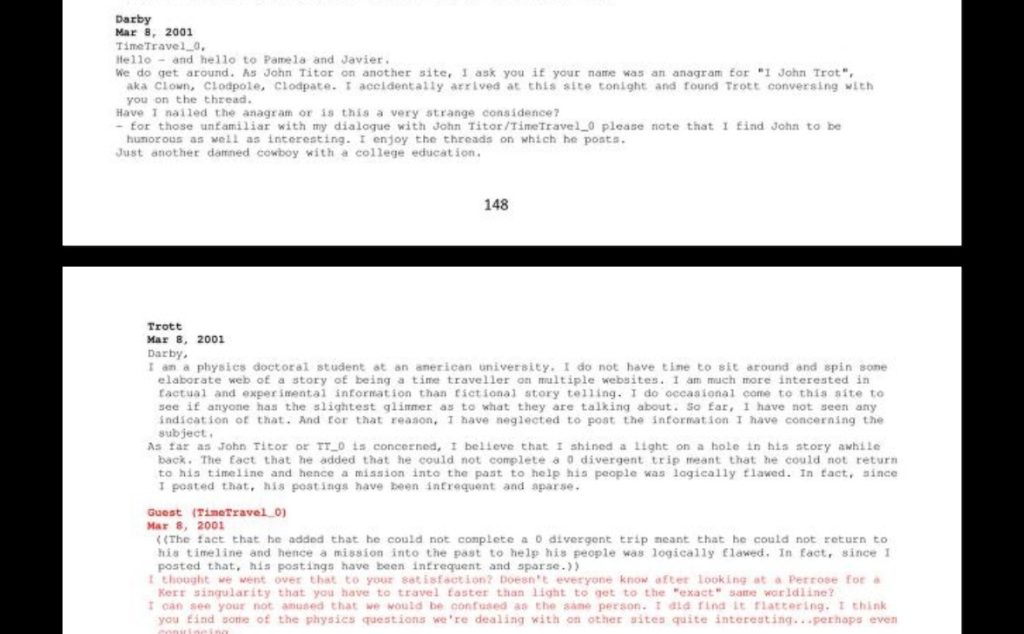
FYI: Trott is not that common a surname—around 5,000 Americans had it in 2010 (about 2 per 100,000) . But on March 8, 2001, a user named Trott appeared in the John Titor forums just after Darby joked about the anagram ‘I John Trot.’ Later, years after the forum died, a real Trott family pops up filing official documents around the John Titor Foundation. Still not widely discussed on the forums, but the odds are low enough to make you suspicious.
Why He Endures
So why did a random stranger on the early internet become such an enduring legend?
Twenty years later, Titor’s predictions never came true on our timeline. No civil war, no World War III, no fractured America. And yet he endures — not because we all believe but because maybe it could be true. It’s fun, in a world obsessed with true crime documentaries, to come together to discuss and debate something from history that is a little bit calmer. It scratches that keyboard detective itch a lot of us have. The need to research, to dig and to find the answers.
But also, John Titor was never just a man on a forum. He was a mirror. His story reflected our anxieties, our imagination, and our fascination with the unknown. And like all the best urban legends, he left behind just enough unanswered questions to keep us looking over our shoulders, wondering… what if?
Sources & Further Reading